
Table of Contents
- How Many Types of Nebulae Are There?
- Emission Nebulae
- Reflection Nebulae
- Dark Nebulae
- Planetary Nebulae
- Supernova Remnants
- Composite Nebulae: When One Cloud Does All Three
- Nebula Types at a Glance
- Birth Clouds vs. Death Clouds
How Many Types of Nebulae Are There?
Five, if you’re being precise about it: emission, reflection, dark, planetary, and supernova remnant. Everything else you’ll see online — “diffuse nebula,” “H II region,” “protoplanetary nebula” — is either a subcategory of one of these five or a different name for the same thing.
The word “nebula” just means cloud in Latin, and astronomers used to slap it on anything fuzzy they couldn’t resolve into stars, including actual galaxies. Once telescopes got good enough to tell the difference, the label narrowed to what it means today: a cloud of gas and dust inside our own galaxy (or another one), sitting somewhere in the process of either building a star or cleaning up after one died.
That last part is the thing most listicles skip. Nebulae aren’t just pretty — they’re timestamps. Some mark a birth in progress. Others mark a death that happened thousands of years ago and is still expanding outward. Knowing which is which changes how you look at every photo of one.
Emission Nebulae
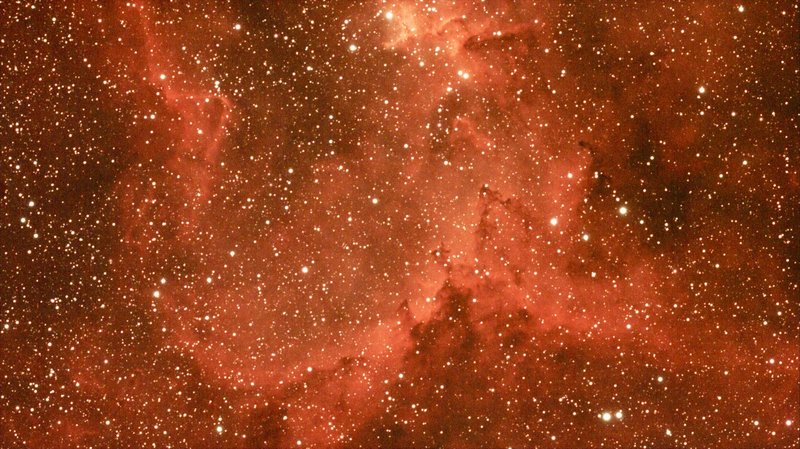
An emission nebula glows on its own. Inside it, young, massive, blisteringly hot stars pump out enough ultraviolet radiation to strip electrons off the surrounding hydrogen gas — a process called ionization. When those electrons recombine with their atoms, they release light at a very specific wavelength, 656 nanometers, which lands squarely in the red part of the spectrum. That’s why almost every emission nebula photo you’ve seen is some shade of red or pink.
The Orion Nebula (M42) is the textbook example, visible to the naked eye as the fuzzy “star” in Orion’s sword and sitting about 1,344 light-years away. The Eagle Nebula’s Pillars of Creation and the Lagoon Nebula work the same way: hot young stars lighting up the nursery they were just born in.
Emission nebulae are almost always stellar nurseries. The same gas that’s glowing is also the raw material collapsing into the next generation of stars.
Reflection Nebulae
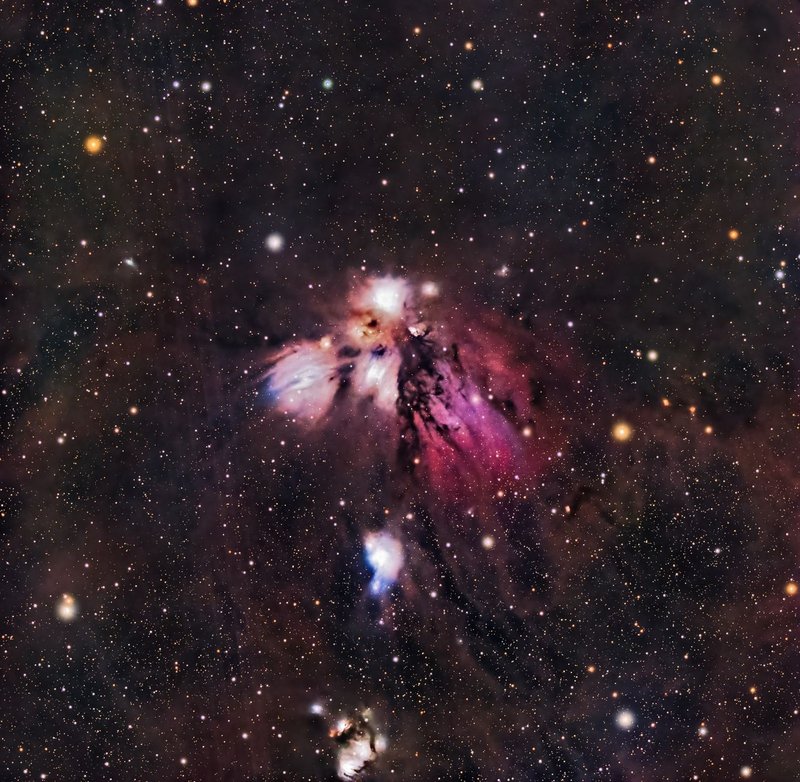
Reflection nebulae don’t produce their own light — they bounce it. A nearby star illuminates a cloud of dust that isn’t hot enough to ionize, and the dust grains scatter that starlight back toward us, the same way water droplets in the atmosphere scatter sunlight into a blue sky. Shorter blue wavelengths scatter more efficiently than red ones, which is why reflection nebulae read as cool blue rather than fiery red.
The nebulosity wrapped around the Pleiades star cluster is the most photographed reflection nebula in the sky — dust the cluster happens to be passing through right now, unrelated to the stars’ formation. The Witch Head Nebula gets its eerie blue glow the same way, reflecting light from the nearby supergiant Rigel.
Reflection and emission nebulae often sit side by side in the same star-forming region, which is exactly why the difference matters: same neighborhood, different physics, different color.
Dark Nebulae
Dark nebulae are the opposite problem — clouds so dense with dust and molecular gas that they block light instead of producing or reflecting it. You don’t see a dark nebula directly; you see its silhouette against something bright behind it, whether that’s a star field or a glowing emission nebula.
The Horsehead Nebula is the famous case: a dense pillar of dust shaped like a knight’s chess piece, visible only because it’s backlit by the emission nebula IC 434. The Coalsack, a dark patch near the Southern Cross visible to the naked eye from the Southern Hemisphere, is dark enough that early sailors described it as a hole in the Milky Way.
Dark nebulae aren’t dead space. They’re often the densest, coldest parts of a molecular cloud — exactly the conditions gravity needs to start collapsing gas into a protostar. A dark nebula today can be an emission nebula in a few hundred thousand years.
Planetary Nebulae
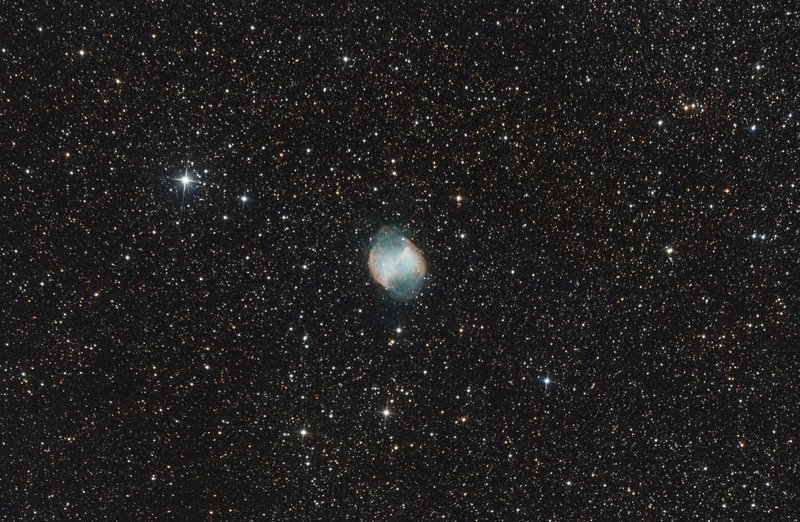
Despite the name, planetary nebulae have nothing to do with planets. William Herschel coined the term in the 1780s because, through his telescope, their small round shape looked like the disk of a planet such as Uranus. The name stuck even after astronomers figured out what they actually are: the discarded outer layers of a low- or medium-mass star — the same fate awaiting our own Sun in roughly five billion years.
As a star like this runs out of fuel, it sheds its outer atmosphere into space while its exposed core collapses into a white dwarf. That white dwarf is hot enough to ionize the expelled gas, and the result is a glowing shell — often a ring, sometimes a more complex hourglass or butterfly shape, depending on how the gas was ejected. The Ring Nebula (M57) and the Helix Nebula, nicknamed the “Eye of God” for its uncanny resemblance to one, are the two most photographed examples.
Planetary nebulae are short-lived on cosmic timescales, lasting maybe 10,000 to 50,000 years before the gas disperses into the interstellar medium for good. If you’re looking at one, you’re catching a very specific, very brief phase of stellar death.
Supernova Remnants
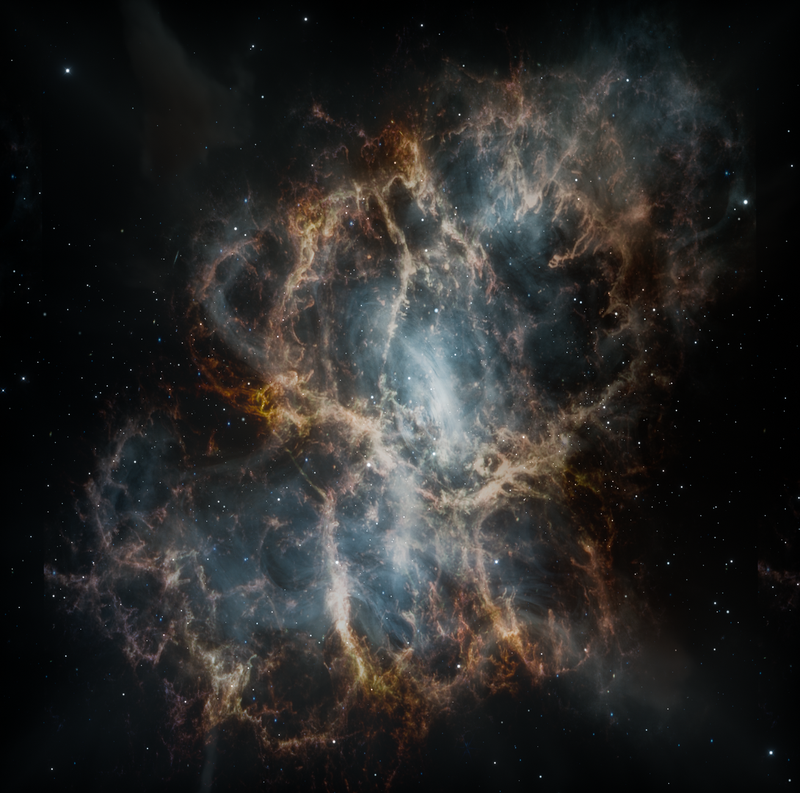
A supernova remnant is what’s left after a massive star detonates, or after a white dwarf in a binary system pulls in enough matter to trigger a runaway thermonuclear explosion. Either way, the result is a shockwave of debris blasting outward at thousands of kilometers per second, sweeping up and heating the surrounding interstellar gas as it goes.
The Crab Nebula (M1) is the clearest case study, because we know almost exactly when it formed: Chinese and Arab astronomers recorded the supernova that created it in the year 1054, bright enough to see in daylight for weeks. The Veil Nebula, a sprawling network of filaments in Cygnus, is the remnant of a similar explosion, just older and more spread out. Supernova remnants also show up strongly in X-ray observations, since the shocked gas reaches millions of degrees — hot enough to glow in a part of the spectrum no visible-light telescope can catch.
This is also where most of the universe’s heavy elements come from. The calcium in your bones and the iron in your blood were forged inside a star and scattered by an explosion just like this one.
Composite Nebulae: When One Cloud Does All Three
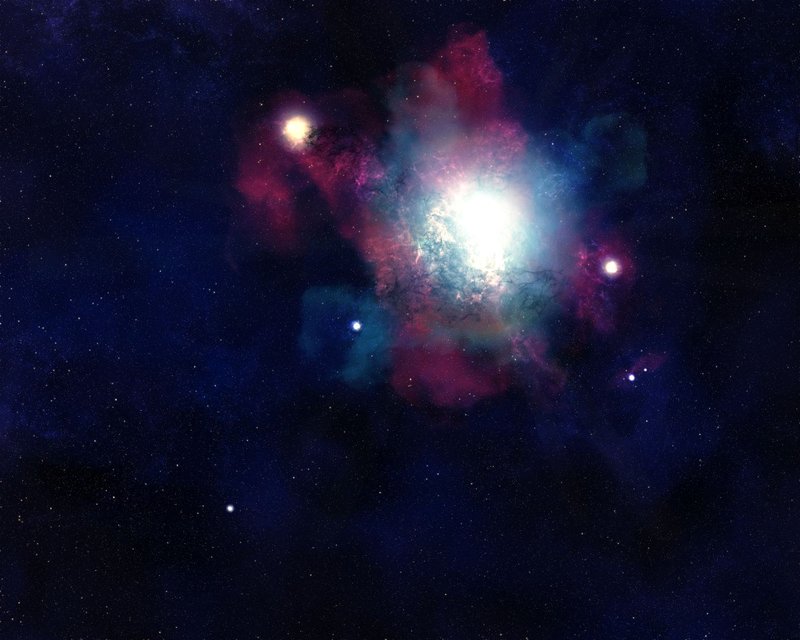
Real nebulae rarely respect the categories cleanly, and this is the part most classification articles leave out entirely. The Trifid Nebula (M20) in Sagittarius is the sharpest example: it’s simultaneously an emission nebula (the pink-red glow from ionized hydrogen), a reflection nebula (a distinct blue patch on its northern edge), and a dark nebula (the dust lanes that carve it into three lobes, which is where the name “trifid” — meaning split into three — comes from).
The Rosette Nebula pairs a wide ring of emission-nebula glow with dense dark globules sitting inside it, knots of gas dense enough to be forming stars of their own. The Carina Nebula complex is bigger still, mixing emission regions, embedded dark clouds like the aptly named Keyhole Nebula, and reflection components across a single star-forming region.
If you’re trying to identify a nebula in your own astrophotography and the colors don’t match a textbook definition, that’s usually not a mistake — it’s a composite. Most large star-forming regions are.
Nebula Types at a Glance
| Type | What Causes It | Typical Color | Famous Example | Birth or Death? |
|---|---|---|---|---|
| Emission | Gas ionized by nearby hot stars | Red / pink | Orion Nebula | Birth |
| Reflection | Starlight scattered by dust | Blue | Witch Head Nebula | Birth |
| Dark | Dense dust blocking light behind it | Black / silhouette | Horsehead Nebula | Birth (usually) |
| Planetary | Gas shed by a dying Sun-like star | Green / blue / red rings | Ring Nebula | Death |
| Supernova remnant | Debris from a massive star’s explosion | Red / filamentary | Crab Nebula | Death |
Birth Clouds vs. Death Clouds
Line the five types up against the stellar life cycle and a pattern falls out that most articles never mention. Emission, reflection, and dark nebulae are almost always birth clouds — raw material either actively forming stars or dense enough that it eventually will. Planetary nebulae and supernova remnants are death clouds, the two different endings available to a star depending on its mass: a quiet shedding of layers for something Sun-sized, a violent explosion for anything roughly eight times heavier or more.
The tidy part is that the material doesn’t just disappear after a star dies. A supernova remnant’s debris eventually mixes back into the interstellar medium, enriches it with heavier elements, and becomes part of the next dark nebula that collapses into the next generation of stars. Every emission nebula lighting up tonight is partly made of the wreckage of stars that died before the Sun existed. The cycle is the whole point — nebulae aren’t a fixed set of objects so much as one process caught at five different moments.
Enjoyed this article?
Get daily 10-minute PDFs about astronomy to read before bed!
Sign up for our upcoming micro-learning service where you will learn something new about space and beyond every day while winding down.