TLDR
Six missions have gotten close to Ganymede, and one is on its way to actually orbit it:
- Pioneer 10 & 11 (1973, 1974) — first, low-resolution photos, taken in passing
- Voyager 1 & 2 (1979) — first detailed maps and evidence of a fractured, ancient surface
- Galileo (1996–1997) — four dedicated flybys, discovered Ganymede’s magnetic field
- Juno (2021) — closest flyby in two decades, new imagery and radiation data
- JUICE (launched 2023) — will become the first spacecraft to orbit a moon that isn’t our own, arriving at Ganymede in December 2034
No spacecraft has orbited Ganymede yet. Every visit so far has been a flyby — a few hours of data from a spacecraft on its way somewhere else. That changes in the 2030s.
Table of Contents
- Why Ganymede Gets This Much Attention
- The Timeline
- Mission Comparison Table
- Why Nobody Has Orbited It Yet
- What’s Next
Why Ganymede Gets This Much Attention
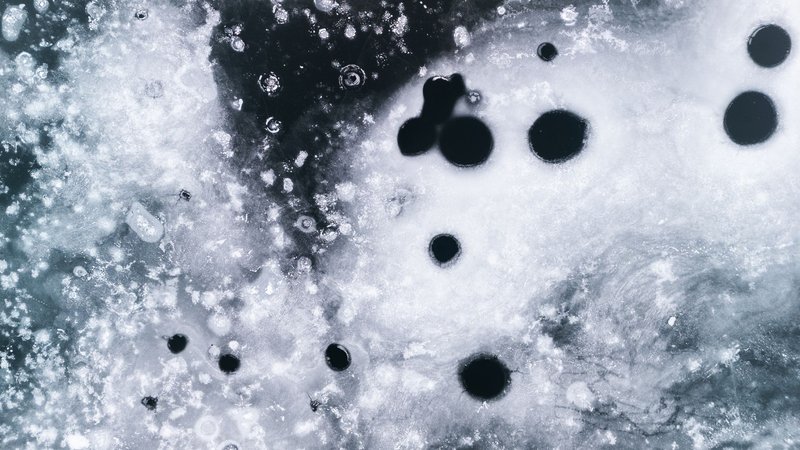
Ganymede is the largest moon in the solar system — bigger than Mercury, though not as massive, since it’s mostly ice and rock rather than dense metal. That alone would make it interesting. What makes it a genuine outlier is what’s happening underneath the ice: a saltwater ocean that researchers believe holds more water than every ocean on Earth combined, sandwiched between layers of ice under enough pressure to behave in ways water never does at the surface of our planet.
Then there’s the magnetic field. Ganymede is the only moon in the solar system known to generate its own — not induced by Jupiter’s field, but produced internally, the same basic mechanism that gives Earth its field. That field carves out a small magnetosphere inside Jupiter’s much larger one, complete with auroras that the Hubble Space Telescope has photographed glowing at Ganymede’s poles. No other moon does this. It’s the reason mission planners keep coming back.
The Timeline
Pioneer 10 and 11: the first look (1973–1974)
Pioneer 10 flew through the Jupiter system in December 1973, followed by Pioneer 11 a year later. Neither was built for close moon studies — their cameras were simple spin-scan imagers designed primarily to photograph Jupiter itself — but both caught Ganymede at a distance on the way past. The images were smeared and low-resolution, barely more than a mottled disk. Still, they were the first photographs of Ganymede ever taken by a spacecraft, and they confirmed that its surface wasn’t uniform: something was going on down there worth a closer look.
Voyager 1 and 2: the first real maps (1979)
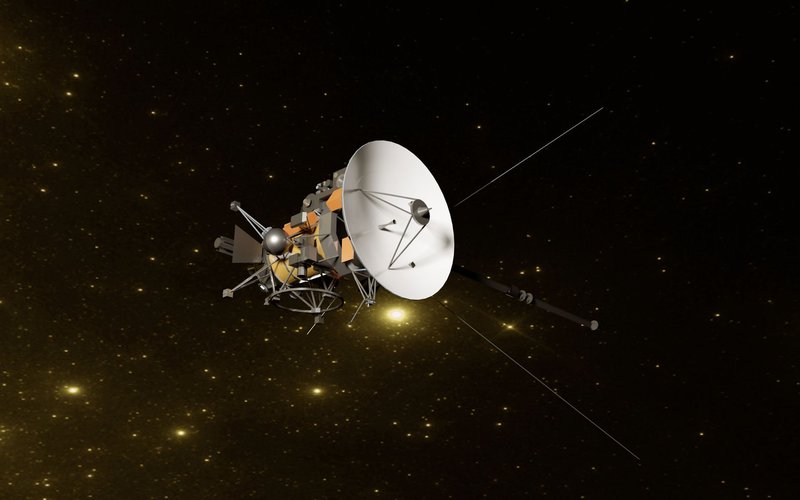
Voyager 1 passed Ganymede on March 5, 1979, and Voyager 2 followed on July 8 of the same year, coming in closer at roughly 62,000 kilometers. Together they returned the first images detailed enough to actually map terrain: two distinct kinds of surface, one dark and heavily cratered, the other lighter with long grooved ridges cutting across it. That grooved terrain turned out to be one of the more puzzling features in the outer solar system — evidence of past tectonic stretching on a moon that, by most models, shouldn’t have had the internal heat to drive it. The Voyager flybys didn’t answer why. They just made it clear there was a why to chase.
Galileo: the moon that has its own magnetic field (1996–1997)
Galileo arrived in the Jupiter system in December 1995 and, over its mission, made four dedicated close passes of Ganymede: June 27, 1996, at about 835 kilometers; September 6, 1996, at roughly 255 kilometers — still the closest any spacecraft has come to Ganymede’s surface; April 5, 1997, at about 3,095 kilometers; and May 7, 1997, at roughly 1,485 kilometers.
It was during that first pass in June 1996 that Galileo’s magnetometer picked up something nobody expected: a magnetic field generated by the moon itself. According to NASA’s mission history, that discovery reshaped how scientists thought about Ganymede’s interior, pointing toward a metallic core still active enough to run a magnetic dynamo. Galileo also gathered the gravity data that first hinted at a subsurface ocean, giving later missions an actual target instead of a guess.
Juno: the closest look in two decades (2021)
Juno wasn’t designed to study Ganymede — its job is Jupiter itself — but on June 7, 2021, a trajectory adjustment carried it within about 1,038 kilometers of the moon’s surface, the closest any spacecraft had gotten since Galileo’s G2 flyby 25 years earlier. The pass lasted minutes, not months, but Juno’s cameras and instruments captured fresh high-resolution imagery and, notably, recorded the moon’s radio emissions as sound — a genuine “audio postcard,” as JPL described it, of a close pass at 41,600 mph.
The orbiter that almost happened: Jupiter Ganymede Orbiter (proposed, cancelled 2011)
Before JUICE, there was a joint NASA/ESA concept called the Europa Jupiter System Mission, split into two spacecraft: NASA’s Jupiter Europa Orbiter and ESA’s Jupiter Ganymede Orbiter. The plan was for JGO to do exactly what its name promised — become the first spacecraft to orbit Ganymede itself, rather than just fly past it. In 2011, NASA withdrew from the joint mission over budget constraints, and the Jupiter Europa Orbiter was shelved. ESA didn’t abandon its half. Instead, the agency reworked the Ganymede Orbiter concept into a broader mission covering three of Jupiter’s icy moons, and by 2012 that reformulated mission had a new name: JUICE.
Mission Comparison Table
| Mission | Agency | Year at Ganymede | Closest Approach | Key Finding |
|---|---|---|---|---|
| Pioneer 10 | NASA | 1973 | Distant flyby | First-ever photographs of Ganymede |
| Pioneer 11 | NASA | 1974 | Distant flyby | Additional early imagery of the Jupiter system |
| Voyager 1 | NASA | 1979 | ~114,710 km | First detailed surface maps |
| Voyager 2 | NASA | 1979 | ~62,130 km | Discovered grooved, tectonically active terrain |
| Galileo | NASA | 1996–1997 | ~255 km (closest of any mission) | Discovered Ganymede’s own magnetic field |
| Juno | NASA | 2021 | ~1,038 km | Closest imagery in 25 years; radio emission recordings |
| Jupiter Ganymede Orbiter | ESA (proposed) | Cancelled 2011 | N/A | Concept absorbed into JUICE |
| JUICE | ESA | Orbit insertion Dec. 2034 | Full orbit (first ever) | Ongoing — subsurface ocean, ice shell, magnetosphere |
Why Nobody Has Orbited It Yet
Getting a spacecraft to orbit Ganymede rather than just fly past it is a fuel problem as much as an engineering one. Jupiter’s gravity dominates everything in its system — a spacecraft trying to slow down enough to be captured by Ganymede, a comparatively small moon, has to fight Jupiter’s pull the entire way in. Every flyby mission so far (Pioneer, Voyager, Galileo, Juno) solved this by not trying: they used Ganymede encounters as one stop on a longer itinerary, borrowing the moon’s gravity to adjust course rather than stopping there.
JUICE solves it differently. Launched by ESA in April 2023, the spacecraft is spending its cruise years threading a long series of flybys past Europa, Callisto, and Ganymede itself, using each pass to bleed off velocity gradually. The payoff comes in December 2034, when JUICE finally has slowed down enough to be captured into orbit around Ganymede — the first time any spacecraft will have orbited a moon other than our own.
What’s Next
JUICE isn’t traveling alone. NASA’s Europa Clipper, launched in October 2024, is headed to the same neighborhood but with a different job: dozens of close flybys of Europa, not an orbit of Ganymede. The two missions are complementary rather than redundant — Clipper is built to characterize Europa’s ice shell and plume activity across repeated passes, while JUICE will spend extended time studying Callisto and Europa before settling into a long-term relationship with Ganymede, using radar and a laser altimeter to map the ice shell and probe the ocean beneath it directly.
Once JUICE enters orbit in 2034, Ganymede stops being a place spacecraft pass through and becomes a place one actually stays. For a moon that’s had every previous visitor gone within hours, that’s the real headline — not one more flyby, but the end of flybys altogether.