TLDR
- K dwarfs are the best bet for life: long-lived, calmer than red dwarfs, and common.
- Red dwarfs (M stars) host the most known candidates, including TRAPPIST-1 and Proxima Centauri, but flares and tidal locking make them risky.
- Sun-like G stars have the one confirmed living world (ours), but Earth-sized planets in their habitable zones are hard to detect.
- No planet outside our Solar System has been confirmed to be habitable. Every name on the list below is a candidate.
Table of Contents
- What makes a star’s planets habitable?
- Sun-like G stars
- K dwarfs: the Goldilocks stars
- M dwarfs: the crowded option
- Notable stars with habitable planets, compared
- Could a star host seven habitable planets?
- The caveats
- Which star type is best for life?
- FAQ
What makes a star’s planets habitable?
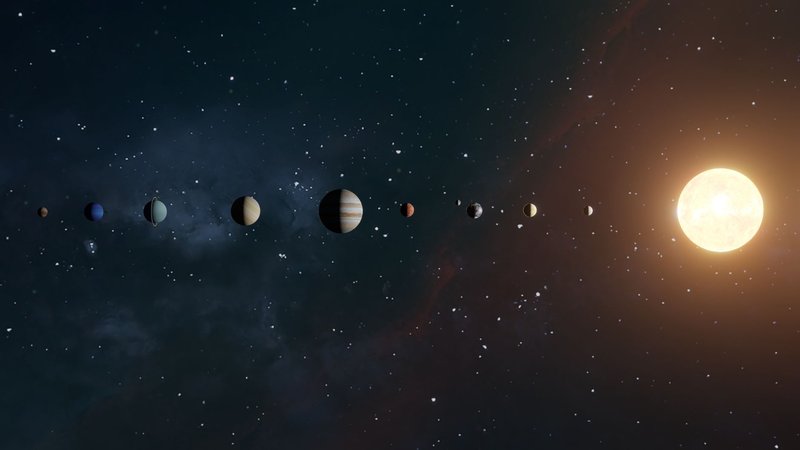
A planet counts as potentially habitable when it orbits inside its star’s habitable zone: the band of distances where surface temperatures could allow liquid water. Too close and the oceans boil off. Too far and they freeze. NASA’s explanation of the habitable zone is a good primer.
The zone moves with the star. A bright, hot star pushes it far out. A dim one pulls it in tight, sometimes closer than Mercury is to the Sun. That’s why the answer to “which stars have habitable planets” depends so much on star type.
Being in the zone is only a starting point. A planet also needs the right size, a rocky composition, and an atmosphere that holds heat. Astronomers call a planet “potentially habitable” when it clears the first two tests and the atmosphere question is still open.
Sun-like G stars
Our Sun is a G2 star, and it’s the only star we know for certain has a habitable planet. G stars burn for roughly 10 billion years, which gives life plenty of time to develop.
The catch is detection. Finding an Earth-sized planet on a year-long orbit means catching a tiny, infrequent dip in starlight. Kepler-452 is the best-known example: a G2 star about 1,800 light-years away with a planet, Kepler-452b, on a 385-day orbit. It’s roughly 1.6 times Earth’s width, which puts it in the gray zone between a big rocky world and a mini-Neptune—a size range known as super-Earths. Nobody knows which.
K dwarfs: the Goldilocks stars
K dwarfs are orange stars smaller and cooler than the Sun, with masses of about half to eight-tenths of the Sun’s. They’re the “Goldilocks” pick for a few reasons.
- They live a long time. Lifespans run from around 15 billion to well over 30 billion years, longer than the current age of the universe.
- They’re calmer than red dwarfs. Less flaring means a better chance a planet’s atmosphere survives.
- Their habitable zones are wide enough that planets there aren’t locked into permanent day and night the way close-in red dwarf worlds usually are.
Alpha Centauri B and Epsilon Eridani are both K dwarfs, and both are close by. K dwarfs also get little attention in headlines, which is odd given how well they score on nearly every criterion.
M dwarfs: the crowded option
Red dwarfs are small, dim and everywhere. Roughly three out of four stars in the Milky Way are M dwarfs, so even a modest rate of habitable planets adds up to a lot of candidates. They’re also easier to study: a planet passing in front of a small star blocks a bigger fraction of its light.
That’s why the nearby candidates are almost all red dwarf systems. The trade-off is that their habitable zones sit very close to the star, where planets face intense flares and tidal forces.
TRAPPIST-1
About 40 light-years away, TRAPPIST-1 is an ultracool red dwarf with seven Earth-sized planets. According to NASA, three of them (e, f and g) orbit in the habitable zone. JWST observations of the inner planets, b and c, point to little or no thick atmosphere on either, which is a sobering result for the rest of the system.
Proxima Centauri
At 4.24 light-years, Proxima is the closest star to the Sun. Its planet Proxima b orbits in the habitable zone every 11 days and has a minimum mass of about 1.07 Earths. Proxima is also a prolific flare star, which could strip an atmosphere away.
Teegarden’s Star
Only about 12.5 light-years away, Teegarden’s Star is another small red dwarf. Its planets b and c are both considered potentially habitable, though their masses are minimum estimates.
Notable stars with habitable planets, compared
| Star | Distance (light-years) | Star type | Potentially habitable planets |
|---|---|---|---|
| Proxima Centauri | 4.2 | M dwarf | 1 (Proxima b) |
| Teegarden’s Star | ~12.5 | M dwarf | 2 (b, c) |
| TRAPPIST-1 | ~40 | M dwarf | 3 (e, f, g) |
| TOI-700 | ~100 | M dwarf | 2 (d, e) |
| Kepler-186 | ~580 | M dwarf | 1 (Kepler-186f) |
| Kepler-452 | ~1,800 | G dwarf | 1 (Kepler-452b) |
Counts vary by source because the definition of “potentially habitable” is loose and new measurements keep revising planet sizes and masses. Treat the table as a snapshot.
Kepler-186f is worth a mention—one of the most fascinating exoplanets ever discovered: it was the first Earth-sized planet found in another star’s habitable zone. TOI-700 is a close second for interest, with two planets in the zone around a star roughly 100 light-years away.
Could a star host seven habitable planets?
A UC Riverside study led by astrophysicist Stephen Kane proposed that some stars could hold up to seven habitable planets. The condition: no Jupiter-sized giant in the system.
The reasoning is gravitational. A gas giant can stir up the orbits of smaller planets nearby, throwing them out of the habitable zone or off the system entirely. In our Solar System, Jupiter’s pull is part of why the asteroid belt never became a planet. A star without a giant leaves orbits undisturbed, which leaves room to pack in more planets at stable distances.
The result comes from modeling, not observation. No seven-planet habitable system has been found. It does point to a useful search strategy: look for stars that lack giant planets.
The caveats
Every candidate above comes with a real problem.
- Flares. Red dwarfs erupt often, especially when young. Radiation like that can erode an atmosphere.
- Tidal locking. Planets in tight orbits likely keep one face toward the star at all times, with a scorched day side and a frozen night side. Thick atmospheres might redistribute heat, but that’s a hypothesis.
- Atmosphere uncertainty. We usually know a planet’s size and orbit, not what surrounds it. JWST is only now starting to measure rocky planet atmospheres, and early results have leaned negative.
Which star type is best for life?
K dwarfs. They combine long lifetimes, moderate flaring, and habitable zones at comfortable distances. Red dwarfs offer the most candidates and the closest ones, and they’re the easiest to observe, so they’ll produce most of the near-term discoveries. G stars are proven, and just difficult to survey.
If a second living world turns up in the next decade, the odds favor a red dwarf. If it turns up in the next century, watch the K dwarfs.
FAQ
What is the closest star with a potentially habitable planet?
Proxima Centauri, at 4.24 light-years, with its planet Proxima b.
Are red dwarf stars good for habitable planets?
They host many candidates, but flares and tidal locking may make surface life difficult. Whether a red dwarf planet can keep an atmosphere is still an open question.
Has any habitable planet been confirmed outside our Solar System?
No. Astronomers have found planets in habitable zones, but none has been shown to have liquid water or a suitable atmosphere.
How many stars have planets in the habitable zone?
Astronomers have identified dozens of candidates, and the number keeps changing as new planets are found and old measurements are revised. Statistical estimates suggest such planets are common in the galaxy.