TLDR
“Stars named after animals” is really three different questions people mash together. Individual stars have animal nicknames (Sirius is the Dog Star). Constellations are animal-shaped star patterns (Leo, Scorpius, Cygnus). Nebulae and galaxies get animal names because of how they look through a telescope (Crab, Horsehead, Tarantula). None of them overlap much. Below: all three, sorted properly.
Table of Contents
- Individual Stars With Animal Nicknames
- Animal Constellations, Grouped by Type
- Nebulae and Galaxies Shaped Like Animals
- Can You Actually Buy a Star Named After Your Pet?
- FAQ
Most articles on this topic pick a lane and stay in it — a constellation encyclopedia, or a “which nebula looks like what” gallery — and never mention that these are three unrelated naming systems. A star’s name describes the star itself. A constellation’s name describes a shape drawn between unrelated stars, often light-years apart, that happen to line up from Earth. A nebula’s name is just an astronomer squinting at a Hubble image and going “huh, that looks like a crab.” Once you know which bucket you’re in, the whole topic stops being confusing.
Individual Stars With Animal Nicknames
Only about 640 stars have IAU-approved proper names as of this year, out of roughly 100 billion in the Milky Way alone, and the IAU’s Working Group on Star Names is the only body with actual authority to assign them. Most named stars carry Arabic, Greek, or Latin names, and a handful translate directly to animals or animal body parts.
- Sirius (Alpha Canis Majoris) — the Dog Star, and the brightest star in the night sky by a wide margin. It marks the nose of Canis Major, the Great Dog, one of Orion’s two hunting companions.
- Regulus (Alpha Leonis) — Latin for “Little King,” but also known as Cor Leonis, the Lion’s Heart, sitting at the base of Leo’s sickle-shaped mane.
- Denebola (Beta Leonis) — from the Arabic dhanab al-asad, “tail of the lion.” It marks the back end of Leo, opposite Regulus.
- Deneb (Alpha Cygni) — same root word, different animal. Deneb sits at the tail of Cygnus, the Swan, and anchors one corner of the Summer Triangle.
- Alphard (Alpha Hydrae) — “the solitary one,” the lone bright star in Hydra, the water serpent — the largest constellation in the sky by area, and one of the faintest given its size.
- Fomalhaut (Alpha Piscis Austrini) — “mouth of the fish,” the brightest star in Piscis Austrinus, the Southern Fish.
- Shaula (Lambda Scorpii) — “the raised tail,” marking the stinger at the end of Scorpius.
- Felis (HD 85951) — the one nobody expects. In 2018 the IAU named this star Felis, Latin for cat, reviving a name from an 18th-century constellation that never made the final cut of 88 (more on that below).
Animal Constellations, Grouped by Type
Of the 88 official constellations, roughly 42 represent animals — a number that shifts slightly depending on whether you count mythical hybrids like Pegasus or Sagittarius. Grouping them by type makes the list easier to actually use than an alphabetical slog through Latin genitives.
Mammals: Ursa Major (Great Bear) and Ursa Minor (Little Bear), Canis Major and Canis Minor (Big and Little Dog), Leo and Leo Minor (Lion, Little Lion), Lynx, Lepus (Hare), Vulpecula (Fox), Camelopardalis (Giraffe), Monoceros (Unicorn), Taurus (Bull), Lupus (Wolf), Capricornus (Sea-Goat).
Birds: Cygnus (Swan), Aquila (Eagle), Corvus (Crow), Grus (Crane), Tucana (Toucan), Pavo (Peacock), Columba (Dove), Apus (Bird of Paradise), Phoenix.
Sea creatures: Delphinus (Dolphin), Dorado (Dolphinfish), Pisces (Fish), Piscis Austrinus (Southern Fish), Cetus (Sea Monster/Whale), Hydra (Water Snake), Hydrus (its southern counterpart), Volans (Flying Fish).
Reptiles and insects: Draco (Dragon), Serpens (Serpent), Chamaeleon, Scorpius (Scorpion), Musca (Fly).
Mythical hybrids: Pegasus (winged horse), Sagittarius (centaur archer), Aries (Ram, though this one’s just a plain animal wearing a mythology hat).
Seven of the twelve zodiac signs are literal animals: Aries, Taurus, Cancer, Leo, Scorpius, Capricornus, and Pisces. That’s not a coincidence — the zodiac constellations were mapped against the sun’s apparent yearly path, and ancient skywatchers tended to see herds, not geometry, in scattered starlight.
And then there’s Felis, the cat that almost made it. French astronomer Jérôme Lalande sketched it into his 1801 star atlas because, in his words, he loved cats and felt bad none had a constellation. When the IAU finalized the modern list of 88 constellations in 1930, Felis missed the cut. The name survived anyway — it just migrated onto a single star instead of a whole constellation.
Nebulae and Galaxies Shaped Like Animals
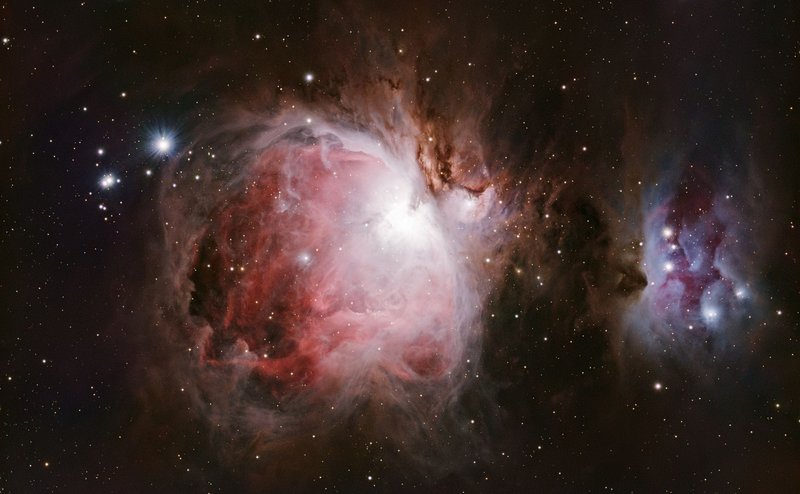
This is the category most “animal stars” articles quietly skip, and it’s arguably the best part — these names come from what the object actually looks like through a telescope, not mythology.
- Crab Nebula (Messier 1) — a supernova remnant in Taurus, the wreckage of a star that Chinese astronomers recorded as a “guest star” visible in daylight in 1054 AD. NASA’s Hubble imagery shows the filament structure that earned the name.
- Horsehead Nebula (Barnard 33) — a dark dust cloud in Orion, silhouetted against a bright red emission nebula behind it. It’s slowly evaporating under ultraviolet radiation from a nearby star system and has an estimated five million years left before it dissipates entirely.
- Tarantula Nebula (30 Doradus) — sits in the Large Magellanic Cloud and is one of the most active star-forming regions known, sprawling enough that if it were as close as the Orion Nebula, it would cast shadows on Earth.
- Eagle Nebula (Messier 16) — home to the Pillars of Creation, the towering columns of gas and dust made famous by Hubble.
- Jellyfish Nebula (IC 443) — another supernova remnant, this one in Gemini, with trailing filaments that give it the name.
- Cat’s Eye Nebula (NGC 6543) — a planetary nebula in Draco with a structure so complex astronomers are still debating what shaped it.
Can You Actually Buy a Star Named After Your Pet?
Companies selling “name a star” certificates exist, and the pitch — permanently naming a star after a deceased pet or a loved one — is emotionally effective enough that it shows up constantly around this topic. Here’s the catch: the IAU has stated plainly that these names carry no scientific or official standing whatsoever. They don’t enter any astronomical catalog. The star doesn’t get renamed in any database an astronomer would ever use. You get a certificate and a star chart; the sky doesn’t change.
That doesn’t make the gesture meaningless as a memorial keepsake, and plenty of people know exactly what they’re buying. But if the pitch is “your star will be officially recognized,” that part is false advertising.
FAQ
What star is named after a dog? Sirius, the brightest star in the night sky, is the Dog Star — part of Canis Major, one of Orion’s hunting dogs.
Is there a star named after a cat? Yes — Felis, officially named by the IAU in 2018, though it’s a single star rather than a full constellation. There’s no official cat constellation; Lalande’s 18th-century attempt didn’t survive the 1930 IAU reorganization.
How many constellations are named after animals? Roughly 42 of the 88 official constellations represent animals, depending on how you count mythical hybrids like Pegasus and Sagittarius.
Are nebulae ever officially named after animals, or is that just a nickname? Nicknames. Catalog designations (Messier 1, NGC 6543) are the official identifiers; “Crab Nebula” and “Cat’s Eye Nebula” are common names based on appearance, not IAU-assigned designations.
Can I name a star myself? No. Only the IAU’s Working Group on Star Names can assign an internationally recognized star name. Commercial registries sell certificates, not official names.