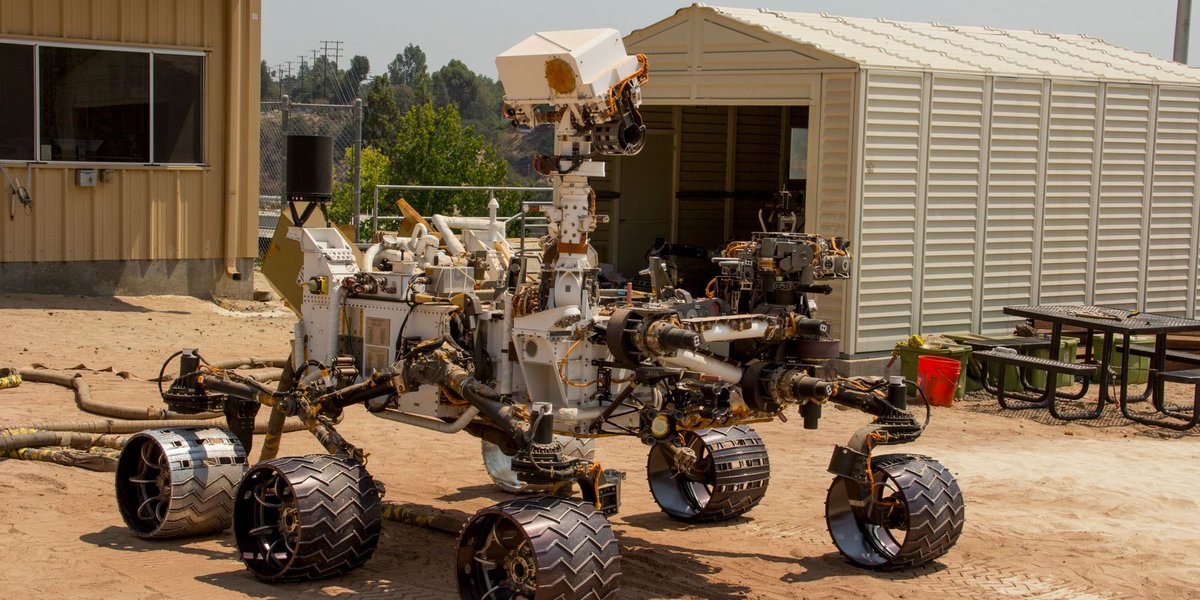
The Mars Exploration Rover mission sent two identical rovers, Spirit and Opportunity, to opposite sides of Mars in January 2004. NASA planned for 90 days of work each. Spirit lasted about six years. Opportunity lasted almost fifteen.
TLDR
- Who: Two twin rovers, Spirit (MER-A) and Opportunity (MER-B), built by NASA’s Jet Propulsion Laboratory.
- When: Both launched in mid-2003 and landed in January 2004.
- Goal: Find rocks and soils that show whether liquid water once shaped Mars.
- Result: Both found strong evidence of past water. Opportunity drove 45 kilometers (28 miles), farther than any other vehicle on another world at the time.
- End: Spirit got stuck in sand and went silent in 2010. Opportunity went quiet during a global dust storm in 2018 and was declared over in February 2019.
Table of contents
- Spirit vs. Opportunity at a glance
- Mars rover timeline
- How two rovers landed in airbags
- What the rovers carried
- Key discoveries: the evidence for water
- How the missions ended
- From MER to Curiosity and Perseverance
Spirit vs. Opportunity at a glance
The rovers were built as twins, but the two landing sites could hardly have been more different. Spirit went to a crater that looked like an old lakebed. Opportunity went to a flat plain that orbital data suggested was rich in a mineral that usually forms in water.
| Spirit | Opportunity | |
|---|---|---|
| Launch | June 10, 2003 | July 7, 2003 |
| Landing site | Gusev Crater | Meridiani Planum |
| Landing date | January 4, 2004 | January 25, 2004 (UTC) |
| Planned mission | 90 Martian days (sols) | 90 sols |
| Last contact | March 22, 2010 | June 10, 2018 |
| Mission declared over | May 25, 2011 | February 13, 2019 |
| Distance driven | About 7.7 km (4.8 mi) | About 45.2 km (28.1 mi) |
| Cause of end | Stuck in soft sand, could not tilt panels toward the winter Sun | Global dust storm blocked sunlight to solar panels |
Both rovers were about the size of a golf cart: 1.6 meters (5.2 feet) long and roughly 185 kilograms (400 pounds). Both ran on solar panels, which turned out to matter more than anyone expected.
Mars rover timeline
- June and July 2003: Spirit and Opportunity launch on Delta II rockets from Cape Canaveral.
- January 4, 2004: Spirit lands in Gusev Crater.
- January 25, 2004: Opportunity lands in Meridiani Planum, rolling into a small crater called Eagle Crater. Astronomers called it a hole-in-one.
- March 2004: Opportunity’s team announces that the rocks at Meridiani formed in the presence of liquid water.
- 2005: Spirit climbs the Columbia Hills and reaches Husband Hill. Opportunity gets stuck in a sand dune called Purgatory for about five weeks and drives itself out.
- 2007: Spirit’s dragging wheel exposes bright soil that turns out to be almost pure silica.
- 2008: Opportunity leaves Victoria Crater and heads for the much larger Endeavour Crater.
- April 2009: Spirit’s wheels break through a crust and sink into soft sand at a spot the team nicknamed Troy.
- March 22, 2010: Spirit sends its last message.
- 2011: Opportunity arrives at Endeavour Crater’s rim. NASA ends attempts to contact Spirit in May.
- 2015: Opportunity completes the equivalent of a marathon (42.2 km) on Mars.
- June 2018: A global dust storm cuts off Opportunity’s power. Its last transmission comes on June 10.
- February 13, 2019: NASA declares the mission complete after more than 1,000 recovery commands go unanswered.
How two rovers landed in airbags
Mars is hard to land on. The atmosphere is thick enough to heat a spacecraft badly on entry but too thin for a parachute to slow it to a gentle touchdown. The MER team used a method that sounds like a joke and worked twice: airbags.
After the heat shield and parachute did most of the slowing, rockets fired to bring the lander nearly to a stop above the surface. Then the bridle was cut and the lander, wrapped in a cluster of inflated airbags, dropped and bounced across the terrain. It rolled to a stop, the airbags deflated, and the petals of the lander opened to release the rover.
Nothing like it had been used since Mars Pathfinder in 1997. It worked because the rovers were light enough. The much heavier Curiosity later needed a different approach entirely (more on that below).
What the rovers carried
Each rover was a mobile geology lab. The instruments were built to work like a field geologist’s kit: look at a rock from far away, decide if it’s interesting, drive up to it, then examine it up close.
- Panoramic Camera (Pancam): Color stereo cameras on the mast, used to scout terrain and identify targets.
- Miniature Thermal Emission Spectrometer (Mini-TES): Reads infrared light to identify minerals from a distance, before the rover drives over.
- Microscopic Imager: A close-up camera on the robotic arm that shows rock grains at roughly the scale of a hand lens.
- Rock Abrasion Tool (RAT): A grinder that scrapes away weathered rock surfaces to expose fresh material underneath.
- Alpha Particle X-ray Spectrometer (APXS): Measures which chemical elements are in a rock or soil sample.
- Mössbauer spectrometer: Identifies iron-bearing minerals and tells you what state the iron is in, which helps reveal whether a rock formed in water.
The rovers also carried magnets to catch dust, and it’s from those that the team confirmed Martian dust is full of magnetic minerals.
Key discoveries: the evidence for water
The main goal of the mission was never “find life.” It was narrower and more answerable: was there ever liquid water at these sites, and for how long? The rovers answered yes at both.
Hematite “blueberries” at Meridiani Planum
Opportunity’s landing site had been picked because orbiters detected the mineral gray hematite there, a mineral that often forms in water on Earth. Right at Eagle Crater, the rover found bedrock studded with small gray spheres, each a few millimeters across. The team called them blueberries. They’re hematite-rich concretions, and they grow inside rock that’s been soaked in groundwater.
The bedrock around them was rich in sulfates and contained cross-bedded layers, which form when water flows over sediment. Later work found the mineral jarosite in the rocks, which forms only in acidic water. Meridiani wasn’t a friendly lake, then. It was a salty, acidic, on-and-off wet environment. Still liquid water.
Silica at Gusev Crater
Spirit’s story started out disappointing. Gusev Crater looked like an ancient lakebed from orbit, but the rover found only volcanic basalt on the plain. The water evidence showed up after it climbed into the Columbia Hills.
In 2007, one of Spirit’s wheels, which had stopped working, dragged through the soil and scraped away the surface. Underneath was bright material that was nearly pure silica. On Earth, that’s typically produced by hot springs or steam vents. That mattered because hot, watery environments are places where microbes thrive on Earth. Spirit also found a rock outcrop named Comanche that was rich in carbonate minerals, which suggested a less acidic environment at some point in Gusev’s past.
Endeavour Crater and clay minerals
Opportunity’s long drive to Endeavour Crater paid off. On the crater’s rim, it found clay minerals that form in water closer to neutral acidity, and veins of gypsum. That’s a friendlier environment than the acidic water it had found earlier, and it gave the team a picture of Mars becoming drier and harsher over time.
For the full mission record, NASA’s Mars Exploration Rover mission page has the science summaries and image archive. The Planetary Society’s 2004 landing-era report shows how the first results looked as they arrived.
How the missions ended
Spirit: stuck in sand
By 2009, Spirit had been driving with a broken wheel, dragging it behind like a bad shopping cart. In April, the rover broke through a crust into soft sand at Troy. Engineers rehearsed escapes on Earth using a test rover in a sandbox of similar material. It didn’t work.
The bigger problem was the season. Spirit was stuck at an angle that couldn’t tilt the solar panels toward the low winter Sun. Power dropped, and the rover went into hibernation. Its last message came on March 22, 2010. NASA kept listening for more than a year before ending the attempts in May 2011.
Opportunity: silenced by dust
Opportunity survived a similar problem earlier. During a dust storm in 2007, its power dropped to a level that came close to ending the mission. It recovered. The 2018 storm was far bigger.
In the summer of 2018, a dust storm grew into a global one, blotting out the Sun over Perseverance Valley, where Opportunity was working. The rover put itself into low-power mode and stopped communicating on June 10. The team sent commands for months, waiting for winds to clean dust off the panels. Nothing came back. The mission was declared over on February 13, 2019, after 5,111 sols. The rover had been planned for 90.
From MER to Curiosity and Perseverance
Spirit and Opportunity turned Mars exploration from a series of single-shot landers into a program with a repeatable goal: follow the water. Every rover since has built on that.
- Curiosity (2012): Too heavy for airbags, it landed using a rocket-powered sky crane. It went to Gale Crater to ask a harder question: could the ancient environment have supported microbial life? MER’s evidence of past water gave that question a solid footing.
- Perseverance (2021): Landing in Jezero Crater, a former lake with a river delta, it’s collecting samples for eventual return to Earth to look for signs of ancient life.
The MER pair also left a lesson for engineers. A machine designed for three months lasted years because the design margins were generous and the operations team learned how to keep it going: drive backward on a broken wheel, use a dust-cleaning wind, park on slopes facing the Sun for winter. Longevity on Mars turned out to come as much from people as from hardware.
Opportunity’s final transmission was a routine status report, later paraphrased in the press as “my battery is low and it’s getting dark.” It’s a human gloss on telemetry, but it fits: two small rovers that kept working long after anyone expected them to.