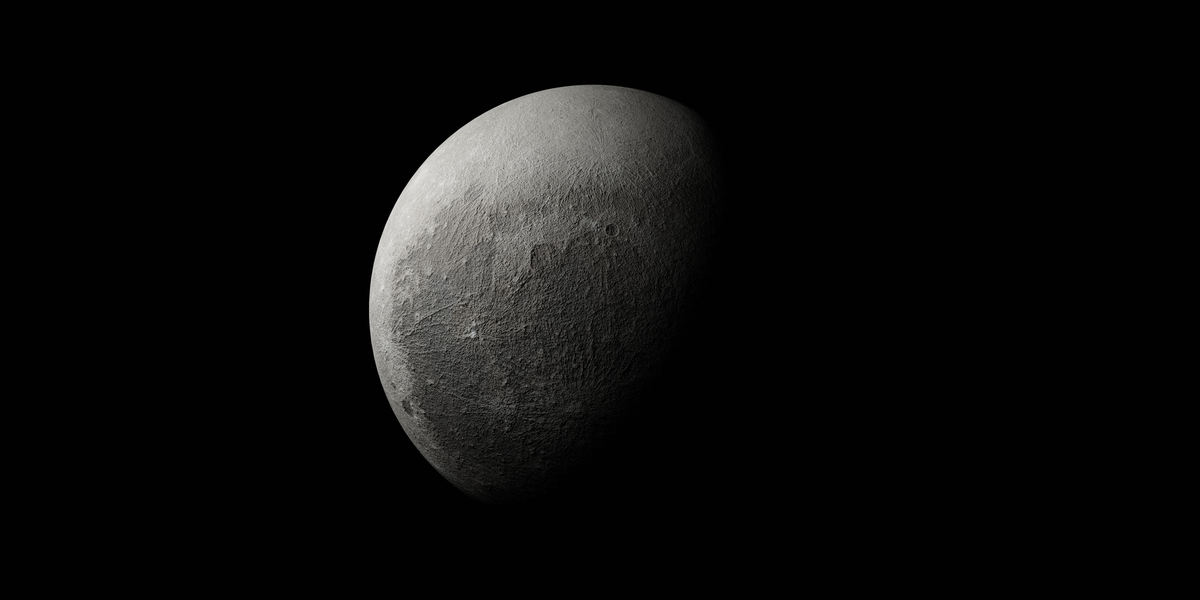
Four spacecraft have ever laid eyes on Tethys. The first passed by in 1979. The last went silent in 2017. In the nearly four decades between those two dates, humanity went from not knowing what Saturn’s sixth-largest moon looked like to mapping a canyon longer than the continental United States.
Here’s every mission that visited Tethys, in the order they arrived.
Table of Contents
- Why Tethys Is Worth Visiting
- Pioneer 11 (1979): First Contact
- Voyager 1 (1980): Close Enough to See Craters
- Voyager 2 (1981): The Canyon Revealed
- Cassini (2004–2017): The Full Picture
- Mission Comparison Table
- Future Missions to Tethys
Why Tethys Is Worth Visiting
Tethys is one of Saturn’s mid-sized icy moons, orbiting at about 295,000 km from the planet’s center. It’s mostly water ice — roughly 94% — which makes it one of the least dense moons in the solar system. It’s almost exactly as dense as liquid water.
The moon has two features that put it on the map: Odysseus, a crater 450 km wide (about two-fifths of Tethys’s entire diameter), and Ithaca Chasma, a valley system stretching roughly 2,000 km across the surface. Those names aren’t a coincidence — the moon is named after the Titaness Tethys from Greek mythology, and the naming convention carried through to its geology.
Neither of those features was known before spacecraft got there.
Pioneer 11 (1979): First Contact
Pioneer 11 became the first spacecraft to reach Saturn on September 1, 1979, and Tethys was one of the moons it passed during that flyby. The closest approach to Tethys was roughly 329,000 km — distant enough that Pioneer couldn’t resolve surface detail, but close enough to confirm the moon’s existence as a distinct object and gather basic data.
Pioneer 11 carried instruments for measuring magnetic fields, cosmic rays, and the interplanetary medium. Its Imaging Photopolarimeter (IPP) could capture images, but at that distance, Tethys appeared as little more than a bright dot. What Pioneer 11 really established was that the Saturn system was survivable — the spacecraft demonstrated that a probe could pass through Saturn’s ring plane without being destroyed, which cleared the way for Voyager to follow a more aggressive approach trajectory.
The mission’s contribution to Tethys science was minimal in isolation, but it was the proof of concept that made everything after it possible.
Voyager 1 (1980): Close Enough to See Craters
Voyager 1 arrived at Saturn on November 12, 1980, and its closest approach to Tethys came to about 415,670 km. That’s farther out than Pioneer 11, but Voyager 1 carried dramatically better instruments — including the Imaging Science System (ISS), which had wide-angle and narrow-angle cameras capable of actual surface imaging.
The images Voyager 1 returned showed a heavily cratered, icy surface. The density of craters suggested a very old surface, one that hadn’t been significantly resurfaced in billions of years. Tethys appeared almost entirely white, consistent with its high ice content.
Voyager 1’s encounter with Tethys was brief and somewhat overshadowed by its passes of Titan and other moons, but it established the basic character of Tethys: old, icy, heavily bombarded, and geologically quiet — or so it seemed. Tethys is just one of over a hundred moons orbiting Saturn, and Voyager 1’s sweep through the system offered glimpses of several of them in a single pass.
Voyager 2 (1981): The Canyon Revealed
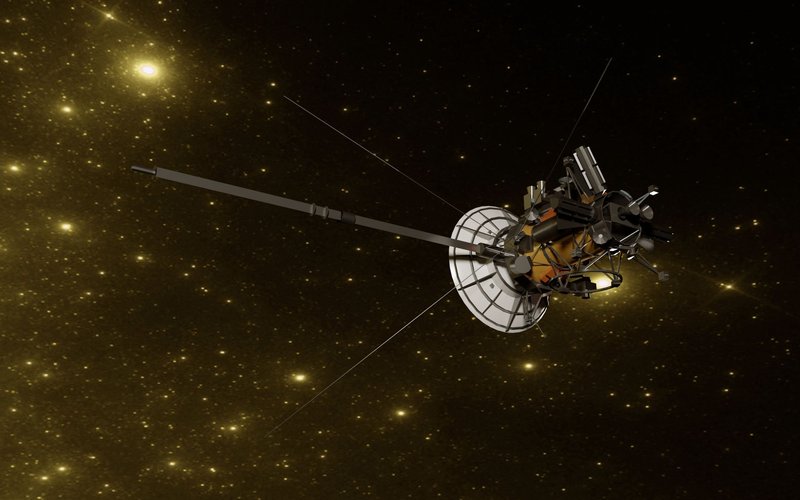
Voyager 2 arrived at Saturn on August 26, 1981, and its Tethys flyby is the one that changed the story. At a closest approach of approximately 93,000 km, it was close enough to capture surface detail that stopped scientists cold.
There it was: Ithaca Chasma. A canyon system running roughly 2,000 km in length, up to 100 km wide, and 3 to 5 km deep. NASA’s planetary science data placed this feature as one of the most striking tectonic structures on any icy moon in the outer solar system. For context, the Grand Canyon is about 450 km long. Ithaca Chasma would swallow it dozens of times over.
The leading hypothesis for how Ithaca Chasma formed: early in Tethys’s history, its interior ocean froze. As water freezes, it expands. The expansion cracked the crust outward, and Ithaca Chasma is the result of that cracking. The orientation of the chasma — running roughly north-to-south, centered on the leading hemisphere — fits this model reasonably well, though it’s not definitively confirmed.
Voyager 2 also returned better images of the Odysseus crater. At 450 km across on a moon only 1,062 km in diameter, Odysseus represents an impact event that probably came close to shattering Tethys entirely. The crater floor has rebounded upward over time, a process called isostatic adjustment — the same kind of slow gravitational settling that happens when ice flows like a very thick fluid over geological timescales.
Voyager 2 then left Saturn and kept going, eventually becoming one of two human-made objects to enter interstellar space.
Cassini (2004–2017): The Full Picture
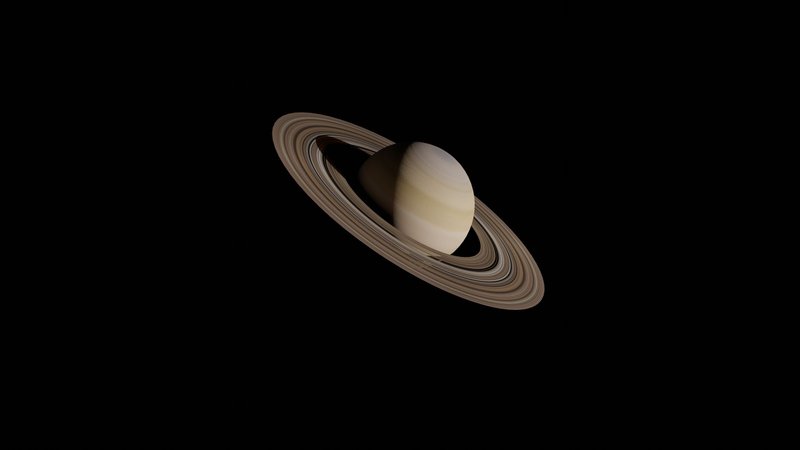
Cassini arrived at Saturn in July 2004 and spent 13 years in orbit, making it incomparably more productive than any of the flyby missions. It completed multiple dedicated Tethys flybys rather than a single pass, and the closest of these — on April 14, 2015 — brought it to within approximately 1,503 km of the surface.
At that distance, Cassini’s cameras could see features on Tethys that were genuinely surprising.
The red arcs. Cassini’s high-resolution images revealed a set of reddish arc-shaped features on Tethys’s surface — features that had no clear parallel on any other icy moon. The arcs are relatively narrow, curving across the terrain in a pattern that doesn’t obviously match impact or tectonic explanations. One leading hypothesis involves radiation-driven chemistry: charged particles trapped in Saturn’s magnetic field bombard the surface and cause chemical reactions that produce organic compounds with a reddish tint. But as of the mission’s end, the arcs remained one of the unexplained finds. Cassini’s Imaging Science Subsystem team at JPL published the discovery in 2016.
Surface composition in detail. Cassini’s VIMS (Visual and Infrared Mapping Spectrometer) and UVIS (Ultraviolet Imaging Spectrograph) instruments gave scientists their most complete look at Tethys’s surface chemistry. The dominant composition is water ice, as expected, but with trace materials that vary across the surface in ways still being studied.
Tethys’s trojan moons. Cassini also confirmed the small moons Telesto and Calypso sharing Tethys’s orbital path — one leading 60 degrees ahead, one trailing 60 degrees behind. These are classic Lagrange point companions, held in place by the gravitational balance between Saturn and Tethys.
Gravity and interior structure. From tracking changes in Cassini’s radio signal during flybys, scientists could measure small gravitational perturbations and refine models of Tethys’s interior. The results suggest a relatively uniform interior — mostly ice throughout — with no compelling evidence for a liquid subsurface ocean today, unlike the situation at Enceladus or Europa.
Cassini ended its mission on September 15, 2017, when it deliberately plunged into Saturn’s atmosphere to avoid contaminating any of the moons with earthly microbes. The data it collected continued to be published for years after.
Mission Comparison Table
| Mission | Flyby Date | Closest Approach | Key Instruments | Primary Findings |
|---|---|---|---|---|
| Pioneer 11 | September 1979 | ~329,000 km | Imaging Photopolarimeter | Confirmed moon exists; no surface detail |
| Voyager 1 | November 1980 | ~415,670 km | ISS cameras | Heavily cratered, icy surface |
| Voyager 2 | August 1981 | ~93,000 km | ISS cameras, PPS, UVS | Discovered Ithaca Chasma; detailed Odysseus crater |
| Cassini | 2004–2017 (multiple) | ~1,503 km (closest) | ISS, VIMS, UVIS, radio science | Red arcs, surface composition, trojan moon confirmation |
Future Missions to Tethys
No mission currently planned will visit Tethys specifically. The two major outer solar system missions in development — NASA’s Europa Clipper, which launched in 2024, and the ESA JUICE mission targeting the Galilean moons of Jupiter — are headed to Jupiter’s system, not Saturn’s.
The next Saturn-focused mission under serious study is the Dragonfly rotorcraft, but that’s headed to Titan. There’s also ongoing academic work toward a dedicated Saturn orbiter or Enceladus lander, driven by the enormous interest in Enceladus’s subsurface ocean and plumes.
Tethys isn’t high on anyone’s target list at the moment. It doesn’t have obvious signs of present-day habitability — no active plumes, no confirmed liquid water — which makes it harder to compete for funding against the more dramatic targets. The unexplained red arcs are a genuine mystery, but mysteries need to compete with potential biosignatures, and right now Tethys loses that competition.
If a future Saturn orbiter mission ever flies, Tethys would almost certainly get additional flybys by proximity. But as a primary destination, it’s not in the queue.
From Pioneer 11’s barely-a-glimpse in 1979 to Cassini’s close-up of features nobody expected, the story of Tethys exploration tracks the whole arc of outer solar system science. We went from “that bright dot near Saturn” to high-resolution maps of unexplained red streaks in about 35 years. Not bad for a moon most people have never heard of.
Enjoyed this article?
Get daily 10-minute PDFs about astronomy to read before bed!
Sign up for our upcoming micro-learning service where you will learn something new about space and beyond every day while winding down.