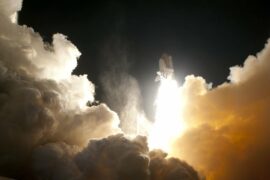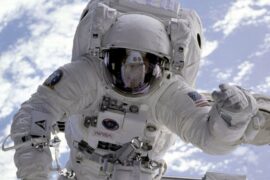
Seven people went up on Space Shuttle Columbia on January 16, 2003. Sixteen days later, sixteen minutes before they were supposed to land, all seven were gone. Most accounts of the Columbia disaster get lost in the foam strike, the wing breach, and the accident report. This isn’t that. The accident matters, but the people matter more — and they tend to get reduced to a list of names under a mission patch.
So here are the seven, as people first. A physician who’d flown the Navy’s F/A-18s. The first Indian-born woman in space. Israel’s first astronaut, carrying a Holocaust survivor’s drawing into orbit. Then we’ll walk through what STS-107 actually was, what went wrong, and the questions people still search for two decades later.
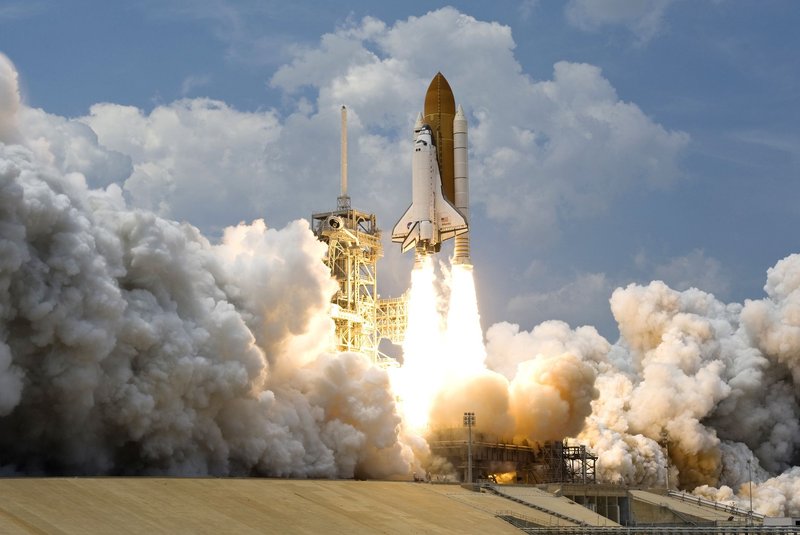
Table of Contents
- The Seven Crew Members
- Rick Husband — Commander
- William McCool — Pilot
- Michael Anderson — Payload Commander
- David Brown — Mission Specialist
- Kalpana Chawla — Mission Specialist
- Laurel Clark — Mission Specialist
- Ilan Ramon — Payload Specialist
- What STS-107 Was Actually Doing
- What Went Wrong
- How the Columbia Astronauts Died
- Were the Bodies Recovered?
- The Legacy
The Seven Crew Members {#the-seven-crew-members}
The STS-107 crew was a mix of military test pilots, a research physician, an aerospace engineer, and an international payload specialist. Five Americans, one Indian-born American, one Israeli. Three of them — Husband, McCool, and Ramon — were spaceflight rookies on a shuttle that had been flying since 1981. Here’s each of them.
Rick Husband — Commander {#rick-husband}
Richard “Rick” Husband was a colonel in the U.S. Air Force and a test pilot before NASA, with more than 3,800 hours of flight time across forty different aircraft. Born in Amarillo, Texas, in 1957, he’d wanted to be an astronaut since he was a kid watching the early space program. NASA turned him down three times before accepting him in 1994.
His first flight was STS-96 in 1999, the first shuttle to dock with the International Space Station. Columbia was his second and final mission as commander. Husband was known among the crew for his faith and for singing — he recorded songs for his two children to play one per day during the mission, so they’d hear his voice every morning he was gone.
William McCool — Pilot {#william-mccool}
Commander Willie McCool, a Navy pilot, was flying his first spaceflight on STS-107 at age 41. He’d graduated second in his class of 1,083 at the U.S. Naval Academy and flew EA-6B Prowlers off carriers before becoming a test pilot. Astronaut Jonn Young once called him one of the best he’d flown with.
McCool was a distance runner and a mountaineer — he and his wife had hiked together for years, and he’d planned to climb after the mission. He handled much of Columbia’s reentry from the pilot’s seat. He was the youngest member of the crew.
Michael Anderson — Payload Commander {#michael-anderson}
Lieutenant Colonel Michael Anderson ran the science side of the mission. An Air Force officer and physicist born in Plattsburgh, New York, in 1959, he was one of relatively few Black astronauts in NASA’s corps at the time and spoke openly about wanting to be a role model for kids who didn’t see themselves in the program.
This was his second flight; his first, STS-89, had docked with the Russian space station Mir in 1998. As payload commander on Columbia, Anderson was responsible for the more than 80 experiments the crew ran around the clock in two shifts. He’d reportedly told a friend before launch that if anything went wrong, he was at peace with it because of the work.
David Brown — Mission Specialist {#david-brown}
Captain David Brown took a route to space that almost no one else does. He was a Navy flight surgeon and a naval aviator — one of the very few people qualified as both a military doctor and a carrier-based pilot. Born in Arlington, Virginia, in 1956, he earned his medical degree before learning to fly.
The detail people remember: in college, Brown performed as a circus acrobat, including stilt-walking and trapeze, to help pay his way. He never married and was, by all accounts, the crew member most purely thrilled to be in orbit. STS-107 was his first and only spaceflight. He filmed much of the crew’s daily life on board, and some of that footage survived.
Kalpana Chawla — Mission Specialist {#kalpana-chawla}
Kalpana Chawla was born in Karnal, India, in 1962, and became the first Indian-born woman to fly in space on STS-87 in 1997. She came to the United States in the 1980s for graduate school, earned a doctorate in aerospace engineering from the University of Colorado, and joined NASA in 1994. She remains one of the most celebrated names on the short list of Indian astronauts who have flown to space.
Chawla flew Columbia twice — STS-87 and STS-107 — meaning she was aboard the same orbiter for both her missions. She’d grown up in a town with no astronauts and few engineers, sketching airplanes as a girl, and she became a national figure in India long before the disaster made her name globally known. On STS-107 she operated the robotic arm and ran microgravity experiments. Today schools, a satellite series, a hill on Mars, and a supercomputer carry her name.
Laurel Clark — Mission Specialist {#laurel-clark}
Captain Laurel Clark was a Navy physician — a flight surgeon and an undersea medical officer who’d served on submarine and diving missions before NASA. Born in Ames, Iowa, in 1961 and raised in Wisconsin, she joined the astronaut corps in 1996. STS-107 was her first spaceflight.
On Columbia she handled the biological and life-science experiments, including watching silkworms spin cocoons in microgravity, which she described in an email home with obvious delight. She was the mother of an eight-year-old son. In one of the last messages she sent from orbit, she wrote about how magical it was to see the sun set and rise every 90 minutes.
Ilan Ramon — Payload Specialist {#ilan-ramon}
Colonel Ilan Ramon was a fighter pilot in the Israeli Air Force and became the first Israeli astronaut. Born in Tel Aviv in 1954, he was the son of a Holocaust survivor, and he carried symbolic items into orbit deliberately: a small Torah that had survived Bergen-Belsen, and a pencil drawing called “Moon Landscape” made by a 14-year-old boy, Petr Ginz, who was later killed at Auschwitz.
Ramon, who was secular, asked a rabbi how to keep the Sabbath in orbit, where the sun rises sixteen times a day — a question with no precedent. He flew the mission as a payload specialist, conducting an experiment on Mediterranean dust storms. He was a national figure in Israel, and his death was felt as a public loss across the country; he and Eytan Stibbe still headline the small list of Israeli astronauts to have reached space.
What STS-107 Was Actually Doing {#what-sts-107-was-doing}
STS-107 was a dedicated science mission, not a station resupply or a satellite deployment. The crew worked in two 12-hour shifts so the lab never went idle, running more than 80 experiments across the sixteen days — combustion in microgravity, bone and cell biology, agricultural studies, the dust-storm research, and dozens more.
This is part of why the loss hit the science community so hard: the mission had been delayed for years, and the crew had trained together unusually long. They weren’t testing hardware on the way somewhere else. The research was the point.
What Went Wrong {#what-went-wrong}
Eighty-one seconds after launch, a piece of insulating foam roughly the size of a briefcase broke off the external fuel tank and struck the leading edge of Columbia’s left wing. Foam shedding had happened on earlier flights and had largely been treated as an accepted risk. This strike punched a hole in a panel of the wing’s reinforced carbon-carbon heat shielding.
For sixteen days, nothing seemed wrong. The crew did their science, unaware of the damage. The breach only mattered on the way home. During reentry on February 1, 2003, superheated atmospheric gases — over 3,000 degrees Fahrenheit — poured through the hole in the wing and began destroying the structure from inside. It’s a sequence that earns Columbia a permanent place among the most dangerous missions in space history.
The Columbia Accident Investigation Board later concluded the technical cause was the foam strike, but laid heavier blame on NASA’s culture: normalized risk, weak safety processes, and dismissed concerns. The Wikipedia summary of the investigation traces how engineers’ requests for imaging of the damaged wing were turned down during the flight.
How the Columbia Astronauts Died {#how-they-died}
This is the question people search for most, so here’s the direct answer. As the left wing failed during reentry over Texas, Columbia lost control and broke apart at roughly 200,000 feet, traveling about 18 times the speed of sound.
A NASA crew survival report concluded the astronauts could not have survived. The cabin lost pressure rapidly, and the crew members were exposed to forces and conditions far beyond human tolerance as the orbiter disintegrated. Space.com’s reporting on the survival findings noted that the loss of cabin pressure happened so fast the crew likely had little to no time to react. Death came within seconds, from depressurization and the breakup itself, not from a long, conscious descent.
Were the Bodies Recovered? {#were-the-bodies-recovered}
Yes. The shuttle broke apart over East Texas and Louisiana, scattering debris across a search area covering thousands of square miles. In one of the largest recovery operations in U.S. history, thousands of searchers on foot, on horseback, and in aircraft combed the ground for weeks.
The remains of all seven crew members were recovered and identified. They were returned to their families, and the astronauts were buried or memorialized according to their families’ wishes, including burials at Arlington National Cemetery. NASA and local communities across Texas continue to mark the recovery sites.
The Legacy {#the-legacy}
The Columbia disaster effectively began the end of the Space Shuttle program. The fleet was grounded for over two years, and although it returned to flight, NASA committed to retiring the shuttles — which it did in 2011 — and shifting toward new vehicles and commercial partners.
The seven names live on in a dense web of memorials. Seven peaks in Colorado’s Sangre de Cristo range were named for the crew. Asteroids, Martian hills, schools, and scholarships carry their names. NASA marks a Day of Remembrance each year for the crews of Apollo 1, Challenger, and Columbia together.
What’s worth holding onto isn’t the foam or the failure. It’s that a circus acrobat turned flight surgeon, a girl who sketched planes in a small Indian town, and the son of a Holocaust survivor all ended up in the same spacecraft, doing science 200 miles above the planet, because they each spent a life clawing toward it. The disaster is how they’re remembered. It shouldn’t be all of why.