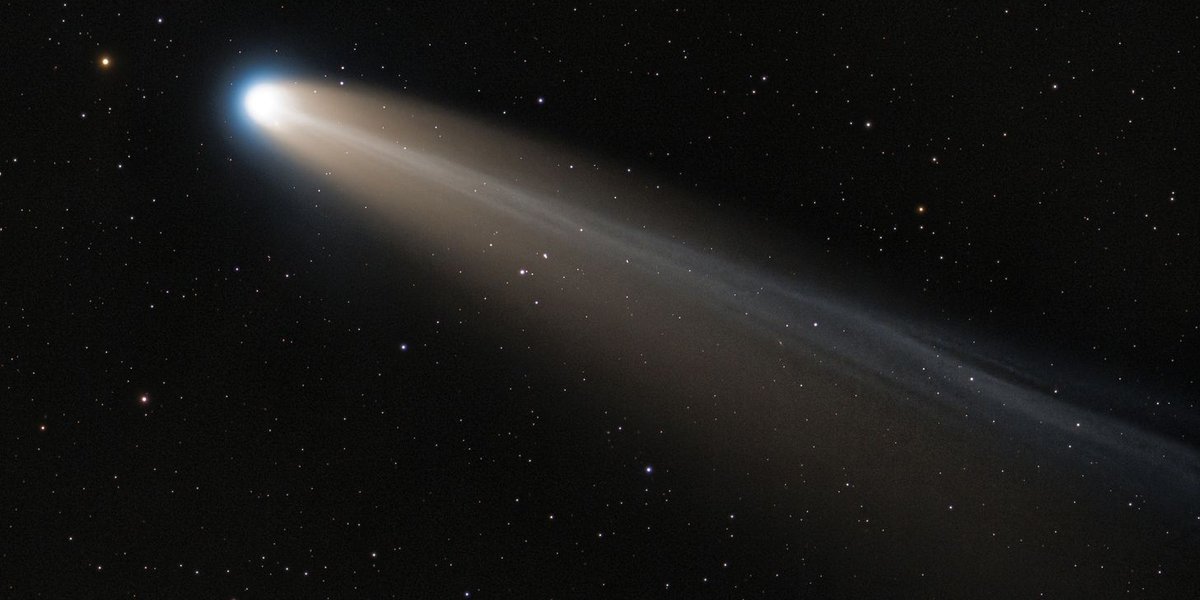
Halley’s Comet swings by every 76 years. That’s the famous one, the one your grandparents and your grandkids both get a shot at. But Halley is the small fry. The comets that actually stop traffic — Hale-Bopp hanging in the sky for 18 months, the one that lit up the autumn of 2024 — those won’t be back for thousands of years, if ever. Those are the long-period comets, and they come from a place so far out that sunlight takes weeks to reach it.
Here’s what separates them from the regulars, why the freshest ones are the brightest, and which ones are worth knowing by name.
Table of Contents
- What counts as a long-period comet
- Short-period vs long-period comets
- Where they come from: the Oort Cloud
- Why the new arrivals are the brightest
- Famous long-period comets
- How to actually see one
- FAQ
What counts as a long-period comet
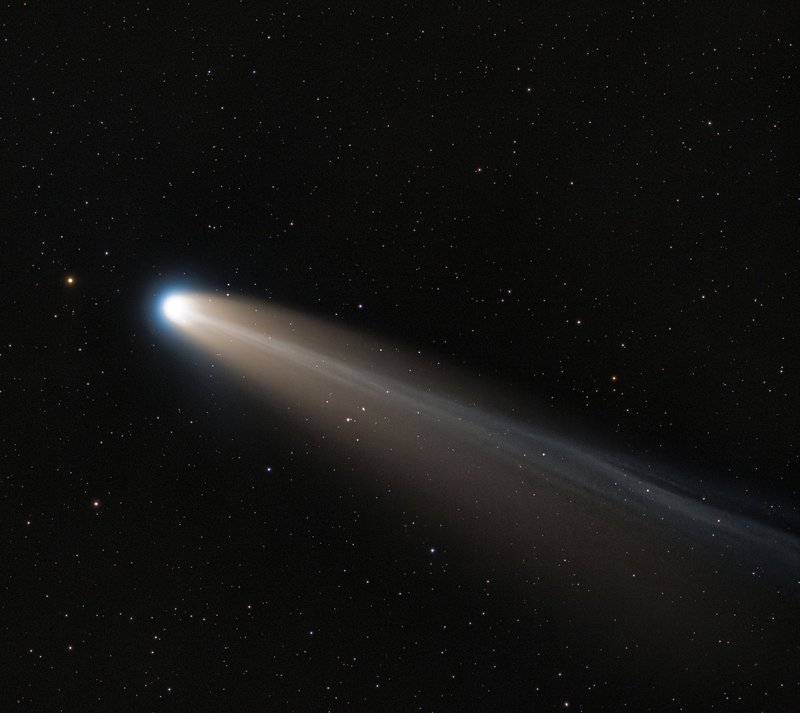
The dividing line is orbital period — how long the comet takes to complete one trip around the Sun. Astronomers draw it at 200 years. Anything that takes longer than that to come back is a long-period comet. Anything shorter is a short-period comet.
Two hundred years is a clean number, but the physics behind it isn’t arbitrary. A 200-year orbit corresponds to an enormous, stretched-out ellipse reaching far beyond the planets. Many long-period comets have orbits so elongated that their periods run into the thousands, millions, or even tens of millions of years. Some arrive on paths that are nearly parabolic, meaning they may be making their first and only pass through the inner solar system before getting flung back out — or ejected from the Sun’s grip entirely.
That’s the other defining trait: long-period comets come at us from every direction. Short-period comets mostly orbit in roughly the same flat plane as the planets. Long-period comets don’t care about the plane at all. They drop in from above, below, sideways — their orbits are tilted at random angles. That randomness is a fingerprint, and it points straight back to where they were born.
Short-period vs long-period comets
The two groups differ in more than just how often they show up. Here’s the side-by-side:
| Feature | Short-period comets | Long-period comets |
|---|---|---|
| Orbital period | Under 200 years | Over 200 years (often thousands to millions) |
| Origin | Kuiper Belt & scattered disc | Oort Cloud |
| Orbital plane | Near the planets’ plane | Any inclination, random |
| Predictability | Returns are known and timed | Often a single observed pass |
| Volatile content | Depleted from repeat passes | Often pristine (“dynamically new”) |
| Example | Halley (76 yrs), Encke (3.3 yrs) | Hale-Bopp (~2,500 yrs), Hyakutake (~70,000 yrs) |
The short-period side of the table draws its members from the icy region beyond Neptune known as the Kuiper Belt, where the orbits stay relatively flat and the returns are predictable enough that astronomers can keep running lists of periodic comets with their next predicted perihelion dates. The Halley-type comets sit in an awkward middle. Halley’s 76-year period makes it short-period by the 200-year rule, but its retrograde, steeply tilted orbit looks more like a long-period comet that got captured into a tighter loop. Astronomers actually use that 200-year line plus orbital tilt to sort the genuinely Oort Cloud-derived objects from the ones the giant planets have wrangled into shorter circuits.
Where they come from: the Oort Cloud
The Oort Cloud is the answer to almost every question about long-period comets, and it’s worth picturing properly. It’s a vast spherical shell of icy bodies surrounding the entire solar system, starting somewhere around 2,000 times the Earth-Sun distance and extending out to perhaps 100,000 times that — a meaningful fraction of the way to the nearest star. NASA describes it as a giant spherical shell surrounding the Sun, planets and Kuiper Belt objects, and it’s the most distant region in our solar system that’s still bound to the Sun.
Nothing has ever directly imaged it. The Oort Cloud is inferred entirely from the comets it sends us — their random inclinations and enormous orbits only make sense if they started in a roughly spherical reservoir very far out. Estimates put the population in the trillions of icy bodies, leftover construction debris from the solar system’s formation 4.6 billion years ago, flung outward by the gravity of the young giant planets.
Out there, temperatures hover near absolute zero and the Sun is just another bright star. The ices stay locked up, untouched, for billions of years. Then something nudges one loose — a passing star, a galactic tide, a gravitational shove — and it begins the long fall inward. That fall can take millions of years. What finally arrives in our skies is a deep-frozen relic from the dawn of the solar system, making its first close encounter with warmth.
Why the new arrivals are the brightest
This is the part casual skywatchers actually feel, even if they don’t know the mechanism. The most dazzling comets are usually the ones we’ve never seen before.
The term is “dynamically new.” A dynamically new comet is one falling in from the Oort Cloud for the very first time, still wrapped in a coating of the most volatile ices — super-volatiles like carbon monoxide and carbon dioxide that vaporize while the comet is still way out past Jupiter, far from the Sun. These ices have never been heated. The moment they catch enough sunlight, they erupt into a sprawling coma and tail, sometimes spectacularly, long before the comet gets close.
Compare that to a short-period comet that’s rounded the Sun hundreds of times. Each pass bakes off another layer. After enough trips, the easy-to-vaporize material near the surface is gone, leaving a crust of dust and depleted ice. The comet still puts on a show, but a muted one.
There’s a catch, and it bites observers regularly. Dynamically new comets are notoriously hard to predict. That early outburst of super-volatiles can make a comet look promising from a great distance, then fizzle as it approaches and the surface ices run dry — the comet “underperforms.” Comet Kohoutek in 1973 was hyped as the comet of the century and turned into a faint disappointment, a cautionary tale that still gets cited every time a bright newcomer is announced.
Famous long-period comets
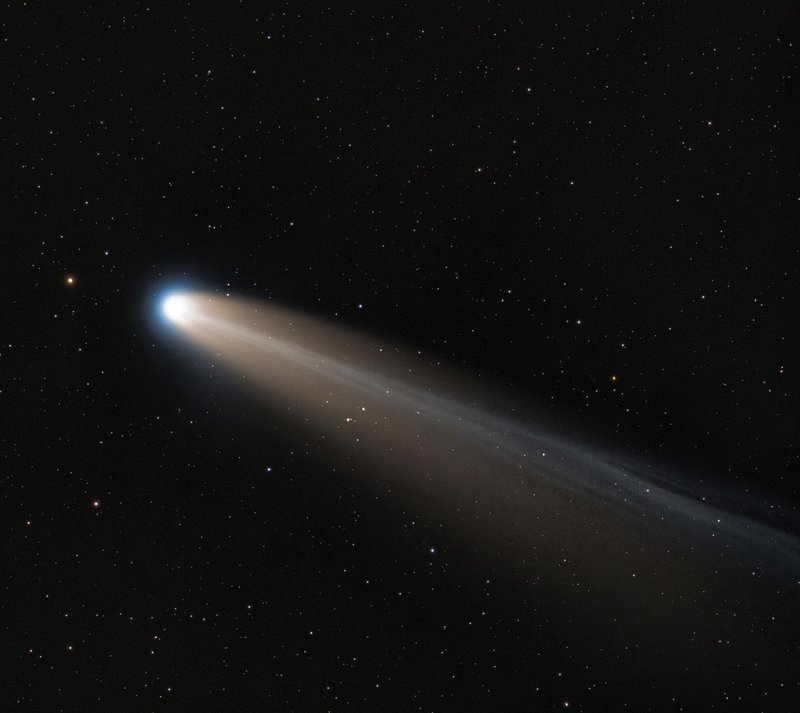
A handful of long-period comets have burned themselves into public memory. These are the ones that have earned a permanent place among the great comets recorded across history, and they’re worth knowing.
Comet Hale-Bopp (C/1995 O1) is the gold standard of the modern era. Discovered in 1995 by two independent observers on the same night, it became visible to the naked eye for a record-breaking 18 months through 1996 and 1997. Its nucleus was unusually large — estimated at 40 to 80 kilometers across, several times bigger than most comets — which is why it stayed so bright for so long. Its orbital period is roughly 2,500 years, shortened slightly by this pass, so it won’t return until around the year 4385. Most people alive in the late ’90s remember it.
Comet Hyakutake (C/1996 B2) stole the show the year before Hale-Bopp peaked. It wasn’t a giant, but it passed extraordinarily close to Earth in March 1996, which made it appear enormous, with a tail stretching across a huge swath of sky. Its orbital period is around 70,000 years. Nobody who saw it will see it again, and neither will anyone they’ll ever meet.
Comet West (C/1975 V1) showed up in 1976 with one of the most beautiful, broad fan-shaped tails of the 20th century. It also fragmented near perihelion, splitting into four pieces — a vivid demonstration of how fragile these icy bodies are when the Sun finally gets to work on them. Its period is on the order of half a million years.
Comet Tsuchinshan-ATLAS (C/2023 A3) is the most recent crowd-pleaser. Through October 2024 it became a genuine naked-eye comet with a long, elegant tail, the best widely-visible comet in years. Its orbit is so stretched it may be effectively a one-way visitor, never to return. If you caught it, you saw something no human will see again.
How to actually see one
You don’t get to schedule this. Unlike Halley or the annual meteor showers, the great long-period comets arrive on their own clock, usually with a year or less of warning once discovered. The move is to stay loosely plugged in — follow an astronomy news source or a tracker of recent comets that are visible now and worth watching so you hear when a bright one is inbound.
When one does come:
- Get away from city lights. Comets are diffuse, faint objects. Light pollution erases tails first. A dark rural sky turns a smudge into a spectacle.
- Know the timing. Comets are usually best shortly after sunset or before sunrise, low near the horizon, when they’re closest to the Sun and most active. The window is often just a couple of weeks.
- Use binoculars. Even when a comet is technically naked-eye, binoculars reveal the coma and tail far better. You don’t need a telescope.
- Be patient with the hype. Remember Kohoutek. Predictions for newly discovered comets carry real uncertainty. Treat “comet of the century” headlines with healthy skepticism and let the comet prove itself.
The reward is worth the effort, because what you’re looking at is genuinely rare — not a recurring event, but a frozen fragment from the edge of the solar system making a one-time appearance, one your grandchildren won’t get to repeat.
FAQ
What is the difference between a short-period and long-period comet? Orbital period. Short-period comets return in under 200 years and come from the Kuiper Belt, orbiting near the plane of the planets. Long-period comets take over 200 years — often thousands to millions — come from the distant Oort Cloud, and arrive from random directions.
Where do long-period comets come from? The Oort Cloud, a spherical shell of trillions of icy bodies surrounding the solar system, starting thousands of times farther from the Sun than Earth. A gravitational nudge from a passing star or the galaxy’s tide sends them on a million-year fall toward the Sun.
Why are long-period comets often brighter than short-period ones? Many are “dynamically new” — falling in for the first time with pristine, never-heated volatile ices. Those ices vaporize dramatically even at great distances, producing big comas and long tails. Short-period comets have lost much of that material over repeated passes.
Will Hale-Bopp come back? Yes, but not soon. Its orbit was shortened by its 1997 pass to roughly 2,500 years, so it’s due back around the year 4385.
Can you predict when a long-period comet will appear? Not in advance. Most are discovered only a year or less before they reach the inner solar system, and their brightness is hard to forecast — some hyped comets fizzle, others surprise everyone. That unpredictability is part of what makes a great one so memorable.