Most “celestial baby name” lists make boys an afterthought. You scroll past Luna, Stella, and Aurora for three screens before you hit a short paragraph of boy names tacked on at the bottom. This isn’t that.
Every name here is a star name for boys, sorted by why it’s a star name, because “Orion” and “Caelum” belong to different decisions. One is a hunter striding across the winter sky. The other just means “sky” in Latin. Knowing which bucket a name comes from tells you whether it’ll sound bold or quiet on a kid in a classroom.
A quick note on the astronomy, since this is a space site and we care: the brightest stars carry Arabic names, because medieval Arab astronomers cataloged the sky while Europe was busy with other things. That’s why Altair, Rigel, Deneb, and Vega all trace back to Arabic roots. The Greek and Latin names tend to be constellations, not individual stars. Worth knowing if the etymology matters to you.
Table of Contents
- How to actually choose a star name
- Names that literally mean “star”
- Named after real stars
- Constellation names for boys
- Planet, moon, and sky names
- Subtle star names nobody will question
- Names with great nicknames
- The teasing test
How to actually choose a star name

Three things decide whether a celestial name works on a real kid.
Wearability. Will he spell it on the phone forty times a year? Will substitute teachers butcher it? Caelum is gorgeous and almost nobody can pronounce it cold. Orion, everyone gets right.
Nickname potential. Long names need an escape hatch. Orion gives you Rio or Ry. Alcor doesn’t really give you anything, which is fine if you like it whole.
The teasing question. A real concern, and the one forum parents bring up most. Some star names are subtle enough that no classmate would ever clock them (Leo, Hugo). Others announce themselves (Cosmo, Cosmos). Neither is wrong. Just go in with eyes open. There’s a whole section on this at the bottom.
The names below are grouped so you can skip straight to the kind you want. If you want the boldest pick, go to constellations. If you want a star name that flies under the radar, go to subtle.
Names that literally mean “star”
These translate directly to “star” in some language. The most on-the-nose option, and a few of them don’t read celestial at all unless you know.
| Name | Pronunciation | Origin | Meaning |
|---|---|---|---|
| Stelio | STEL-ee-oh | Greek/Italian | From stella, star |
| Sterling | STUR-ling | English | Often linked to “little star” (also “high quality”) |
| Tarek | TAH-rek | Arabic | The morning star (also “morning knocker”) |
| Najm | NAJM | Arabic | Star |
| Hoku | HOH-koo | Hawaiian | Star |
| Esha | EH-shah | Sanskrit | Star, desire |
| Itri | EE-tree | Amazigh (Berber) | Star |
| Csilla | CHEEL-lah | Hungarian | Morning star (more often a girl’s name) |
| Setareh | seh-tah-REH | Persian | Star (usually feminine, used unisex) |
Tarek is the standout here. Common across the Arabic-speaking world, it references At-Tariq, the morning star, and it carries real weight without sounding invented. Sterling is the stealth pick: it reads as a classic English surname-name, and the “little star” link is a bonus only you need to know about.
Named after real stars
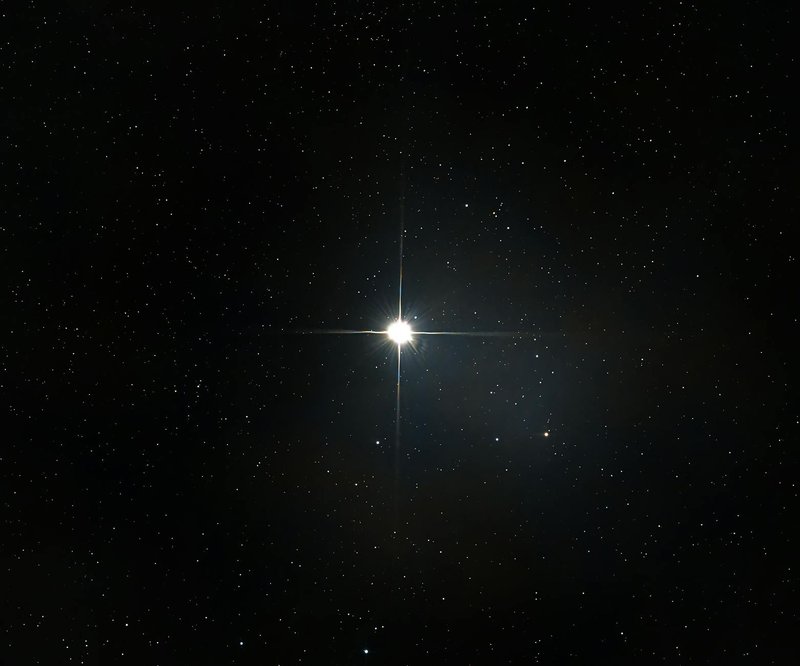
These are actual stars you can point at. That’s the appeal: the name has a fixed address in the sky. Most of the bright ones are Arabic in origin, as noted up top.
| Name | Pronunciation | Origin | The star |
|---|---|---|---|
| Altair | al-TYE-er | Arabic | Brightest star in Aquila; “the flying eagle” |
| Sirius | SEER-ee-us | Greek | The Dog Star, brightest star in the night sky |
| Rigel | RYE-jel | Arabic | Blue supergiant, Orion’s foot; “the foot” |
| Antares | an-TAIR-eez | Greek | Red supergiant heart of Scorpius; “rival of Mars” |
| Deneb | DEN-eb | Arabic | Tail of Cygnus the swan; one corner of the Summer Triangle |
| Vega | VAY-gah | Arabic | Brightest star in Lyra; “the swooping eagle” |
| Atlas | AT-lass | Greek | A star in the Pleiades cluster (and the Titan) |
| Alcor | AL-cor | Arabic | The faint companion star in the Big Dipper’s handle |
| Castor | KAS-ter | Greek | One of the two bright stars in Gemini |
| Pollux | POL-uks | Greek/Latin | The other Gemini twin, an orange giant |
| Caph | KAF | Arabic | A bright star in Cassiopeia; “the palm” |
| Hadar | hah-DAR | Arabic | Also called Beta Centauri; “ground” |
| Mirach | MEER-ak | Arabic | A red giant in Andromeda |
| Phact | FAKT | Arabic | Brightest star in Columba the dove |
Sirius is the one most people land on, partly thanks to Sirius Black, and it’s a genuinely great name. It’s the brightest star humans can see, sitting in Canis Major. Antares is the dark-horse pick: it means “rival of Mars” because its red color rivals the planet, and it sounds like a name a kid grows into rather than out of.
Rigel deserves a mention too. It’s a blue supergiant marking Orion’s foot, the word itself comes from the Arabic for “foot,” and it gives you a clean, modern one-syllable-feel name without being common.
Constellation names for boys
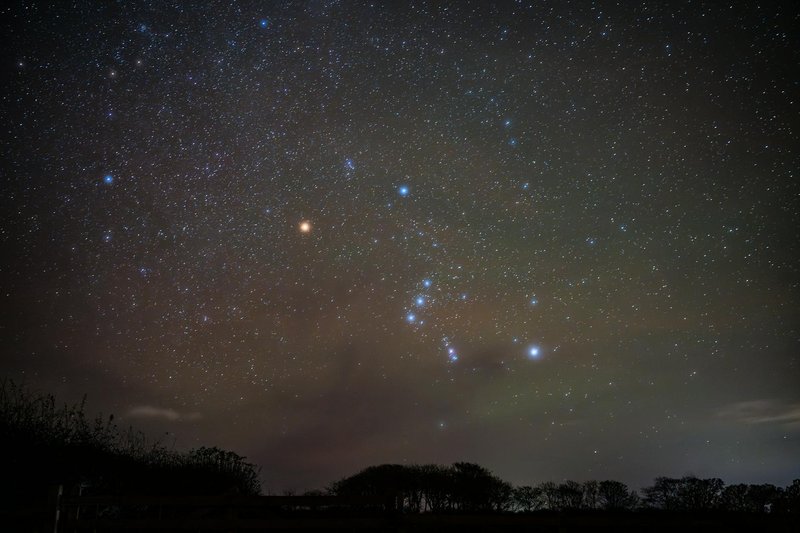
The boldest category. A constellation name puts a whole figure in the sky behind your kid, not just a point of light. These carry the most mythology and the most presence.
| Name | Pronunciation | Origin | The constellation |
|---|---|---|---|
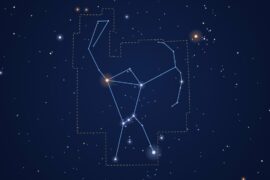
| Orion | oh-RYE-un | Greek | The hunter; the most recognizable winter constellation |
| Leo | LEE-oh | Latin | The lion; a zodiac constellation |
| Draco | DRAY-koh | Latin | The dragon, coiling around the north celestial pole |
| Perseus | PUR-see-us | Greek | The hero who slew Medusa |
| Cepheus | SEE-fee-us | Greek | The king, father of Andromeda |
| Lyra | LYE-rah | Greek | The lyre (usually feminine, used unisex) |
| Corvus | KOR-vus | Latin | The crow |
| Cygnus | SIG-nus | Latin | The swan, flying down the Milky Way |
| Aquila | AK-wih-lah | Latin | The eagle |
| Indus | IN-dus | Latin | A southern constellation, “the Indian” |
| Crux | KRUKS | Latin | The Southern Cross |
| Pyxis | PIK-sis | Latin/Greek | The mariner’s compass |
Orion is the king here, and for good reason: instant recognition, a strong sound, and nicknames in Rio and Ry. Leo is the soft entry point. It’s already a popular boy’s name on its own, so it reads as completely normal while still being a constellation and a zodiac sign. Maximum stealth.
Draco swings the other way. Thanks to a certain blond Slytherin, it now reads as a clear reference, which is either exactly what you want or exactly what you’re avoiding. Perseus is the underused gem: a full Greek hero, a real constellation, and it gives you Percy, which is having a moment. A few of these figures, like Lyra, lean feminine, so if you’re naming a daughter it’s worth browsing the constellation names for girls instead, where the same mythology gets sorted for the other side.
Planet, moon, and sky names
Not stars in the strict sense, but the same celestial neighborhood. These pull from planets, moons, and the sky itself.
| Name | Pronunciation | Origin | Meaning |
|---|---|---|---|
| Caelum | SYE-lum | Latin | Sky, heaven (also a small southern constellation) |
| Cosmo | KOZ-moh | Greek | Order, the universe |
| Jupiter | JOO-pih-ter | Latin | The largest planet; king of the Roman gods |
| Mars | MARZ | Latin | The red planet; god of war |
| Neptune | NEP-toon | Latin | The ice-giant planet; god of the sea |
| Titan | TYE-tun | Greek | Saturn’s largest moon |
| Triton | TRY-tun | Greek | Neptune’s largest moon |
| Phobos | FOH-bos | Greek | One of Mars’s two moons; “fear” |
| Ganymede | GAN-ih-meed | Greek | Jupiter’s largest moon, biggest moon in the solar system |
| Apollo | uh-POL-oh | Greek | God of the sun (and the moon program) |
| Helios | HEE-lee-os | Greek | The sun personified |
| Sol | SOHL | Latin | The Sun |
| Aster | AS-ter | Greek | Star (root of “asteroid” and “astronomy”) |
Cosmo is the most overtly “space kid” name on the whole list. Worth it if you love it, but it announces itself. Titan and Triton are the sleepers: real moons, strong sounds, and neither screams “named after the solar system” the way Cosmo does. If the moon angle is what draws you, there are plenty more where those came from in our full list of moon names for boys, each with the same origin-and-pronunciation breakdown. Aster is the quiet one, the Greek root behind every astronomy word, soft and modern.
Subtle star names nobody will question

For parents who want the celestial meaning without the celestial billboard. Every name here reads as a normal, wearable boy’s name first. The space connection is yours to know.
| Name | Pronunciation | Origin | The connection |
|---|---|---|---|
| Hugo | HYOO-goh | Germanic | Honors astronomer Hugo Gernsback / sci-fi’s Hugo Awards; sounds entirely normal |
| Felix | FEE-liks | Latin | “Lucky”; shares roots with the bright vibe of many star names |
| Atlas | AT-lass | Greek | A Pleiades star and a Titan; reads as a strong modern name |
| Leo | LEE-oh | Latin | A zodiac constellation hiding in plain sight |
| Hesper | HES-per | Greek | The evening star (Venus); rare and wearable |
| Nash | NASH | Arabic | Gamma Sagittarii, a real star; reads as a cool surname-name |
| Elio | EL-ee-oh | Italian | From Helios, the sun; soft and current |
| Ray | RAY | English | A ray of light; the most low-key celestial name there is |
| Dov | DOHV | Hebrew | Not celestial by meaning, but pairs cleanly with star middle names |
| Knox | NOKS | Scottish | Surname-name that anchors a bolder celestial middle name |
Nash is the trick play. It’s the proper name of Gamma Sagittarii, a real star, yet it reads as a tough, modern surname-name with zero space baggage. Hesper is for the parent who wants something nobody else has: it’s the Greek word for the evening star, soft on the ear, and almost completely unused.
Names with great nicknames
A long celestial name needs a short everyday one. Here’s what the standouts give you.
- Orion → Rio, Ry
- Perseus → Percy
- Apollo → Pol, Apo
- Ganymede → Gany, Gan
- Jupiter → Jude, Pit
- Antares → Ari, Tar
- Sirius → Si, Ry
- Sterling → Ster, Lee
- Cassius (a nod to Cassiopeia) → Cass, Cash
- Augustine (Augusta, autumn sky season) → Gus, Augie
If a name has no natural short form and that bothers you, it’ll bother you for eighteen years. Test the nickname out loud before you commit.
The teasing test
The question forum parents ask most, and the one the big lists skip. Here’s the honest read, sorted by how much attention each name draws on a playground.
Flies completely under the radar. Leo, Hugo, Felix, Ray, Nash, Knox, Elio, Atlas. No kid will ever know these are space names unless you tell them. Pick from here if “would this get teased” keeps you up at night.
Strong but safe. Orion, Rigel, Sirius, Atlas, Sterling, Cassius. Distinctive enough to be memorable, grounded enough that they read as confident, not costume-y. This is the sweet spot for most parents.
Bold, knows it. Cosmo, Draco, Jupiter, Apollo, Mars. Big names with big energy. They can absolutely work, especially on a kid with the personality to carry them, but they don’t blend in. That’s the trade.
Pronunciation roulette. Caelum, Ganymede, Antares, Cepheus, Phact. Beautiful on paper. Expect to correct people for life. Worth it if you love the name enough to play teacher every September.
There’s no wrong tier. A name that draws attention isn’t a liability if your kid grows up owning it, and plenty do. The point is to choose the tier on purpose instead of finding out at kindergarten drop-off.
Pick the bucket that matches the kid you imagine, then pick the name that sounds right out loud. The sky has more than enough to go around.