
Most “space names for boys” lists bury a dozen real options inside a mixed-gender pile, hand you “Orion” and “Leo,” and call it a day. This isn’t that. Below are 110 boy names pulled from stars, constellations, planets, moons, dead astronomers, and a few cosmic myths most lists skip. Every name gets a meaning, an origin, and a pronunciation. The featured ones also get a 2026 popularity read and a quick note on whether it’s wearable or just a cool idea you’ll talk yourself out of at the hospital.
A few names show up on the U.S. Social Security Administration list and a few don’t show up at all, and that gap matters. A name ranked in the SSA top 1,000 is one teachers will spell on the first try. A name that’s nowhere on it is yours to define, with the trade-off that he’ll spell it out for the rest of his life. I’ll flag which is which.
Table of Contents
- Star Names for Boys
- Constellation Names for Boys
- Planet & Moon Names for Boys
- Astronomer-Inspired Names
- Mythological Cosmic Names
- Hidden Gem & Rare Names
- Sibling & Twin Pairings
- FAQ
TLDR: The Standouts {#tldr}
If you want the shortlist and not the full menu, here’s where the strongest options cluster.
| Name | Style | 2026 read |
|---|---|---|
| Leo | Star/constellation, mainstream | Top 30, rising — the safe celestial pick |
| Orion | Constellation, bold | Top 350, climbing fast |
| Atlas | Star/myth, trendy | Top 130, one of the fastest risers |
| Cyrus | Star-adjacent, classic-cool | Top 500, steady |
| Castor | Star, rare with a built-in twin | Off the top 1,000 — wide open |
| Rigel | Star, hidden gem | Off the chart — pure cosmic flex |
Star Names for Boys {#star-names}

Stars give you the deepest well of boy names because so many bright ones carry Arabic names from medieval star catalogs. That’s why this section leans heavy on Arabic origins — those names traveled from Baghdad astronomers into Latin star charts and stuck. If you want to go even deeper into this vein, star names for boys sorted by wearability covers the full landscape with pairing ideas the big listicles skip.
1. Sirius (SEER-ee-us) — Greek, “scorching” or “glowing.” The brightest star in the night sky, in Canis Major. Carries Harry Potter weight, which cuts both ways: instantly recognizable, possibly too recognizable. Off the SSA top 1,000, so it reads as a deliberate choice. Nickname: Si.
2. Rigel (RYE-jel) — Arabic, “foot,” from rijl al-jabbar, the giant’s foot in Orion. A blue supergiant and one of the most luminous stars you can see. Cool, clipped, genuinely rare. Not on the chart. This is the hidden gem of the whole list.
3. Vega (VAY-ga) — Arabic, “the swooping eagle.” A brilliant blue-white star in Lyra and the fifth-brightest in the sky. Reads slightly feminine to some American ears, but it ranks for boys in Spanish-speaking countries. Off the top 1,000 in the U.S.
4. Altair (al-TAIR) — Arabic, “the flying eagle.” The brightest star in Aquila. Strong, unusual, easy enough to say once you’ve heard it. Off the chart.
5. Castor (KASS-tur) — Greek, “beaver” or from the mythological twin. The brighter twin star in Gemini, paired forever with Pollux. Built-in sibling name if you’re planning twins. Not on the top 1,000.
6. Pollux (POL-uks) — Greek/Latin, the immortal twin. The other Gemini star, slightly brighter than Castor in reality. Edgier than its twin. Off the chart.
7. Mizar (MY-zar) — Arabic, “waistband” or “girdle.” The middle star in the Big Dipper’s handle, famous for its faint companion Alcor — a classic eyesight test. Off the chart. See the sibling section for why this one’s special.
8. Hadar (hah-DAR or HAY-dar) — Arabic, “ground” or “settled.” The traditional name for Beta Centauri, a blue giant. Doubles as a Hebrew name meaning “splendor.” Off the chart.
9. Caph (kaf) — Arabic, “palm of the hand.” A star in Cassiopeia. Short and strange in a good way. Not ranked.
10. Phact (fakt) — Arabic, “ring dove.” The brightest star in Columba. Unusual enough to raise eyebrows; handle with care.
11. Cyrus (SY-rus) — Persian, “sun” or “throne.” Not a star name in the strict sense, but rooted in the Persian word for the sun and carried by a famous king. Ranks in the SSA top 500 and feels classic-cool. Nickname: Cy.
12. Talitha — usually feminine, skip for a boy.
13. Sol (sohl) — Latin, “sun.” The proper name of our own star. Three letters, warm, used widely across Latin cultures. Off the U.S. top 1,000 for boys but very wearable.
14. Algol (AL-gol) — Arabic, “the ghoul,” the demon star in Perseus that famously dims every few days. Genuinely metal. Maybe too much, depending on your tolerance for “the demon star.”
15. Antares (an-TAIR-eez) — Greek, “rival of Mars,” for its red color. The heart of Scorpius. Big, dramatic, a lot of name. Off the chart.
16. Deneb (DEN-eb) — Arabic, “tail,” the tail of Cygnus the swan. One of the most distant bright stars visible. Soft and short. Not ranked.
17. Spica (SPEE-ka) — Latin, “ear of grain.” The brightest star in Virgo. Leans feminine in the U.S.; works better as a middle name for a boy.
18. Aldebaran (al-DEB-a-ran) — Arabic, “the follower.” The red eye of Taurus. Beautiful but a mouthful — better as a name you nickname down to “Alde” or “Ari.”
19. Bellatrix — feminine in usage, skip.
20. Procyon (PRO-see-on) — Greek, “before the dog,” because it rises just before Sirius. The brightest star in Canis Minor. Quirky and erudite. Not ranked.
Constellation Names for Boys {#constellation-names}
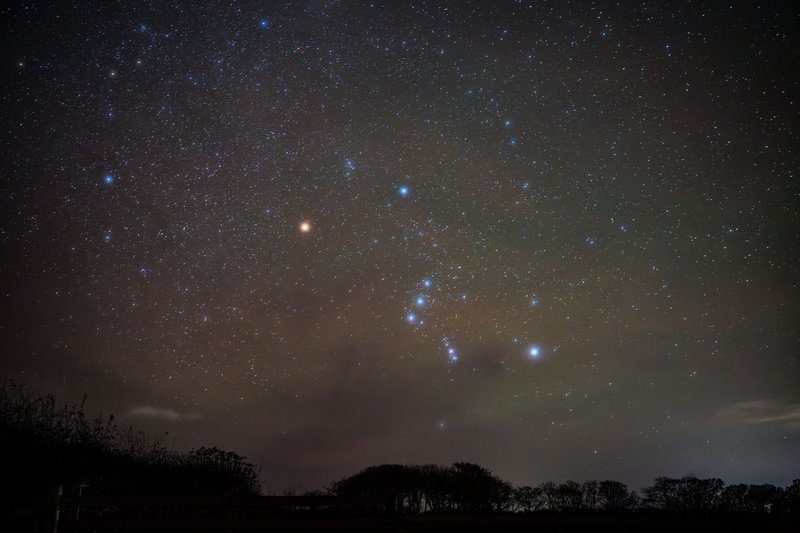
Constellations skew mythological, which means most of them come pre-loaded with a story. That’s a feature — a name with a myth attached is a name with a built-in answer to “where’d you get that?”
21. Orion (oh-RYE-on) — Greek, the great hunter. The most recognizable constellation in the winter sky. Ranks in the SSA top 350 and climbing fast — the one celestial name that’s both bold and broadly accepted. Nickname: Ri or Rio.
22. Leo (LEE-oh) — Latin, “lion.” Both a zodiac constellation and a hugely popular name, sitting in the top 30 and rising. The lowest-risk way to put a constellation on a birth certificate.
23. Perseus (PUR-see-us) — Greek, the hero who slew Medusa. A northern constellation. Heroic and substantial; nickname Percy softens it.
24. Draco (DRAY-ko) — Latin, “dragon.” A constellation winding around the north pole. Harry Potter baggage again, but it’s a real, ancient name. Off the top 1,000.
25. Cygnus (SIG-nus) — Latin, “swan.” A summer constellation also called the Northern Cross. Elegant and rare.
26. Lyra — feminine in usage, skip for a boy.
27. Corvus (KOR-vus) — Latin, “crow” or “raven.” A small southern constellation. Dark and handsome in a literal sense.
28. Aquila (AK-wil-a or a-KEE-la) — Latin, “eagle.” A constellation on the celestial equator. Strong meaning, soft sound.
29. Pavo (PAH-vo) — Latin, “peacock.” A southern constellation. Short, punchy, genuinely uncommon.
30. Indus (IN-dus) — Latin, “Indian,” a southern constellation, also the great river. Off the chart.
31. Lynx (links) — A faint northern constellation named for the animal. One syllable, all edge.
32. Crux (kruks) — Latin, “cross,” the Southern Cross. Minimal and modern.
33. Carina — feminine in usage, skip.
34. Cepheus (SEE-fee-us or SEF-ee-us) — Greek, the mythological king and a northern constellation. Father of Andromeda. Stately and rare.
35. Phoenix (FEE-niks) — Greek, the firebird, and a southern constellation. Ranks in the SSA top 250 — the rebirth symbolism does heavy lifting. Already mainstream.
36. Hercules (HUR-kyoo-leez) — Latin/Greek, the strongman hero and a large constellation. Big name, literally. Nickname: Herc or Cole.
37. Auriga (aw-RY-ga) — Latin, “the charioteer.” A bright winter constellation. Unusual and worth a second look.
38. Pyxis (PIK-sis) — Latin, “compass” or “box.” A small southern constellation. Sharp and short.
39. Caelum (SEE-lum or KY-lum) — Latin, “the chisel” but literally “sky” or “heaven.” A faint constellation whose root word means sky. Wearable and meaningful.
40. Norma — reads feminine, skip.
Planet & Moon Names for Boys {#planet-moon-names}
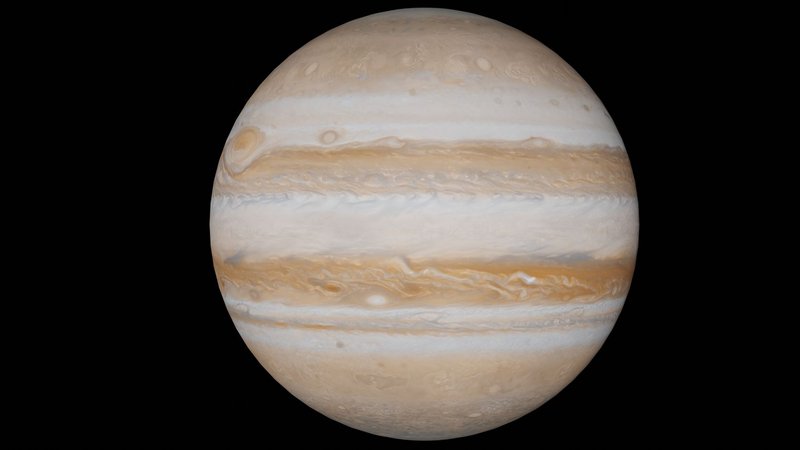
Planet and moon names are where Roman and Greek mythology fully take over, because that’s what we named the solar system after. The moons of Jupiter and Saturn are an underused goldmine here — and if you’re drawn to that vein, the complete list of moon names for boys goes well beyond the solar system’s most famous satellites.
41. Atlas (AT-las) — Greek, the Titan who holds up the sky, and a moon of Saturn. Sits in the SSA top 130 and is one of the fastest-rising boy names in America. The breakout celestial name of the decade.
42. Mars (marz) — Roman god of war and the red planet. One syllable, all impact. Off the U.S. top 1,000 as a first name but increasingly used.
43. Jupiter (JOO-pi-ter) — Roman king of the gods, the largest planet. A big swing. Nickname: Jupe or Jove.
44. Neptune (NEP-toon) — Roman god of the sea, the eighth planet. Cool and watery. Rare as a name.
45. Titan (TY-tan) — Greek, the elder gods, and Saturn’s largest moon — the only moon in the solar system with a thick atmosphere. Already used as a strength name; the moon connection is a bonus. Off the top 1,000.
46. Triton (TRY-ton) — Greek, son of Poseidon, and Neptune’s largest moon, which orbits backward. Strong and aquatic.
47. Castor — see star section; also a moon-adjacent twin name.
48. Phobos (FOH-bos) — Greek, “fear,” a moon of Mars. Intense. Better as a deep-cut middle name.
49. Deimos (DY-mos) — Greek, “dread,” the other Martian moon. Same energy as Phobos. For the bold only.
50. Io (EYE-oh) — Greek, a moon of Jupiter, the most volcanic body in the solar system. Two letters. Reads androgynous; works as a striking middle name.
51. Ganymede (GAN-i-meed) — Greek, the cupbearer to the gods, Jupiter’s largest moon and the biggest moon in the solar system. Ornate but real. Nickname: Gan.
52. Caliban (KAL-i-ban) — A moon of Uranus, by way of Shakespeare’s Tempest. Literary and cosmic at once.
53. Janus (JAY-nus) — Roman god of doorways, and a moon of Saturn that shares an orbit with Epimetheus. Clean and short.
54. Hyperion (hy-PEER-ee-on) — Greek, a Titan of light, and a chaotically tumbling moon of Saturn. Grand. Nickname: Perry.
55. Pluto (PLOO-toh) — Roman god of the underworld, the famous dwarf planet. The Disney association is real; weigh accordingly.
56. Charon (KAIR-on or SHAIR-on) — Greek, the ferryman of the dead, and Pluto’s largest moon. Moody and distinctive.
57. Oberon (OH-be-ron) — A moon of Uranus, again via Shakespeare, the fairy king. The most wearable of the Uranian moons. Nickname: Obie.
58. Rhea — usually feminine, skip for a boy.
59. Castor — listed once; don’t double-count.
60. Nereus (NEER-ee-us) — Greek, the old man of the sea, tied to Neptune’s lore. Soft and unusual.
Astronomer-Inspired Names {#astronomer-names}

This is the section the big listicles skip, and it’s the richest for parents who want a name with a person behind it, not just a celestial object. These are the people who figured out the sky.
61. Galileo (gal-i-LAY-oh) — Italian. Galileo Galilei pointed the first good telescope at Jupiter and found its four big moons. A statement name. Nickname: Leo or Gal.
62. Newton (NOO-ton) — English surname meaning “new town.” For Isaac Newton, who explained why the planets stay in their orbits. Reads preppy and modern. Off the top 1,000 but very usable. Nickname: Newt.
63. Edwin (ED-win) — Old English, “rich friend.” For Edwin Hubble, who proved other galaxies exist and that the universe is expanding. A grandpa-cool classic back in the SSA top 350. Nickname: Ed or Win.
64. Carl (karl) — German, “free man.” For Carl Sagan, who made the cosmos feel like home for a generation. A vintage name due for a comeback.
65. Neil (neel) — Irish/Gaelic, “champion.” For Neil Armstrong and Neil deGrasse Tyson — two ways to honor the sky. Solid and unfussy.
66. Copernicus (ko-PUR-ni-kus) — Latinized Polish. For Nicolaus Copernicus, who moved the sun to the center. Enormous as a name; lives best as a middle name or the source of nickname Copper.
67. Kepler (KEP-ler) — German surname. For Johannes Kepler, who worked out that orbits are ellipses. Crisp, modern, surname-style. Off the chart but rising in spirit.
68. Tycho (TY-ko) — Danish, from Greek “hitting the mark.” For Tycho Brahe, the naked-eye observer with the famous metal nose. Distinctive and short.
69. Halley (HAL-ee) — English surname. For Edmond Halley and his comet, which swings back every 76 years. Works for a boy, though it reads unisex.
70. Percival (PUR-si-val) — French/Welsh, “pierce the valley.” For Percival Lowell, who built an observatory and predicted Planet X. Knightly. Nickname: Percy.
71. Clyde (klyde) — Scottish, from the river. For Clyde Tombaugh, who actually found Pluto in 1930 as a young farm-kid astronomer. Hip vintage name. Already climbing back.
72. Brahe (BRAH or BRAH-eh) — Danish surname, Tycho’s family name. An obscure but striking middle name.
73. Sagan (SAY-gan or SAH-gan) — Surname honoring Carl Sagan. Increasingly used as a first name. Nods to “Sagan-Saga.” Off the chart but trending up.
74. Cassini (ka-SEE-nee) — Italian surname. For Giovanni Cassini, who found gaps in Saturn’s rings and four of its moons. Romantic and rare.
75. Herschel (HUR-shel) — German/Yiddish, “deer.” For William Herschel, who discovered Uranus. Vintage and warm. Nickname: Herc or Schel.
76. Aristarchus (a-ris-TAR-kus) — Greek. For the ancient Greek who proposed a sun-centered cosmos 1,800 years before Copernicus. A deep cut. Nickname: Ari.
77. Bruno (BROO-no) — Italian/German, “brown.” For Giordano Bruno, who imagined infinite worlds. Already a charming, usable name in the SSA top 1,000.
78. Lemaître (luh-MET-ruh) — French surname. For Georges Lemaître, the priest-physicist who first proposed the Big Bang. Elegant as a middle name.
79. Drake (drayk) — English, “dragon.” For Frank Drake of the famous equation estimating alien civilizations. A sharp, mainstream name with a hidden astronomy hook. In the SSA top 500.
80. Percy — see Percival; counts as the nickname, not a separate entry.
Mythological Cosmic Names {#mythological-names}

These names come from the sky myths themselves — gods of the heavens, the dawn, the sun, and the stars across several cultures. They carry the cosmic theme without being attached to a specific star you have to point out.
81. Castor & 82. Pollux — already covered as stars, but worth remembering they’re the mythic Gemini twins first.
83. Helios (HEE-lee-os) — Greek, the sun god who drove the sun across the sky. Radiant and grand. Nickname: Leo.
84. Apollo (a-POL-oh) — Greek/Roman god of the sun, light, and music. In the SSA top 350 and rising. The most usable of the sun gods.
85. Ra (rah) — Egyptian sun god. Two letters, immense weight. Striking as a middle name.
86. Aten (AH-ten) — Egyptian, the sun disk. Soft and unusual.
87. Sol — Roman/Norse sun; see star section.
88. Lugh (loo) — Irish, a god associated with the sun and light. Short, Celtic, distinctive.
89. Indra (IN-dra) — Sanskrit, the Vedic king of the heavens and storms. Strong cross-cultural option.
90. Surya (SOOR-ya) — Sanskrit, the sun god. Warm and widely used in India.
91. Tiwaz / Tyr (teer) — Norse, a sky god; the root of “Tuesday.” Spare and ancient.
92. Mani (MAH-nee) — Norse, the personification of the moon, brother to the sun. Gentle and rare.
93. Castor — don’t recount.
94. Atlas — see planet section; the Titan first.
95. Cronus (KROH-nus) — Greek, the Titan of time, father of the gods. Heavy and dark. Nickname: Cole.
96. Aether (EE-ther) — Greek, the primordial god of the upper sky and the bright air the gods breathed. The literal personification of the heavens.
97. Eos (EE-os) — Greek dawn; reads feminine, better as a middle name for a boy.
98. Caelus (SY-lus or SEE-lus) — Roman, the primal god of the sky, equivalent to Greek Uranus. Wearable and meaningful.
99. Boreas (BOR-ee-as) — Greek, the north wind, tied to the northern sky. Cool and crisp.
100. Horus (HOR-us) — Egyptian sky god with the sun and moon for eyes. Bold and ancient.
Hidden Gem & Rare Names {#hidden-gem-names}
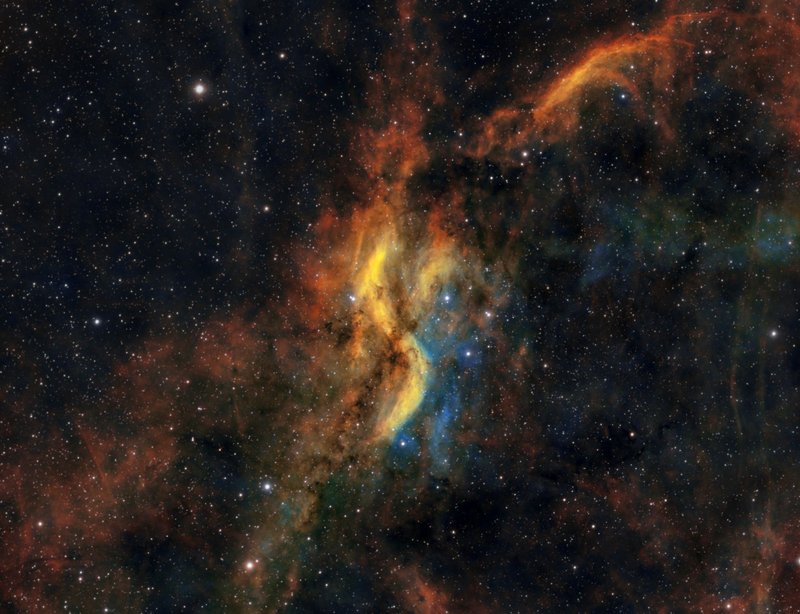
These are the deep cuts — names pulled from fainter stars, asteroids, space missions, and cosmic phenomena. None of them rank on the SSA list, which is exactly the point. Pick one of these and your son will likely be the only one in his school, maybe his city.
101. Nash (nash) — The traditional name of a star in Sagittarius, also a sleek English surname. Mainstream-sounding with a secret celestial source. The most wearable hidden gem here.
102. Kuiper (KY-per) — Dutch surname, for the Kuiper Belt of icy bodies past Neptune. Surname-style and unusual. Nickname: Ky.
103. Comet (KOM-it) — English, the icy visitor with a tail. A nature-name swing, like Bear or Wolf but cosmic.
104. Cosmo (KOZ-mo) — Greek, “order” or “universe.” The most usable “space word” name, charming and retro. Off the U.S. top 1,000 but climbing.
105. Nova (NOH-va) — Latin, “new,” an exploding star. Trending heavily for girls, but it started as a boy’s name and still works as one. Decide based on your region.
106. Quasar (KWAY-zar) — A blazing galactic core powered by a black hole. Futuristic and rare. Nickname: Quay.
107. Zenith (ZEN-ith) — Arabic origin, the point directly overhead in the sky. An aspirational word-name. Nickname: Zen.
108. Apex (AY-peks) — Latin, “peak”; in astronomy, the point the sun moves toward through the galaxy. Modern and sharp.
109. Caelan (KAY-lan) — Gaelic/Latin-blend, “slender” but echoing caelum, “sky.” A soft, modern name with a celestial undertone that no one will question.
110. Astro (AS-tro) — Greek root astron, “star,” the building block of the word astronomy itself. The most on-the-nose name on the list, and weirdly it works — playful, short, unmistakable.
Sibling & Twin Pairings {#sibling-pairings}
The sky gives you ready-made sets, which the listicles almost never mention. A few that actually have a relationship in the heavens, not just a vibe:
- Castor & Pollux — the literal Gemini twins, two stars and two mythic brothers. The cleanest twin-boy pairing in the entire night sky.
- Mizar & Alcor — two stars so close together that spotting Alcor was an ancient eyesight test. Perfect if you want a “they go together” story without two heavyweight names.
- Phobos & Deimos — the two moons of Mars, “fear” and “dread.” For parents with a sense of humor and a high tolerance for unusual.
- Sol & Luna — sun and moon, if you’re having a boy and a girl. Warm, balanced, instantly understood.
- Atlas & Orion — not related astronomically, but both are strong, on-trend, and won’t fight each other on the playground.
FAQ {#faq}
What are good astronomy names for boys? The most usable astronomy boy names that also rank on the 2026 SSA list are Leo, Orion, Atlas, Apollo, and Phoenix. For something rarer, Rigel, Castor, Sirius, and Cosmo deliver the cosmic theme without being on every roll call.
What boy names mean “star”? Several star names literally mean star or describe one: Sirius means “scorching” or “glowing,” Vega and Altair both relate to “eagle” stars, Astro comes from the Greek for “star,” and Sol means “sun” — our own star.
Is Orion a good name for a boy? Yes. Orion sits comfortably in the SSA top 350 and is climbing, so it’s recognizable and easy to spell, while still feeling bold and distinctly celestial. It nicknames neatly to Ri or Rio.
What’s the rarest space name for a boy? From this list, Rigel, Algol, Quasar, and Kuiper are the deepest cuts — none appear in the SSA top 1,000, so your son would almost certainly be the only one with the name in his school.
Are celestial names just for girls? No. Names like Nova, Luna, and Vega trend feminine in the U.S. right now, but the night sky is full of strongly masculine options — Orion, Atlas, Titan, Mars, and most star names of Arabic origin (Rigel, Altair, Deneb) read clearly as boy names.
Why do so many star names sound Arabic? Because medieval Arab astronomers catalogued and named most of the bright stars during a golden age of astronomy, and those names — Rigel, Altair, Vega, Deneb, Aldebaran — passed straight into the European star charts we still use today.
Enjoyed this article?
Get daily 10-minute PDFs about astronomy to read before bed!
Sign up for our upcoming micro-learning service where you will learn something new about space and beyond every day while winding down.