Updated October 2026 by Elena Stone
The right space book for a child depends on age more than on topic. Babies and toddlers need one picture and one idea per page. Kids from 3 to 5 learn through stories. From 6 to 8 they are ready for real numbers and NASA photographs. From 9 to 12 they can take a star guide outside. Teenagers can read the real history and physics.
This list has 28 books sorted into five age groups, with the book finder below to narrow it down by age, topic and type of book.
Little Astronomy earns a commission from qualifying Amazon purchases made through the links on this page, at no extra cost to you.
Quick picks: the best space book for each age
| Age | Book | Why |
|---|---|---|
| Ages 0-2 | Hello, World! Solar System | One short line per page covers the Sun, each planet, the Moon and the stars, which is as much as a toddler can take in. |
| Ages 3-5 | When Moon Became the Moon | It explains how the Moon formed and why it has phases, told by the Moon itself, and School Library Journal gave it a starred review. |
| Ages 6-8 | A Hundred Billion Trillion Stars | It explains the size of the universe with numbers a child can compare to ants, sand and people. |
| Ages 9-12 | Ultimate Explorer Field Guide: Night Sky | It is pocket-size and built to be used outside, with star charts a kid can read by red flashlight. |
| Ages 13+ | Almost Astronauts | It won the 2010 Sibert Medal and shows how NASA chose its first astronauts and why women were shut out. |
| Best gift | Planetarium | Astrophysicist Raman Prinja wrote the text and it is a large illustrated hardcover, which makes it the gift pick for a 9 to 12 year old. |
Find a space book by age and interest
Pick an age to see the books that fit it and a top 3 for that age. Add a topic or a type of book to narrow the list. The link to the filtered list can be copied and sent to a grandparent or teacher.
Top 3 for you
How we chose these books
- Correct science. The books that cover the solar system teach eight planets and treat Pluto as a dwarf planet.
- Outside review. Most titles were reviewed by Kirkus, School Library Journal, Booklist or Publishers Weekly, and several won awards such as the Sibert Medal. The age ranges are the publishers’ own.
- One job per book. Each title covers something the others in its age group do not: the Moon’s phases, a real astronaut’s story, constellations a child can find from the backyard, the engineering of Apollo.
- Current editions. Older titles are linked in their most recent edition, and every link goes to a book sold new on Amazon in October 2026.
Best space books for babies and toddlers (ages 0 to 2)
At this age a book is something to hold, chew and point at. Board books with thick pages, high-contrast pictures and a single word or line per page work best. The goal is vocabulary: Sun, Moon, star, planet, rocket. Touch prompts and tabs keep small hands busy while you read.
-
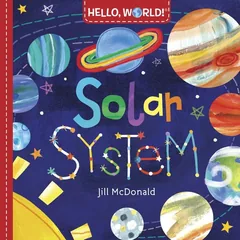

Hello, World! Solar System
- Ages 0-3
- Board book
- Read-aloud
The book introduces the sun, the planets, the moon and the stars with a short line and a bright picture on each page. Extra facts, such as asteroids and comets hitting Mercury, are added as small prompts.
Why it’s here: One short line per page covers the Sun, each planet, the Moon and the stars, which is as much as a toddler can take in.
View on Amazon Read next: When Moon Became the Moon ↓
Explore on Little Astronomy: Name the planets quiz How far away is each planet
-
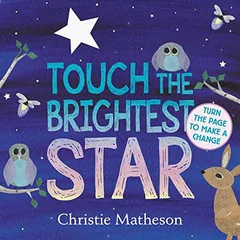
Touch the Brightest Star
- Ages 0-3
- Board book
- Read-aloud
The book follows one night from sunset to sunrise, and each page asks the child to tap, wave or blow to make fireflies, stars, constellations, a full moon and owls appear. Collage pictures are in blues.
Why it’s here: Every page asks the child to tap, wave or blow, so even a one-year-old stays involved from sunset to sunrise.
View on Amazon Read next: Here We Are ↓
Explore on Little Astronomy: How to identify constellations Moon phase on your birthday
-
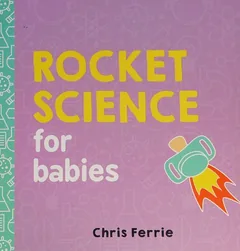

Rocket Science for Babies
- Ages 0-3
- Board book
- Read-aloud
The book explains lift and thrust, the two forces that make a plane or a rocket fly, with one idea and one simple picture per page. It ends with a rocket leaving the ground.
Why it’s here: Written by a physicist, it explains why a rocket flies with one picture per page, a good companion for a toddler who loves rockets more than planets.
View on Amazon Read next: Rocket Says Look Up! ↓
Explore on Little Astronomy: Types of space missions Famous astronauts
-
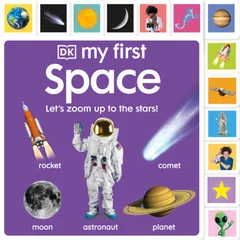
My First Space Let's Zoom Up to the Stars!
- Ages 0-3
- Board book
- Aloud or alone
A tabbed board book with 13 chunky tabs covering planets, the solar system and astronauts, with colorful pictures and counting activities. The publisher says it supports early word learning.
Why it’s here: Chunky tabs give small hands something to grab, and it adds astronauts and rockets to the planets.
View on Amazon Read next: Rocket Says Look Up! ↓
Explore on Little Astronomy: Name the planets quiz Famous astronauts
-
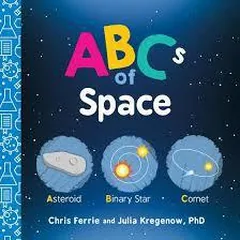
ABCs of Space
- Ages 0-3
- Board book
- Aloud or alone
Each letter of the alphabet introduces one astronomy concept with a simple picture. A second, more detailed line of text on each page is aimed at the adult reader.
Why it’s here: Each letter teaches a real astronomy word, and the second line of text gives parents more to say as the child grows.
View on Amazon Read next: Goodnight, Astronaut ↓
Explore on Little Astronomy: Name the planets quiz
No books in this age group match those filters.
Best space books for preschoolers (ages 3 to 5)
Preschoolers follow a story better than a list of facts. The best books for 3, 4 and 5 year olds put a fact inside a plot: the Moon tells how it was made, an astronaut says goodnight from the space station, a girl gets her family outside for a meteor shower. All of them are meant to be read aloud, and several end with a page of facts for the adult.
-
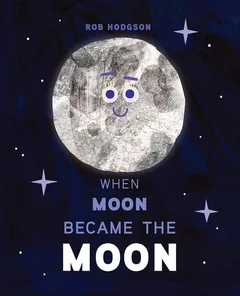

When Moon Became the Moon
- Ages 3-5
- Grades PreK-K
- Picture book
- Aloud or alone
The Moon narrates its own story in eleven short chapters, from its formation to its phases and its slow drift away from Earth. Cartoon panels show each stage, with short facts a preschooler can repeat.
Why it’s here: It explains how the Moon formed and why it has phases, told by the Moon itself, and School Library Journal gave it a starred review.
View on Amazon Read next: Our Solar System ↓
Explore on Little Astronomy: Moon phase on your birthday Space missions to the Moon
-
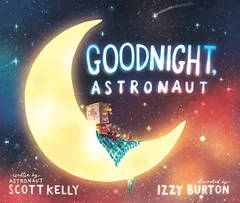

Goodnight, Astronaut
- Ages 3-7
- Grades PreK-2
- Picture book
- Read-aloud
Astronaut Scott Kelly describes places he has slept, including a submarine, a fighter jet cockpit, a yurt on Mount Everest and the International Space Station. Each spread ends with a goodnight line, so it works as a bedtime read.
Why it’s here: Scott Kelly spent nearly a year on the International Space Station, and this is his real story told as a bedtime book.
View on Amazon Read next: You Are the First Kid on Mars ↓
Explore on Little Astronomy: Famous astronauts
-
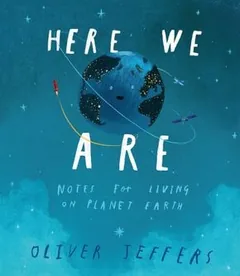

Here We Are Notes for Living on Planet Earth
- Ages 3-7
- Grades PreK-2
- Picture book
- Read-aloud
Written for the author's newborn son, it shows Earth's land, sea and sky, where the planet sits in space and the variety of people on it. Illustrations mix collage, paint and diagrams.
Why it’s here: It shows a young child where Earth sits in space and who lives on it, in under 50 pages of pictures.
View on Amazon Read next: The Sun Is Kind of a Big Deal ↓
Explore on Little Astronomy: Name the planets quiz How far away is each planet
-
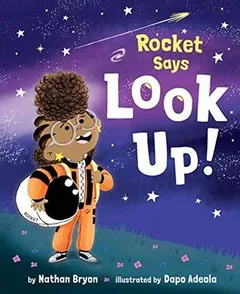

Rocket Says Look Up!
- Ages 3-7
- Grades PreK-2
- Picture book
- Aloud or alone
Rocket, a girl who wants to be an astronaut, gets her neighbours and her phone-absorbed brother outside to watch a meteor shower. Back matter has facts about meteors and about astronaut Mae Jemison.
Why it’s here: The story ends with the family outside watching a meteor shower, which is the easiest next step after reading it.
View on Amazon Read next: Find the Constellations ↓
Explore on Little Astronomy: Famous astronauts How to identify constellations
-
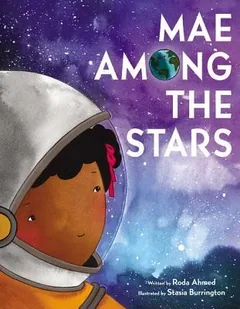

Mae Among the Stars
- Ages 4-8
- Grades PreK-3
- Picture book
- Read-aloud
Young Mae Jemison tells her parents she wants to be an astronaut, and they tell her to believe it, work hard and learn everything she can. When a teacher suggests nursing instead, Mae holds on to the dream, and the last page shows her in space as the first African American woman to fly there.
Why it’s here: It turns Mae Jemison's childhood into a bedtime story, and it pairs with Rocket Says Look Up!, whose hero looks up to the same astronaut.
View on Amazon Read next: A Hundred Billion Trillion Stars ↓
Explore on Little Astronomy: Famous astronauts How to join NASA's astronaut corps
-
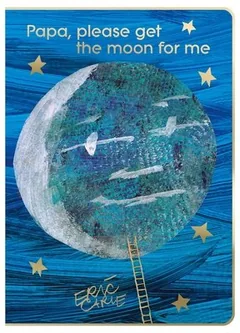

Papa, Please Get the Moon for Me 40th Anniversary Edition
- Ages 2-5
- Grades PreK-K
- Picture book
- Read-aloud
Monica asks her father to fetch the Moon, and fold-out pages show the ladder and the full Moon at life size. The Moon then shrinks to a crescent and disappears, and a thin sliver returns and grows back to full.
Why it’s here: Fold-out pages show the Moon shrinking to nothing and growing back, which teaches the phases to a child too young for a diagram.
View on Amazon Read next: A Hundred Billion Trillion Stars ↓
Explore on Little Astronomy: Moon phase on your birthday
No books in this age group match those filters.
Best space books for 6, 7 and 8 year olds
Between 6 and 8 most children start reading on their own and ask “how big?” and “how far?”. This group mixes picture books that explain scale with the first photo books built on NASA spacecraft images. Find the Constellations is the first book on the list meant to be used outside at night.
-
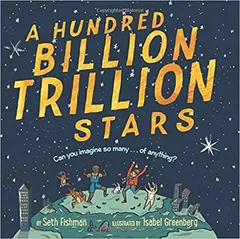

A Hundred Billion Trillion Stars
- Ages 4-8
- Grades PreK-3
- Picture book
- Aloud or alone
The book compares very large numbers, starting with the estimated number of stars in the universe and moving to grains of sand, ants and gallons of water on Earth. Each number is paired with a visual comparison.
Why it’s here: It explains the size of the universe with numbers a child can compare to ants, sand and people.
View on Amazon Read next: See You in the Cosmos ↓
Explore on Little Astronomy: Name the planets quiz How far away is each planet
-
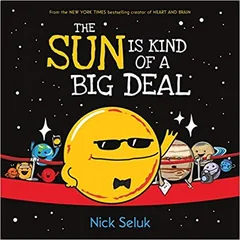
The Sun Is Kind of a Big Deal
- Ages 4-8
- Grades PreK-3
- Picture book
- Read-aloud
The Sun narrates how its light and gravity shape Earth: day and night, seasons, the water cycle and photosynthesis. Planets appear as cartoon characters, and bold vocabulary words are defined in a glossary at the back.
Why it’s here: The Sun tells the jokes and the science is accurate, so it works for kids who skip fact books.
View on Amazon Read next: Planetarium ↓
Explore on Little Astronomy: Name the planets quiz Space missions to the Sun
-
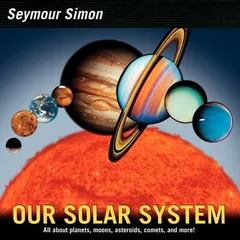
Our Solar System
- Ages 6-10
- Grades 1-5
- Nonfiction
- Aloud or alone
A tour of the Sun, the eight planets and their moons with NASA photographs from Voyager, Magellan, the Mars rovers and Hubble. Includes a planet comparison chart, an author's note, a glossary and an index.
Why it’s here: Seymour Simon built it on NASA spacecraft photographs, and the 2014 revision has current planet facts.
View on Amazon Read next: Eyewitness Universe ↓
Explore on Little Astronomy: How far away is each planet Name the planets quiz Mars 3D map
-
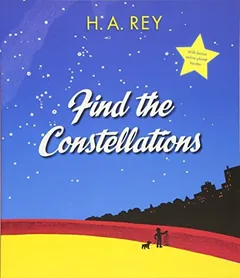

Find the Constellations
- Ages 6-9
- Grades 1-4
- Nonfiction
- Aloud or alone
It shows how to find each constellation using line drawings of the star patterns, with seasonal sky maps and an index. The later pages cover light-years, the seasons and the planets of the solar system.
Why it’s here: H. A. Rey's stick-figure star patterns are still the easiest way for a child to find real constellations outside.
View on Amazon Read next: Ultimate Explorer Field Guide: Night Sky ↓
Explore on Little Astronomy: How to identify constellations Name the planets quiz
-
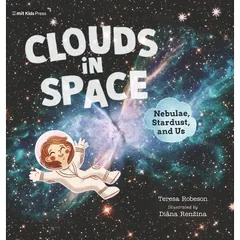
Clouds in Space Nebulae, Stardust, and Us
- Ages 7-9
- Grades 1-3
- Picture book
- Aloud or alone
Compares nebulae to clouds on Earth and explains how supernova remnants and star nurseries produce new stars and planets. Digital art incorporates real nebula photographs, and the back pages list nebula types with photos.
Why it’s here: It explains nebulae and where the elements in our bodies came from, a topic few picture books cover.
View on Amazon Read next: Astrophysics for Young People in a Hurry ↓
Explore on Little Astronomy: How to identify constellations Name the planets quiz
-

You Are the First Kid on Mars
- Ages 5-8
- Grades K-3
- Picture book
- Aloud or alone
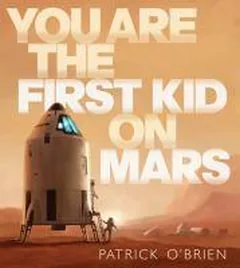
Second-person trip from Earth via a space elevator and orbital station to a Mars base, then outings to Olympus Mons, Valles Marineris and the Sojourner rover. 42 digital paintings show proposed habitats and vehicles, and the trip ends with a return home six months later.
Why it’s here: It walks through a whole crewed trip to Mars, from launch to the base to the trip home, with realistic paintings.
View on Amazon Read next: See You in the Cosmos ↓
Explore on Little Astronomy: Mars 3D map How far away is each planet
No books in this age group match those filters.
Best space books for 9, 10, 11 and 12 year olds
This is the age when a space interest turns into a hobby. Kids from 9 to 12 can handle a full reference book, read a star chart with a red flashlight and follow a 300-page novel. The list covers all three, plus the young readers’ edition of Hidden Figures. For a child this age who wants to see the planets for real, the telescope finder recommends a first telescope.
-

Planetarium Welcome to the Museum
- Ages 8-12
- Grades 3-7
- Reference
- Aloud or alone
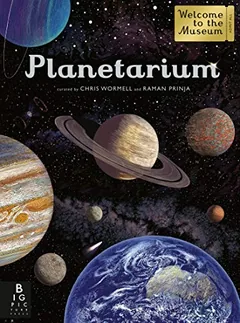
Laid out as a museum with galleries on how people observe the sky, the solar system, stars, galaxies and the universe. Each spread pairs a woodblock-style illustration by Chris Wormell with short text by astrophysicist Raman Prinja, plus fold-out pages and a gallery of constellations.
Why it’s here: Astrophysicist Raman Prinja wrote the text and it is a large illustrated hardcover, which makes it the gift pick for a 9 to 12 year old.
View on Amazon Read next: Big Bangs and Black Holes ↓
Explore on Little Astronomy: How far away is each planet Identify constellations
-

Ultimate Explorer Field Guide: Night Sky Find Adventure! Go Outside! Have Fun! Be a Backyard Stargazer!
- Ages 8-12
- Grades 3-7
- Activity
- Reads alone
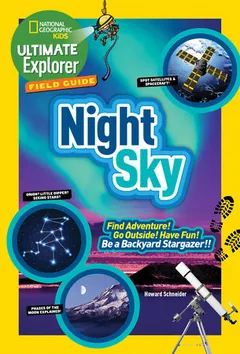
A pocket-size guide to what is visible from a backyard: the moon, planets, meteor showers, the seasonal sky and 41 constellations, with star charts and tips on using binoculars. Includes the zodiac and the myths behind constellation names.
Why it’s here: It is pocket-size and built to be used outside, with star charts a kid can read by red flashlight.
View on Amazon Read next: Turn Left at Orion ↓
Explore on Little Astronomy: Identify constellations Find the best telescope for you Moon phase on my birthday
-

Eyewitness Universe
- Ages 8-12
- Grades 3-7
- Reference
- Aloud or alone
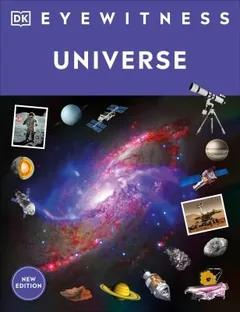
Photograph-led reference covering the Big Bang, the sun, rocky and gas planets, stars, pulsars, black holes and distant galaxies. The 2023 revision adds new photographs, updated statistics and timelines plus first-person accounts from working astronomers.
Why it’s here: The 2023 revision replaces older DK space books that still carry outdated numbers.
View on Amazon Read next: Big Bangs and Black Holes ↓
Explore on Little Astronomy: How far away is each planet Name the planets quiz
-

See You in the Cosmos
- Ages 10-12
- Grades 5-7
- Novel
- Reads alone
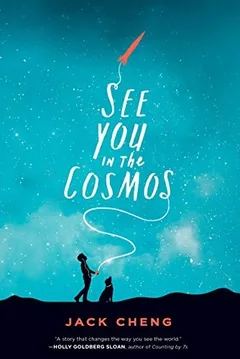
Eleven-year-old Alex Petroski travels from Colorado toward Las Vegas to launch a model rocket carrying a golden iPod, recording messages for aliens like the Voyager Golden Record. On the way he meets adults who change his view of his family, and he finds out where his father is.
Why it’s here: Alex's golden iPod is modeled on the Voyager Golden Record, so the novel leads straight into real space history.
View on Amazon Read next: The Secret Astronomers ↓
Explore on Little Astronomy: Space missions to the Moon Find the best telescope
-

Astrophysics for Young People in a Hurry
- Ages 10-14
- Grades 3-7
- Nonfiction
- Reads alone
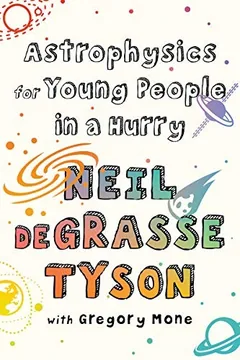
Eleven chapters cover the Big Bang, dark matter and dark energy, the elements, light, why planets are round and how to communicate with aliens. Full-color photos, infographics and extra explanations by Gregory Mone sit beside Tyson's text.
Why it’s here: Neil deGrasse Tyson rewrote his adult bestseller for ages 10 to 14 with Gregory Mone, adding photographs and diagrams.
View on Amazon Read next: Big Bangs and Black Holes ↓
Explore on Little Astronomy: How far away is each planet Name the planets quiz
No books in this age group match those filters.
Best astronomy books for teens (13 and up)
Teenagers are ready for the real history and the real physics. These books cover the women who passed the Mercury astronaut tests in 1960, the engineering of the Saturn V, black holes and dark energy, and a telescope observing guide that adult amateur astronomers still use. One novel is set in the West Virginia town that hosts the Green Bank radio telescope.
-

Almost Astronauts 13 Women Who Dared to Dream
- Ages 10+
- Grades 5-12
- Nonfiction
- Reads alone
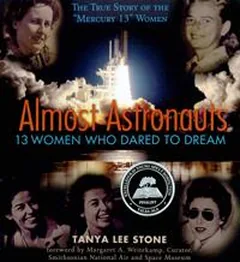
Covers the Mercury 13, women pilots who passed the same physical tests as the Mercury astronauts in 1960 and 1961 and were then denied astronaut jobs. Uses period photographs and interviews to follow Jerrie Cobb and the other women through testing, the 1962 congressional hearings and the program's cancellation.
Why it’s here: It won the 2010 Sibert Medal and shows how NASA chose its first astronauts and why women were shut out.
View on Amazon Read next: How We Got to the Moon ↓
Explore on Little Astronomy: Famous astronauts Missions to the Moon
-
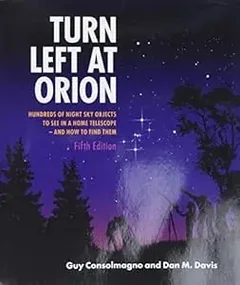

Turn Left at Orion Hundreds of Night Sky Objects to See in a Home Telescope, and How to Find Them
- Ages 13+
- Reference
- Reads alone
Each spread shows how one object (the Moon, planets, double stars, clusters, nebulae, galaxies) looks through a small home telescope, with a finder chart and a drawing of the eyepiece view. The 5th edition updates star names and planet sections and adds links to online tables.
Why it’s here: Its eyepiece drawings show what a small telescope really shows, so a teen with a first telescope knows what to look for.
Explore on Little Astronomy: Find the best telescope Try the telescope view simulator Identify constellations
-
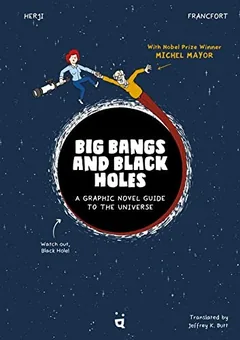

Big Bangs and Black Holes A Graphic Novel Guide to the Universe
- Ages 12+
- Grades 7-12
- Nonfiction
- Reads alone
A graphic-novel lesson in which an astrophysicist and her college-age niece, with Nobel laureate Michel Mayor appearing as himself, cover Galileo, Newton and Einstein, the Big Bang, gravitational waves, black holes, dark matter and dark energy. Panels carry diagrams and the text explains each idea in a few lines.
Why it’s here: It covers black holes, dark matter and the Big Bang at high school level as a 64-page comic.
Explore on Little Astronomy: Types of black holes How cosmic inflation shaped the universe
-
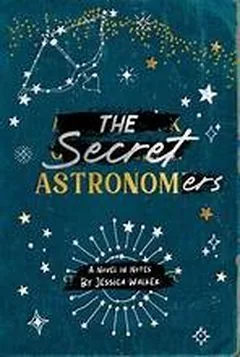

The Secret Astronomers
- Ages 12+
- Grades 7-12
- Novel
- Reads alone
Two high-school seniors in Green Bank, West Virginia, home of a radio observatory, write letters to each other in the margins of an old astronomy textbook and investigate strange events from their town's past. The text and collage art are drawn on the pages of a real historical astronomy textbook.
Why it’s here: It is set in Green Bank, West Virginia, the town built around a radio observatory, for teens who want a story with their astronomy.
Explore on Little Astronomy: Identify constellations Name the planets quiz
-
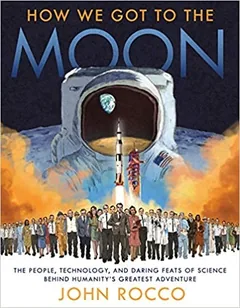

How We Got to the Moon The People, Technology, and Daring Feats of Science Behind Humanity's Greatest Adventure
- Ages 10+
- Grades 5-12
- Nonfiction
- Reads alone
Describes the Saturn V, the Apollo capsule, each onboard instrument and the NASA facilities, from Sputnik through Apollo 11, with cutaway diagrams and repainted period photographs. Profiles the engineers and workers behind the program, including Max Faget, Katherine Johnson and Farouk El-Baz.
Why it’s here: At 264 pages, with cutaway diagrams of the Saturn V and the Apollo capsule, it explains how the Moon landings were engineered and who built them.
Explore on Little Astronomy: Missions to the Moon Moon phase on your birthday Famous astronauts
No books in this age group match those filters.
After the book: space activities on Little Astronomy
- Name the planets is a quiz for kids who have finished a solar system book.
- Moon phase on my birthday shows the Moon on the night your child was born.
- How far away is each planet turns the distances in the books into travel times.
- Mars 3D map lets kids spin Mars and find Olympus Mons and Valles Marineris.
- Telescope simulator shows what the Moon and planets look like through different telescopes before you buy one.
Frequently asked questions
What is a good first space book for a baby or toddler?
Hello, World! Solar System by Jill McDonald. It is a board book for ages 0 to 3 with one bright picture and one short line per page about the Sun, the planets, the Moon and the stars. ABCs of Space by Chris Ferrie works for toddlers who are learning letters.
What are the best space books for a 3, 4 or 5 year old?
When Moon Became the Moon by Rob Hodgson tells how the Moon formed and why it has phases, in the Moon’s own voice. Goodnight, Astronaut by Scott Kelly and Rocket Says Look Up! by Nathan Bryon are both stories that teach a real fact about space along the way.
What are the best space books for 8 year olds?
A Hundred Billion Trillion Stars explains the size of the universe with numbers an 8 year old can compare. Our Solar System by Seymour Simon is a photo tour of the eight planets built on NASA spacecraft images, and Find the Constellations by H. A. Rey teaches kids to find real constellations from the backyard.
What astronomy book should a 10 to 12 year old read?
National Geographic’s Ultimate Explorer Field Guide: Night Sky is a pocket guide to the Moon, planets, meteor showers and 41 constellations, made to be used outside. For reading at home, Astrophysics for Young People in a Hurry by Neil deGrasse Tyson explains the Big Bang, dark matter and black holes for ages 10 to 14.
What are good astronomy books for teens?
Almost Astronauts by Tanya Lee Stone won the Sibert Medal for its history of the Mercury 13 women pilots. How We Got to the Moon by John Rocco covers the engineering of Apollo in 264 pages. Teens with a first telescope should read Turn Left at Orion, which shows what each object looks like through a small telescope.
What age is The Secret Astronomers for?
Kirkus Reviews lists The Secret Astronomers by Jessica Walker as fiction for ages 13 to 18. It is a novel about two high school seniors in Green Bank, West Virginia, the town that hosts the Green Bank radio telescope.
Are older space books still accurate?
Space books printed before 2006 count Pluto as the ninth planet, and many older books list far fewer moons for Jupiter and Saturn than are known today. Check the edition date before buying a used copy. Classics such as Our Solar System and Find the Constellations have revised editions with current facts.
About the author
Elena Stone is a Canadian journalist and researcher with a master’s degree from the University of British Columbia. She started looking at the sky at 8, on a family camping trip, and founded Little Astronomy to bring more people into the hobby.