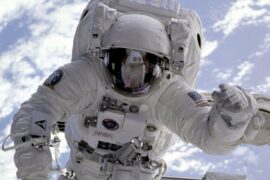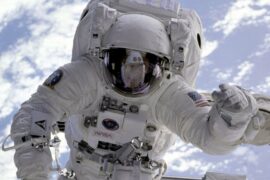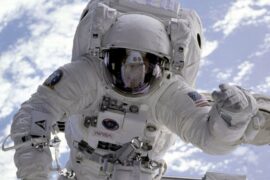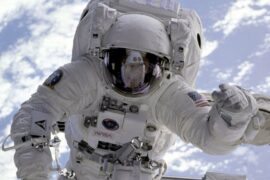
For a state with barely 1.4 million people and zero rocket pads, Maine punches absurdly above its weight in orbit. Two of its natives have flown to the International Space Station. One performed the first all-woman spacewalk in history. The other ran the ISS as commander after a career hunting bad guys as a Navy SEAL. And as of 2026, a kid who grew up watching the stars over Caribou is commanding a SpaceX Dragon back to space.
If you searched “astronauts from Maine,” you almost certainly landed on a single biography and had to go hunting for the rest. Here’s the whole roster in one place, with the missions, the records, and where each of them stands right now.
Contents
Quick facts
Two NASA astronauts were born in Maine. Here’s how they stack up.
| Jessica Meir | Chris Cassidy | |
|---|---|---|
| Hometown | Caribou | York |
| Born | 1977 | 1970 |
| Selected by NASA | 2013 | 2004 |
| Spaceflights | 1 (Expedition 61/62), Crew-12 in 2026 | 2 (STS-127, Expedition 35/36) |
| Days in space | 205 | 182 |
| Spacewalks | 3 | 6 |
| Notable first | First all-woman spacewalk | ISS commander, former Navy SEAL |
| Background | Marine biologist, physiologist | U.S. Navy SEAL |
Two people. Two completely different paths to the same place. That contrast is most of the story.
Jessica Meir
Jessica Meir was born in Caribou, a town in Aroostook County so far north it’s closer to the Canadian border than to Portland. She has said the dark, unpolluted skies over rural Maine — where the stars genuinely shine — were where the obsession started. She decided she wanted to be an astronaut in the first grade. Most kids say that. She actually did it.
The path there was not a straight shot through fighter jets. Meir is a scientist first. She earned a doctorate in marine biology and studied how animals survive in extreme environments — emperor penguins diving under Antarctic ice, bar-headed geese flying over the Himalayas at altitudes where the air barely exists. The throughline is physiology under stress, which turns out to be excellent training for thinking about a human body in vacuum.
NASA selected her in 2013, and she launched to the ISS in September 2019 for Expedition 61/62. Then came the moment that put her in every headline. On October 18, 2019, Meir and Christina Koch stepped outside the station together — the first all-woman spacewalk in the history of human spaceflight. It almost didn’t happen the way it should have: an earlier attempt had been scrapped partly over spacesuit sizing, which made the eventual all-woman EVA land even harder.
Meir logged 205 days in orbit before returning in April 2020 — coming home, in a strange twist, to a planet that had locked itself down for a pandemic while she was away. She’s also in the Artemis astronaut cohort, NASA’s group eligible for crewed missions to the Moon, which keeps her name in the conversation to one day join the short list of astronauts who have flown to the Moon.
Then 2026. Meir is commanding SpaceX Crew-12, her return to the ISS and her first time in the commander’s seat — a notable step up from flight engineer. For a first-grader from Caribou who picked this career before she could do long division, “mission commander” is roughly the top of the mountain.
Chris Cassidy
Chris Cassidy grew up in York, on Maine’s southern coast, and his road to NASA could not look less like Meir’s. Before he was an astronaut, he was a U.S. Navy SEAL — ten years of service, four operational deployments, two to Afghanistan, plus a Bronze Star with combat “V.” This is a man who came to spaceflight already comfortable with environments that try to kill you.
NASA selected Cassidy in 2004. He first flew in 2009 on space shuttle Endeavour (STS-127), a mission to deliver the final components of Japan’s Kibo laboratory to the ISS. He went up again in 2013 for Expedition 35/36, and then a third time — though by then the shuttle was retired, so he rode a Russian Soyuz.
Across his career Cassidy racked up 182 days in space and six spacewalks. On his final mission he served as commander of the International Space Station, the senior leadership role on the orbiting lab — running the show for an entire crew and a national-flagship’s worth of experiments and hardware.
After leaving NASA, Cassidy took over as president and CEO of the National Medal of Honor Museum, which is exactly the kind of second act you’d script for a decorated SEAL turned astronaut. He’s also publicly honored fallen crews; NASA has noted his role marking the legacy of the Challenger astronauts.
Why Maine?
Two astronauts isn’t a coincidence so much as it’s a small sample finding the same ingredients twice.
The honest answer is partly the sky. Aroostook County and the rural stretches of Maine have some of the darkest skies on the U.S. East Coast — no sprawl, no light dome, just stars. Meir credits exactly that for lighting the fuse. You can’t be obsessed with something you’ve never actually seen, and most American kids grow up under a gray, light-polluted ceiling that hides the Milky Way entirely.
The rest is culture. Maine produces a particular kind of person — practical, outdoorsy, comfortable being cold and far from help. That profile shows up in both flavors here: the field scientist who studied animals in Antarctica, and the SEAL who deployed to Afghanistan. Different jobs, same tolerance for hard, remote, unforgiving conditions. NASA happens to love that tolerance.
It’s worth being precise about the count. When people say “astronauts from Maine,” they mean astronauts born in Maine, and that list is Meir and Cassidy. Others have Maine ties through college, family, or residence, but for native-born NASA astronauts, these two are the roster. Two is a respectable haul for a small state — more than you might guess, though still shy of the five astronauts from Ohio, the runaway leader in this particular game.
The Maine astronaut timeline
A quick walk through how the state’s space record actually unfolded:
- 1970 — Chris Cassidy born in York.
- 1977 — Jessica Meir born in Caribou.
- 2004 — Cassidy selected as a NASA astronaut.
- 2009 — Cassidy’s first spaceflight, STS-127 aboard Endeavour, completing the Kibo lab.
- 2013 — Cassidy returns to the ISS for Expedition 35/36. Same year, NASA selects Meir.
- 2019 — Meir launches to the ISS; on October 18 she and Christina Koch perform the first all-woman spacewalk.
- 2020 — Meir returns to Earth after 205 days, landing into a pandemic.
- 2026 — Meir commands SpaceX Crew-12, her first mission as commander.
Both Maine natives were, fittingly, born in the 1970s — Cassidy at the start of the decade and Meir a few years behind. Two people, half a century, one small state at the top-right corner of the map. The next Maine astronaut is almost certainly out there right now, somewhere up north, looking at a sky most of the country never gets to see.
Enjoyed this article?
Get daily 10-minute PDFs about astronomy to read before bed!
Sign up for our upcoming micro-learning service where you will learn something new about space and beyond every day while winding down.