
Russia’s astronomers keep showing up at the exact moment physics turns a corner. The first atmosphere ever found on another planet? A Russian spotted it through a hand-ground lens in 1761. The math that says the universe is expanding? A Russian wrote it down five years before anyone had the telescope to prove it. The idea that black holes power quasars? Also Russia. Yet outside a few specialist circles, most of these names never get said out loud in English.
So here’s the roster that actually matters, grouped by the era that shaped the work, with what each person did and why it still comes up.
Table of Contents
- Imperial Russia: the foundations
- The Soviet era: cosmology, radio, and the Moon
- Post-Soviet and modern: still on the frontier
- The women who mapped the asteroid belt
- Why Russia produced so many
Imperial Russia: the foundations
Mikhail Lomonosov is the one to start with, because he got there first. On a June day in 1761, watching Venus cross the face of the Sun from St. Petersburg, Lomonosov noticed something no one else recorded that day: a thin, luminous arc bulging off the edge of Venus’s black disk as it slipped onto the Sun. He read it correctly. That glow was sunlight bending through gas, which meant Venus had an atmosphere. It was the first atmosphere ever detected on another world, and he had it in print, in Russian and German, within a month. The observation was so subtle that astronomers argued for two centuries over whether he really saw what he claimed. Modern reconstructions of the 2004 and 2012 transits, published in the astronomical literature, came down on his side.
Vasily (Wilhelm) von Struve, prominent among 19th-century astronomers, built the house Russian astronomy lived in for the next century. In 1839 he founded and directed Pulkovo Observatory on a hill south of St. Petersburg, and its 38-centimeter refractor was, for a while, the largest telescope on Earth. Pulkovo’s obsessive precision in cataloguing star positions earned it a nickname among astronomers of the day: the astronomical capital of the world. Struve also founded a dynasty. Four more generations of Struves became professional astronomers, one of the longest scientific bloodlines in the field.
The Soviet era: cosmology, radio, and the Moon
Alexander Friedmann did something in 1922 that took nerve. Working through Einstein’s own equations of general relativity, he found solutions Einstein hadn’t wanted to see: the universe didn’t have to sit still. It could expand or contract. Einstein, committed to a static cosmos, published a note calling Friedmann’s result an error, then quietly retracted it a year later after realizing the young Russian’s arithmetic was fine and his own objection was wrong. Friedmann died of typhoid in 1925 at 37, seven years before Edwin Hubble’s redshift measurements confirmed exactly the expansion he’d predicted on paper. The Friedmann equations are still the backbone of Big Bang cosmology today.
Yakov Zeldovich is the most consequential physicist most people have never heard of. He started in Soviet weapons work and came out the other side as a cosmologist. In 1964, he and Edwin Salpeter independently proposed that quasars, those blindingly bright dots at the edge of the universe, are powered by gas spiraling into supermassive black holes. That’s now textbook. With his student Rashid Sunyaev he described the effect that carries both their names. And in 1973 he and Alexei Starobinsky told a visiting Stephen Hawking that spinning black holes should leak particles, an argument that helped push Hawking toward Hawking radiation. Hawking has said the conversation stuck with him.
Iosif Shklovsky had a gift for reading faint signals correctly before the tools caught up. In 1946 he worked out that the Sun’s radio emission comes from its million-degree corona, not its surface. In 1967, a year before pulsars were even understood, he looked at the X-rays pouring off Scorpius X-1 and deduced they came from gas falling onto a neutron star. He also co-wrote Intelligent Life in the Universe with a young Carl Sagan in 1966, which is why a certain generation of American astronomers knew his name.
Nikolai Kozyrev gave the field one of its strangest nights. On November 4, 1958, aiming the 50-inch reflector at Crimean Astrophysical Observatory at the lunar crater Alphonsus, he caught a reddish mist glowing from the crater’s central peak for about half an hour, then fading. His spectrum showed carbon gas. It was the first real-time evidence that the Moon might not be geologically dead after all. Astronomers still argue about that observation, but it single-handedly launched the serious study of transient lunar phenomena.
Post-Soviet and modern: still on the frontier
Rashid Sunyaev is proof the tradition didn’t end with the USSR. Born in Tashkent in 1943, he co-created the Sunyaev-Zeldovich effect in 1972: as light from the Big Bang’s afterglow passes through the hot gas of a galaxy cluster, electrons nudge its energy in a specific, measurable way. Surveys now use that fingerprint to find galaxy clusters billions of light-years off, clusters too faint to see any other way. Sunyaev never retired into a portrait on a wall. He’s been chief scientist at Russia’s Space Research Institute since 1992, a director at the Max Planck Institute for Astrophysics since 1996, and a professor at the Institute for Advanced Study in Princeton since 2010. He was named the 2026 Fritz Zwicky Prize laureate, more than fifty years after the effect that made his name.
The women who mapped the asteroid belt
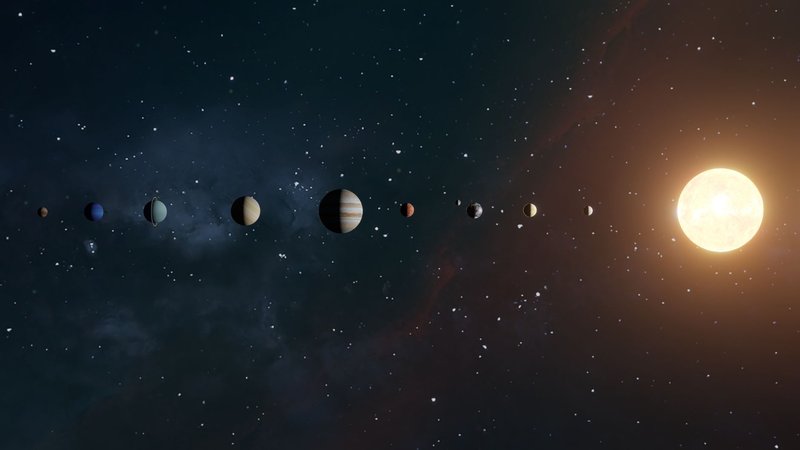
Soviet astronomy ran on a quiet army of minor-planet hunters, and a striking number of the most prolific were women working the same Crimean skies.
Tamara Smirnova, at the Institute of Theoretical Astronomy in Leningrad, discovered 135 numbered minor planets between 1966 and 1984 and co-discovered a periodic comet, 74P/Smirnova-Chernykh, that still swings back through the inner solar system on schedule.
Lyudmila Zhuravleva worked at Crimean Astrophysical Observatory and racked up 213 minor planets between 1972 and 1992, including a Trojan asteroid, 4086 Podalirius, that shares Jupiter’s orbit. By discovery count she ranks 57th out of more than 1,400 astronomers in history. Alongside her, Lyudmila Chernykh and Lyudmila Karachkina kept the same tradition running, three women named Lyudmila quietly filling in the map of the asteroid belt from one observatory.
Why Russia produced so many
Two things stand out. First, infrastructure: Pulkovo and later the Crimean observatory gave Russia world-class instruments early, and the Soviet state funded fundamental physics hard, partly as a byproduct of the weapons and space programs. Second, a culture that prized theory. Friedmann, Zeldovich, and Sunyaev did their biggest work with pencils, deriving consequences of physics that hardware only confirmed years later.
Look up on a clear night and a lot of what you’re seeing was named or explained by someone on this list. The expanding space between the galaxies. The atmosphere smeared across Venus. The hundreds of numbered rocks between Mars and Jupiter. Not a bad legacy for a roster most people can’t name.
Enjoyed this article?
Get daily 10-minute PDFs about astronomy to read before bed!
Sign up for our upcoming micro-learning service where you will learn something new about space and beyond every day while winding down.