
For roughly fourteen centuries, educated people believed the Earth sat still at the center of everything. The Sun, the Moon, the planets, the stars — all of it wheeled around us once a day. This wasn’t ignorance. It was the considered view of the best minds available, backed by Aristotle, formalized by Ptolemy, and blessed by the Church. It also happened to be wrong.
The story of how that belief came apart is the story of a handful of people working between roughly 1500 and 1640. They didn’t agree with each other. Some never met. One spent decades building data he didn’t know how to use; another inherited that data and cracked it open. What they share is that each one moved the same argument forward: the universe is not arranged the way it looks, and you can prove it with measurement.
Here’s who did it, in order, and what each one actually contributed.
Table of Contents
- The Setup: Geocentric vs Heliocentric
- Nicolaus Copernicus (1473–1543)
- Tycho Brahe (1546–1601)
- Johannes Kepler (1571–1630)
- Galileo Galilei (1564–1642)
- Comparison Table
- Timeline
- The Thread That Connects Them
- What Came Before, and What Came After
The Setup: Geocentric vs Heliocentric
The geocentric model put Earth at the center. To explain why planets sometimes appear to slow down, stop, and move backward against the stars — retrograde motion — Ptolemy’s system used epicycles: small circles riding on bigger circles. It worked, in the sense that it predicted planetary positions well enough for calendars and astrology. It just needed dozens of nested circles and constant tweaking to do it. The geocentric cosmos eventually joined the long list of space theories that turned out wrong, but it took the astronomers in this article to dismantle it.
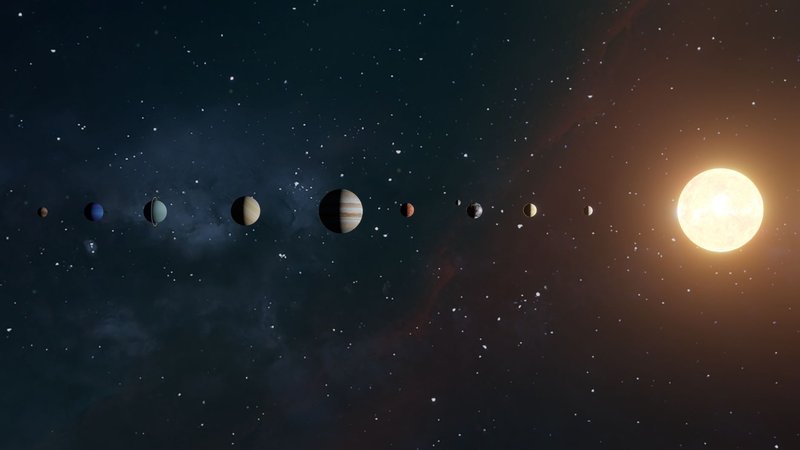
The heliocentric model put the Sun at the center and let Earth become a planet like any other. Retrograde motion stops being a puzzle: it’s just what you see when a faster inner planet (Earth) overtakes a slower outer one (Mars), the same way a car you pass seems to drift backward. The simplicity was the whole appeal. Whether it was true took another century to nail down.
That century is the rest of this article.
Nicolaus Copernicus (1473–1543)
A Polish church administrator and physician who did astronomy on the side, Copernicus is the man who put the Sun back in the middle. His book De revolutionibus orbium coelestium (On the Revolutions of the Heavenly Spheres) laid out a Sun-centered cosmos in full mathematical detail.
The famous detail: he sat on it for decades. The completed manuscript circulated quietly among friends years before he allowed it to print, and the legend — probably embroidered, but rooted in fact — is that he saw the first printed copy on the day he died in 1543. A cautious preface, added by a colleague without Copernicus’s approval, framed the whole thing as a mere calculation trick rather than a claim about reality. That hedge is why the Church mostly ignored the book for seventy years.
Two things to keep straight about Copernicus, because popular accounts blur them. First, he wasn’t the first person ever to propose a moving Earth — the Greek Aristarchus of Samos had floated the idea in the third century BCE. Copernicus’s achievement was working it out as a complete, usable astronomical system, the kind of contribution that lands him on nearly every list of the most important astronomers in history. Second, his model still wasn’t simpler than Ptolemy’s in practice, because he kept the assumption that orbits must be perfect circles. To make circular orbits fit the observations, he needed epicycles too. The Sun was in the right place. The shape was still wrong.
Tycho Brahe (1546–1601)
Tycho is the one people remember for the wrong reasons: the silver-and-gold prosthetic nose (he lost the bridge of his real one in a student duel over a math dispute), the private island, the pet elk that reportedly died falling down stairs after drinking too much beer. All true, more or less. None of it is why he matters.
Tycho matters because he was the greatest naked-eye observer who ever lived, working in the last generation before telescopes. On the Danish island of Hven, the king built him Uraniborg, a purpose-built observatory and research compound — arguably the first modern research institution. There Tycho spent twenty years measuring planetary positions with instruments he designed himself, pushing naked-eye accuracy to roughly one arcminute, several times better than anyone before.
His own model was a compromise: the planets orbit the Sun, but the Sun orbits a stationary Earth. It satisfied both the observations and his discomfort with a moving Earth. The model didn’t survive. The data did. When Tycho died in Prague in 1601, he left behind decades of the most precise planetary records in existence — and an assistant who knew exactly what to do with them.
Johannes Kepler (1571–1630)
Kepler is the quiet hinge of the whole story. A German mathematician, a devout and somewhat mystical Lutheran, and Tycho’s assistant in the master’s final year, he inherited the great trove of observations after Tycho’s death — and then spent years fighting them.
The fight was over Mars. Kepler tried to fit its orbit to circles, the way everyone had for two thousand years. He got agonizingly close: a model that was wrong by eight arcminutes. Most astronomers would have called that a rounding error and moved on. Kepler trusted Tycho’s data too much to do that. Eight arcminutes, he decided, was Tycho telling him the circle was wrong.
So he abandoned the circle. Kepler’s three laws of planetary motion followed:
- Planets move in ellipses, with the Sun at one focus — not the center, a focus. The two-thousand-year obsession with perfect circles was finally dead.
- A planet sweeps equal areas in equal times. It speeds up near the Sun and slows down far away, which means orbital motion isn’t uniform.
- The square of a planet’s orbital period is proportional to the cube of its average distance from the Sun. This one ties the whole solar system together with a single equation, linking how far a planet is to how long its year lasts.
These laws described the heavens with an accuracy nobody had achieved. They didn’t explain why — that needed gravity, and Newton. But Kepler did something no one before him had: he made the math match reality to the limit of the best data on Earth.
Galileo Galilei (1564–1642)
If Kepler won the argument on paper, Galileo won it for the public — by pointing a new instrument at the sky and reporting what he saw. He didn’t invent the telescope (Dutch lensmakers did), but in 1609 he heard about the device, built a far better version, and turned it upward. Born in Pisa, he was the most famous of a long line of Italian astronomers who shaped the field. What he found over the next two years gutted the geocentric model piece by piece.
Galileo’s telescope discoveries hit the old cosmology from several directions at once:
- The Moon has mountains and craters. Aristotle said the heavens were perfect and unchanging. The Moon turned out to be rocky terrain with shadows you could measure.
- Jupiter has four moons. Here were objects plainly orbiting something other than Earth — direct proof that not everything circles us. We still call them the Galilean moons.
- Venus shows a full set of phases, like the Moon. This was the kill shot. A full cycle of phases is only possible if Venus orbits the Sun, not the Earth. The pure Ptolemaic model simply can’t produce it.
- The Milky Way is made of stars, countless individual ones the naked eye blurs into a band. The universe was vastly bigger than anyone had pictured.
Galileo published this in Sidereus Nuncius (The Starry Messenger) and became famous fast. He also pushed Copernican astronomy openly and combatively, which is where the trouble started. In 1616 the Church declared heliocentrism contrary to scripture; in 1633 the Roman Inquisition tried Galileo, forced him to recant, and put him under house arrest for the rest of his life. The data didn’t care about the verdict. The phases of Venus were still there for anyone with a telescope to check.
Comparison Table
| Astronomer | Dates | Model | Breakthrough |
|---|---|---|---|
| Copernicus | 1473–1543 | Heliocentric (circular orbits) | Put the Sun at the center as a complete system |
| Tycho Brahe | 1546–1601 | Geo-heliocentric (hybrid) | Most precise pre-telescope observational data |
| Kepler | 1571–1630 | Heliocentric (elliptical orbits) | Three laws of planetary motion |
| Galileo | 1564–1642 | Heliocentric | Telescopic proof: Jupiter’s moons, phases of Venus |
Timeline
- 1473 — Copernicus born in Toruń, Poland.
- 1543 — De revolutionibus published; Copernicus dies.
- 1546 — Tycho Brahe born.
- 1564 — Galileo born in Pisa.
- 1571 — Kepler born.
- 1576 — Tycho begins building Uraniborg on Hven.
- 1601 — Tycho dies; Kepler inherits his observations.
- 1609 — Kepler publishes his first two laws; Galileo builds his telescope.
- 1610 — Galileo publishes Sidereus Nuncius with the moons of Jupiter.
- 1619 — Kepler publishes his third law.
- 1633 — Galileo tried by the Inquisition and placed under house arrest.
- 1642 — Galileo dies. Isaac Newton born the same year (by the old calendar).
The Thread That Connects Them
The popular version treats these four as a relay race of geniuses, each handing the baton to the next. That’s half right. The real connective tissue is more specific: it’s the move from belief to measurement, and you can watch it happen one person at a time.
Copernicus had the right idea but the wrong shape, because he reasoned from what orbits ought to be (perfect circles) instead of from data. Tycho distrusted theory and just measured, obsessively, for twenty years — and built a hybrid model that was scientifically a dead end. Kepler took Tycho’s measurements seriously enough to throw out the circle that everyone, including Copernicus, had clung to for two millennia. Galileo supplied the physical evidence anyone could verify with their own eyes.
Notice that none of them got everything right. Copernicus kept epicycles. Tycho kept a stationary Earth. Kepler wrapped his laws in mystical theories about musical harmonies and nested geometric solids. Galileo botched his own theory of the tides and rejected Kepler’s ellipses. The system worked anyway, because each correct piece survived its author’s mistakes. That’s the actual lesson of Renaissance astronomy: science advances by people being right about one thing while wrong about several others, as long as the right things are checkable.
The capstone arrived after all four were gone. In 1687, Isaac Newton published his law of universal gravitation and showed why Kepler’s ellipses had to be ellipses — a single force, falling off with the square of distance, that explained planetary orbits and a dropped apple with the same equation. Kepler had found the pattern. Newton found the cause.
What Came Before, and What Came After
One correction to the standard roll-call, because it usually gets skipped. The Renaissance astronomers didn’t build from nothing. The Greek mathematical astronomy they argued with had survived the medieval centuries largely through the work of scholars in the Islamic world — figures like Ibn al-Shatir, whose 14th-century planetary models used geometric devices strikingly similar to ones Copernicus later employed. The instruments, the trigonometry, the preserved and corrected star catalogs: a lot of the toolkit reached Renaissance Europe by that route. The revolution had a long runway.
And it didn’t really end with Galileo’s house arrest. It ended when the argument stopped being an argument — when heliocentrism became the boring default that telescopes, stellar parallax measurements, and Newtonian mechanics all confirmed independently. The four people in this article didn’t finish the job. They made it impossible to go back.
That’s the thing worth holding onto. The Earth doesn’t feel like it’s moving. It looks, every single day, like the Sun goes around us. These astronomers believed the math and the measurements over the evidence of their own senses, and they turned out to be right. Evidence-based science wasn’t handed down as a method. It was assembled, in fits and arguments, by exactly these people, over exactly this stretch of years.