In 1929 Edwin Hubble published a simple chart showing that galaxies farther away have larger redshifts — a discovery that flipped our picture of the cosmos.
Why this matters: the idea that space itself is stretching changes how we think about time, distances and the ultimate fate of everything we observe. Expansion sets the scale for cosmic history, from the hot early stages to the galaxies we see today.
Multiple independent lines of evidence — from galaxy redshifts to the cosmic microwave background, baryon acoustic oscillations, supernova time dilation and primordial element abundances — together form a robust proof universe is expanding.
Below are 10 well-tested observations, grouped by type, that together make the case: direct measurements of light and distance, relic radiation from the early universe, and evolving large-scale and nuclear signatures.
Direct Observational Measurements
This category is the most immediate: we measure light from distant sources, convert that light into distances and velocities, and find a systematic recession pattern. Redshift is simply the stretching of spectral lines to longer wavelengths, and it produces a velocity–distance relationship that we can test directly.
1. Galaxy redshifts and Hubble’s original law
Most galaxies show spectral lines shifted to longer wavelengths, which implies they are moving away from us. In 1929 Edwin Hubble published a velocity–distance plot showing the roughly linear relation v = H0 × d, where v is recession speed and d is distance.
Hubble’s first diagram used a few dozen galaxies and established the pattern; modern values for the Hubble constant fall in the ~67–75 km/s/Mpc range depending on method. Note that Andromeda (M31) is a nearby exception with a blueshift because local gravity dominates its motion.
2. Distance ladders: Cepheids, Type Ia supernovae, and Gaia
Measuring redshift alone gives z, not distance, so astronomers rely on a ladder of distance indicators to map the relation between speed and scale.
Cepheid variables follow Leavitt’s period–luminosity relation and anchor nearby distances. Type Ia supernovae act as standard candles out to cosmological scales; the 1998 results from the Perlmutter and Riess teams used SN Ia to reveal accelerated expansion. Gaia’s precise parallaxes have tightened the base rung, reducing distance uncertainties and improving H0 estimates.
3. Large redshift surveys map recession across the sky
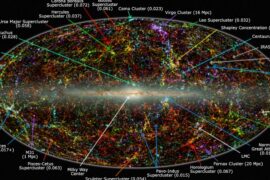
Systematic surveys have measured redshifts for millions of galaxies, turning Hubble’s scatter plot into a three-dimensional map. The Sloan Digital Sky Survey (SDSS) and the 2dF survey produced catalogs with millions and hundreds of thousands of redshifts respectively.
These maps show very few blueshifted galaxies beyond the Local Group and reveal the overall trend of increasing redshift with distance; deep surveys now push detections to z>6–8 (and higher with recent JWST follow-ups). Large samples let astronomers test expansion statistically and measure how structure grows over time.
4. Consistency across independent distance methods
Different techniques — parallax (Gaia), Cepheids, the tip of the red giant branch, Tully–Fisher relations, surface-brightness fluctuations and Type Ia supernovae — all point to the same qualitative picture: galaxies recede in an expanding space.
Quantitatively, these methods converge on H0 values near the low seventies or high sixties (local measurements ~73 km/s/Mpc versus CMB-derived ~67.4 km/s/Mpc), a tension that drives current research but does not undermine the basic expansion picture. Taken together, the cross-checks are strong evidence that what we measure is cosmic expansion, not an artifact of one technique.
Relic Radiation and Early-Universe Signals
The leftover radiation from the hot early universe and its tiny variations encode an expanding, cooling history. These signals are precise and quantitative, and they let us reconstruct conditions when the cosmos was minutes to hundreds of thousands of years old.
5. The cosmic microwave background: a cooled Big Bang glow
A nearly uniform microwave background fills the sky with a precise blackbody spectrum at 2.7255 K. Arno Penzias and Robert Wilson first detected the excess microwave noise in 1965; COBE’s 1992 measurements then confirmed the spectrum is an almost perfect Planck blackbody.
A photon bath that cools to the microwave today implies the universe was once much hotter and denser and has since expanded and cooled. That single observational discovery reshaped cosmology by turning a theoretical idea into measurable evidence.
6. CMB anisotropies and acoustic peaks match expansion models
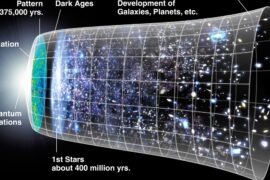
Tiny temperature fluctuations in the CMB are not random noise; they form a characteristic angular power spectrum with acoustic peaks predicted by models of a hot, expanding plasma. COBE first detected anisotropy, WMAP mapped it with precision in the 2000s, and Planck (final data release 2018) delivered high-fidelity measurements that tightly constrain cosmological parameters.
The first acoustic peak appears near a one-degree angular scale, and the pattern of peaks determines the matter, radiation and dark energy content and the expansion history. From these data we infer an age of about 13.8 billion years and a consistent expansion model for the universe’s evolution.
7. Baryon acoustic oscillations: a cosmic standard ruler
Baryon acoustic oscillations are frozen sound waves from the early plasma that set a characteristic comoving scale of roughly 150 Mpc. In 2005 Eisenstein and colleagues detected the BAO feature in SDSS galaxy clustering, providing a standard ruler in the late-time universe.
Subsequent BAO measurements from BOSS and eBOSS track the expansion history across redshift slices, helping to measure distances and dark energy. BAO serve like mileposts in the cosmic web and independently corroborate the expansion inferred from redshifts and the CMB.
Large-Scale Structure, Nuclear Signatures, and Time-Dependent Effects
Complementary observations—abundances set minutes after the Big Bang, time stretching of distant explosions, and evolving absorption and galaxy populations—give consistent, time-ordered evidence for expansion and structure growth.
8. Primordial nucleosynthesis matches predicted light-element ratios
Big Bang nucleosynthesis (BBN) predicts the abundances of light elements produced in the first minutes when the universe was hot and expanding. The predicted helium mass fraction is about 24% by mass, and observed primordial deuterium levels match the theory when using the baryon density inferred from the CMB.
Measurements of helium, deuterium and lithium in old, nearly pristine gas clouds and in metal-poor stars provide an independent check on early expansion rates and baryon content. Agreement between BBN and CMB-derived baryon density ties the first minutes and the first 380,000 years into a single expanding-universe story.
9. Time dilation in distant supernova light curves
The light curves of Type Ia supernovae appear stretched in time by a factor of (1+z), exactly as expected if cosmic expansion lengthens the arrival time of photons. Observational studies (for example work by Goldhaber and later SN surveys) have measured this stretching at redshifts z∼0.5–1.0.
For instance, a supernova at z = 0.5 shows light-curve durations roughly 1.5 times longer than an identical local event. Time dilation is a direct test that rules out non-expansion hypotheses like simple scattering or “tired light” models.
10. High-redshift probes: Lyman-alpha forest and evolving galaxies
Quasar spectra contain the Lyman-alpha forest—many absorption lines from intervening neutral hydrogen at different redshifts—which maps intervening gas along a line of sight and reveals a sequence of expanding epochs. The forest shows continuous absorption across a range of z values, matching predictions for a universe that expands and becomes more ionized over time.
Galaxy populations themselves change with look-back time: star-formation rates, morphology and mass distributions vary predictably with redshift. Deep surveys with HST, ground-based telescopes and early JWST candidate detections at z>9–10 probe denser, earlier stages that align with structure formation in an expanding cosmos.
Summary
These ten lines of observation—direct redshifts and distance ladders, survey maps, the cosmic microwave background and its acoustic peaks, BAO, primordial element abundances, supernova time dilation, and high-redshift probes—form a consistent picture of a universe that stretches and ages over time.
Individually each item is persuasive; together they are decisive. The CMB’s near-perfect blackbody spectrum (2.7255 K) and acoustic peaks give a precise early snapshot, BAO provides a standard ruler (~150 Mpc), and time-dilation of supernovae offers a simple, direct test of expanding spacetime.
Ongoing work—resolving the H0 tension between local (~73 km/s/Mpc) and CMB-derived (~67.4 km/s/Mpc) values, and pushing JWST observations deeper—refines the parameters but does not overturn the observational proof universe is expanding.
Want to learn more? Authoritative sources include NASA summaries and the Planck collaboration papers (Planck 2018) for technical details.
- Multiple, independent measurements—from galaxy redshifts and distance ladders to the CMB, BAO, BBN and SN time dilation—converge on cosmic expansion.
- The CMB’s blackbody spectrum (2.7255 K) and anisotropy peaks provide a precise snapshot of the early expanding universe and set tight cosmological constraints.
- BAO serves as a standard ruler (~150 Mpc) while redshift surveys and deep observations trace structure growth and cosmic history across time.
- Simple, direct tests—like the (1+z) stretching of supernova light curves—rule out non-expansion alternatives and confirm that redshifts reflect expanding spacetime.
- Active areas of research (the H0 tension; high-redshift galaxy searches with JWST) are sharpening our measurements, not overturning the core evidence.
Enjoyed this article?
Get daily 10-minute PDFs about astronomy to read before bed!
Sign up for our upcoming micro-learning service where you will learn something new about space and beyond every day while winding down.