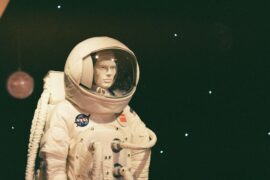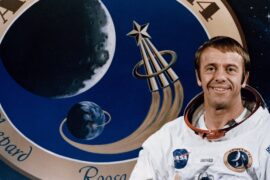
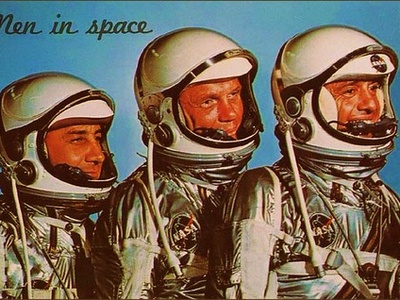
In the early 1960s, NASA’s Mercury program put a small group of test pilots at the forefront of America’s first manned space efforts. Those short, high-risk missions proved the basics of human spaceflight and set the stage for Gemini and Apollo.
There are 7 Mercury Astronauts, ranging from Alan Shepard to Wally Schirra. For each, you’ll find below Mission(s) & role,Lifespan (YYYY–YYYY),Notable fact (<=15 words).
How were the Mercury astronauts chosen?
They were selected in 1959–1960 from military test pilots based on flight hours, physical fitness, and psychological screening; the goal was a small, highly skilled group able to handle early spacecraft limits.
What legacy did the Mercury program leave?
Mercury validated human orbital flight, life‑support basics, and reentry techniques, directly enabling later programs; its seven pilots became technical pioneers and public symbols of early space exploration.
Mercury Astronauts
| Name | Mission(s) & role | Lifespan (YYYY–YYYY) | Notable fact (<=15 words) |
|---|---|---|---|
| Alan Shepard | Mercury-Redstone 3 (Freedom 7), May 5, 1961 — Pilot | 1923–1998 | First American in space |
| Gus Grissom | Mercury-Redstone 4 (Liberty Bell 7), July 21, 1961 — Pilot | 1926–1967 | Second American in space; later Gemini commander |
| John Glenn | Mercury-Atlas 6 (Friendship 7), February 20, 1962 — Pilot | 1921–2016 | First American to orbit Earth |
| Scott Carpenter | Mercury-Atlas 7 (Aurora 7), May 24, 1962 — Pilot | 1925–2013 | Second American to orbit Earth; oceanography advocate |
| Wally Schirra | Mercury-Atlas 8 (Sigma 7), October 3, 1962 — Pilot | 1923–2007 | Only Mercury astronaut to fly Mercury, Gemini, and Apollo |
| Gordon Cooper | Mercury-Atlas 9 (Faith 7), May 15–16, 1963 — Pilot | 1927–2004 | Completed America’s first multi-orbit mission |
| Deke Slayton | No Mercury flight (grounded medically); did not fly in Mercury — No flight | 1924–1993 | Grounded medically; later Apollo–Soyuz crew and operations chief |
Images and Descriptions
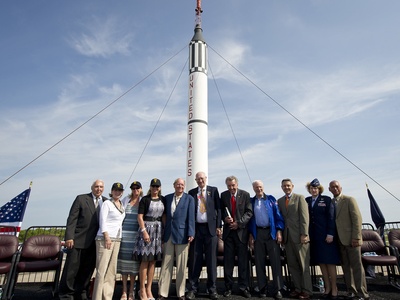
Alan Shepard
Alan Shepard was a naval aviator and the first American in space, piloting Mercury-Redstone 3 (Freedom 7) on May 5, 1961. A Mercury Seven member, he later commanded Apollo 14 and became a symbol of U.S. early spaceflight achievement.
Gus Grissom
Gus Grissom was a USAF test pilot and one of the Mercury Seven, piloting Liberty Bell 7 (Mercury-Redstone 4) on July 21, 1961. He was the second American in space and later commanded Gemini 3.

John Glenn
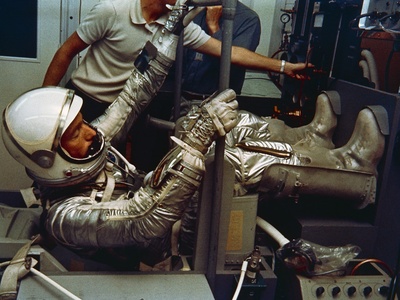
John Glenn was a Marine Corps pilot and the first American to orbit Earth, flying Friendship 7 (Mercury-Atlas 6) on February 20, 1962. A beloved national figure, he later returned to space aboard STS-95 in 1998.
Scott Carpenter
Scott Carpenter was a Navy test pilot who flew Aurora 7 (Mercury-Atlas 7) on May 24, 1962, becoming the second American to orbit Earth. He later pursued oceanography and supported spaceflight education.
Wally Schirra
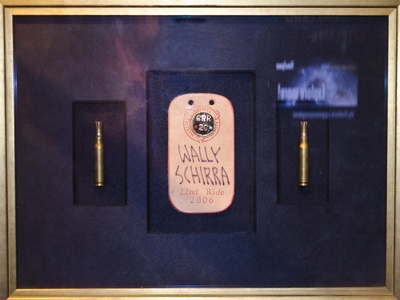
Wally Schirra was a naval aviator who piloted Sigma 7 (Mercury-Atlas 8) on October 3, 1962, demonstrating precision orbital performance. A Mercury Seven member, he later flew in Gemini and Apollo programs.
Gordon Cooper
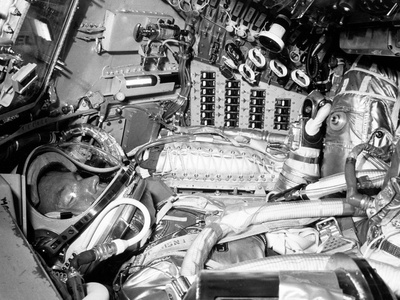
Gordon Cooper was an Air Force test pilot who flew Faith 7 (Mercury-Atlas 9) on May 15–16, 1963, completing America’s first multi-orbit mission. He was the last Mercury astronaut flight and later flew in Gemini.
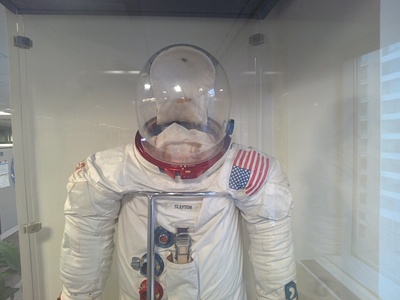
Deke Slayton
Deke Slayton was an Air Force pilot and Mercury Seven member grounded medically; he did not fly in Mercury but later served as NASA’s director of flight crew operations and flew on Apollo–Soyuz in 1975.
Enjoyed this article?
Get daily 10-minute PDFs about astronomy to read before bed!
Sign up for our upcoming micro-learning service where you will learn something new about space and beyond every day while winding down.