The Moon has been the focal point of human exploration for decades, shaping missions, technology, and the careers of those who ventured beyond Earth. This list gathers the people who traveled to lunar distance and summarizes what each did during those missions.
There are 24 Lunar Astronauts, ranging from Al Worden to Tom Stafford. For each person you’ll find below the columns Mission(s),Role,Lunar outcome so you can quickly see which flights they flew, what positions they held, and whether they landed, orbited, or stayed in support — all laid out for easy scanning; you’ll find below the full list and details.
How many of these astronauts actually walked on the Moon?
Of the 24 who traveled to the Moon, 12 conducted lunar surface EVAs (moonwalks). The others either remained in lunar orbit as command module pilots or served in support roles; the “Lunar outcome” column clarifies surface landings versus orbital or flyby missions.
What do the columns Mission(s),Role,Lunar outcome tell me and how should I use them?
Mission(s) lists each flight designation, Role names the crew position (commander, command module pilot, lunar module pilot, etc.), and Lunar outcome indicates whether they landed, orbited, or had another result. Use these columns to sort by mission, find who walked on the surface, or trace each astronaut’s lunar career.
Lunar Astronauts
| Name | Mission(s) | Role | Lunar outcome |
|---|---|---|---|
| Frank Borman | Apollo 8 | Commander | Orbited — no EVA |
| Jim Lovell | Apollo 8; Apollo 13 | Command Module Pilot (Apollo 8); Commander (Apollo 13) | Orbited (Apollo 8); Flyby (Apollo 13) |
| Bill Anders | Apollo 8 | Lunar Module Pilot | Orbited — no EVA |
| Tom Stafford | Apollo 10 | Commander | Orbited — no EVA |
| John Young | Apollo 10; Apollo 16 | Command Module Pilot (Apollo 10); Commander (Apollo 16) | Orbited (Apollo 10); Landed — walked (Apollo 16) |
| Gene Cernan | Apollo 10; Apollo 17 | Lunar Module Pilot (Apollo 10); Commander (Apollo 17) | Orbited (Apollo 10); Landed — walked (Apollo 17) |
| Neil Armstrong | Apollo 11 | Commander | Landed — walked (EVA) |
| Buzz Aldrin | Apollo 11 | Lunar Module Pilot | Landed — walked (EVA) |
| Michael Collins | Apollo 11 | Command Module Pilot | Orbited — no EVA |
| Pete Conrad | Apollo 12 | Commander | Landed — walked (EVA) |
| Richard Gordon | Apollo 12 | Command Module Pilot | Orbited — no EVA |
| Alan Bean | Apollo 12 | Lunar Module Pilot | Landed — walked (EVA) |
| Jack Swigert | Apollo 13 | Command Module Pilot | Flyby — no EVA |
| Fred Haise | Apollo 13 | Lunar Module Pilot | Flyby — no EVA |
| Alan Shepard | Apollo 14 | Commander | Landed — walked (EVA) |
| Stuart Roosa | Apollo 14 | Command Module Pilot | Orbited — no EVA |
| Edgar Mitchell | Apollo 14 | Lunar Module Pilot | Landed — walked (EVA) |
| David Scott | Apollo 15 | Commander | Landed — walked (EVA) |
| Al Worden | Apollo 15 | Command Module Pilot | Orbited — no lunar EVA |
| Jim Irwin | Apollo 15 | Lunar Module Pilot | Landed — walked (EVA) |
| Ken Mattingly | Apollo 16 | Command Module Pilot | Orbited — no EVA |
| Charlie Duke | Apollo 16 | Lunar Module Pilot | Landed — walked (EVA) |
| Harrison Schmitt | Apollo 17 | Lunar Module Pilot | Landed — walked (EVA) |
| Ronald Evans | Apollo 17 | Command Module Pilot | Orbited — no lunar EVA |
Images and Descriptions
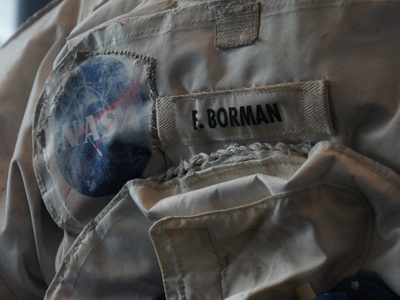
Frank Borman
Frank Borman commanded Apollo 8 (Dec 21–27, 1968), the first crewed spacecraft to orbit the Moon. He led Jim Lovell and Bill Anders through ten lunar orbits, witnessed the iconic “Earthrise,” and returned the crew safely to Earth.
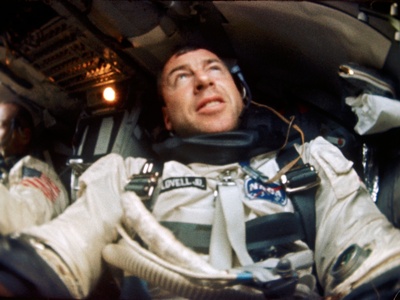
Jim Lovell
Jim “Jim” Lovell flew to lunar distance twice: CMP on Apollo 8 (Dec 1968) and commander of Apollo 13 (Apr 11–17, 1970). The latter looped around the Moon after an in-flight accident and returned the crew safely.
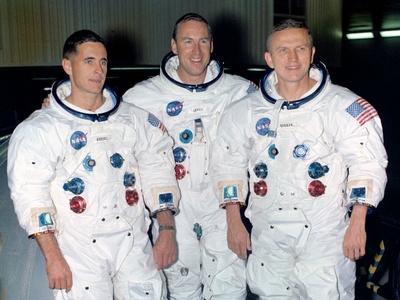
Bill Anders
Bill Anders served as Lunar Module Pilot on Apollo 8 (Dec 21–27, 1968), joining the first crew to orbit the Moon. He took the famous “Earthrise” photograph and later became an advocate for space and environmental policy.
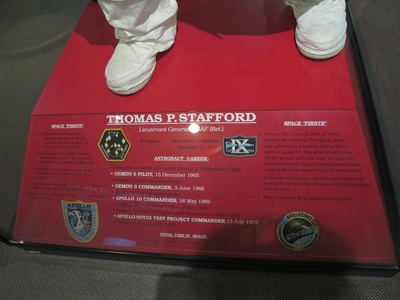
Tom Stafford
Tom Stafford commanded Apollo 10 (May 18–26, 1969), the full “dress rehearsal” for a lunar landing. His crew orbited the Moon and brought the Lunar Module to within a few miles of the surface to test landing procedures.
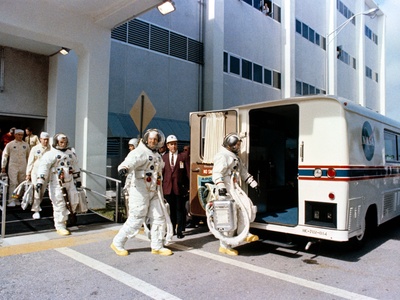
John Young
John Young flew as CMP on Apollo 10 (May 1969) and later commanded Apollo 16 (Apr 16–27, 1972), where he walked on the lunar highlands, conducting geology fieldwork and leading surface EVA operations.
Gene Cernan
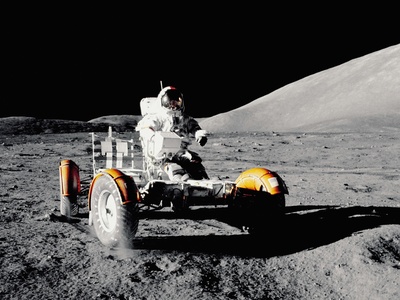
Gene Cernan was LMP on Apollo 10 (May 1969) and commanded Apollo 17 (Dec 7–19, 1972). He walked on the Moon and is remembered as the last person to leave the lunar surface during the Apollo era.
Neil Armstrong
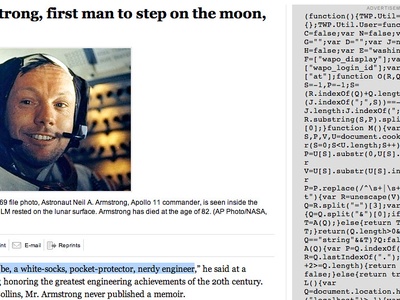
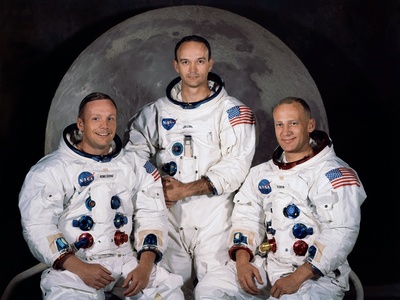
Neil Armstrong commanded Apollo 11 (July 16–24, 1969) and became the first human to walk on the Moon. He piloted the Lunar Module to Mare Tranquillitatis, conducted the initial EVA, and made history with his famous first step.
Buzz Aldrin
Buzz Aldrin was Lunar Module Pilot on Apollo 11 (July 16–24, 1969) and joined Neil Armstrong as the second person to walk on the Moon. He helped deploy experiments and conduct the EVA at Tranquility Base.
Michael Collins
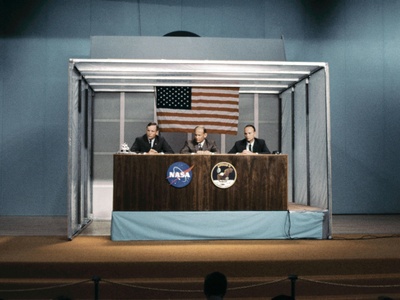
Michael Collins remained alone in lunar orbit aboard Columbia during Apollo 11 (July 1969) while Armstrong and Aldrin walked on the surface. He kept the command module operational and ensured their safe rendezvous and return to Earth.
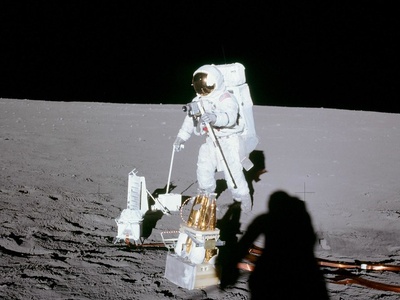
Pete Conrad
Pete Conrad commanded Apollo 12 (Nov 14–24, 1969) and executed a precision landing near Surveyor 3. He and Alan Bean conducted multiple EVAs, collected samples, and performed experiments at the Ocean of Storms site.
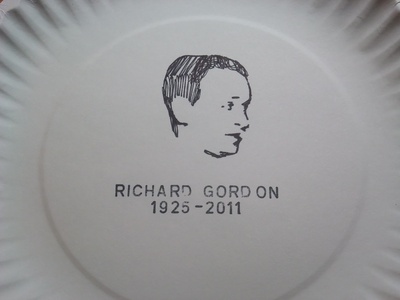
Richard Gordon
Richard Gordon was Command Module Pilot on Apollo 12 (Nov 1969), orbiting the Moon while Pete Conrad and Alan Bean worked on the surface. He managed orbital operations, photography, and observations from the command module.

Alan Bean
Alan Bean served as Lunar Module Pilot on Apollo 12 (Nov 14–24, 1969) and became the fourth person to walk on the Moon. He conducted EVAs with Pete Conrad and later pursued a career as an artist celebrating space exploration.
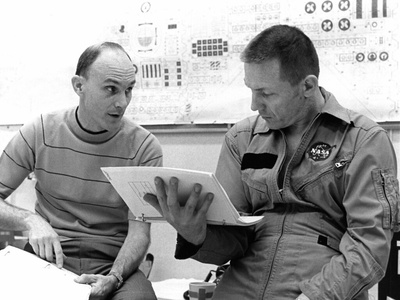
Jack Swigert
Jack “Jack” Swigert joined Apollo 13 as Command Module Pilot (Apr 11–17, 1970) after a late crew change. Following an in-flight explosion, the crew looped around the Moon and returned safely, with Swigert helping manage critical systems.
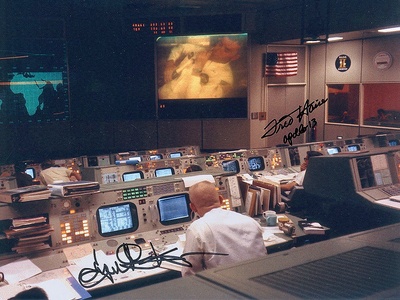
Fred Haise
Fred Haise was Lunar Module Pilot on Apollo 13 (Apr 1970). Although the planned landing was aborted after an onboard accident, Haise traveled to lunar distance and played a crucial role in improvising survival procedures for the return.
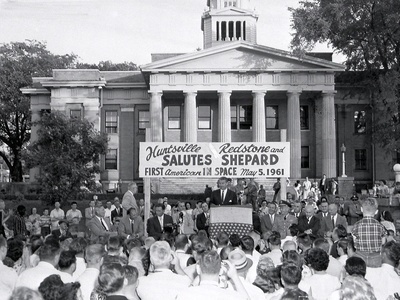
Alan Shepard
Alan Shepard commanded Apollo 14 (Jan 31–Feb 9, 1971) and became the fifth person to walk on the Moon. He and Edgar Mitchell conducted geological EVAs, and Shepard famously hit two golf balls on the lunar surface.
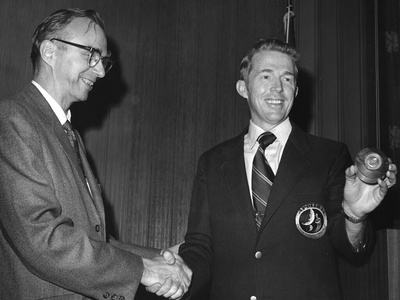
Stuart Roosa
Stuart Roosa served as Command Module Pilot on Apollo 14 (Feb 1971), orbiting the Moon while Shepard and Mitchell explored the surface. He performed photography and orbital science experiments before reuniting the crew for return.
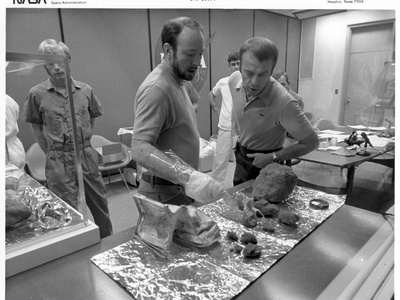
Edgar Mitchell
Edgar Mitchell was Lunar Module Pilot on Apollo 14 (Feb 1971), conducting EVAs focused on geology and sample collection with Alan Shepard. He later founded the Institute of Noetic Sciences and became known for studying consciousness.
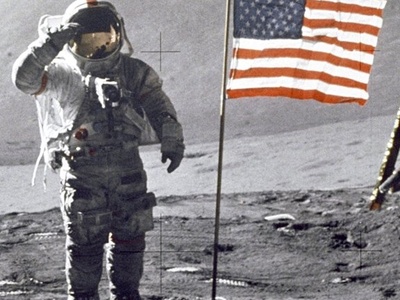
David Scott
David Scott commanded Apollo 15 (Jul 26–Aug 7, 1971), the first mission to carry a lunar rover. He and Jim Irwin explored the Hadley–Apennine region, deployed experiments, and returned a large cache of geological samples.
Al Worden
Al Worden was Command Module Pilot on Apollo 15 (Jul–Aug 1971), orbiting the Moon while Scott and Irwin worked on the surface. He performed a rare deep-space EVA to retrieve film cassettes from the service module.
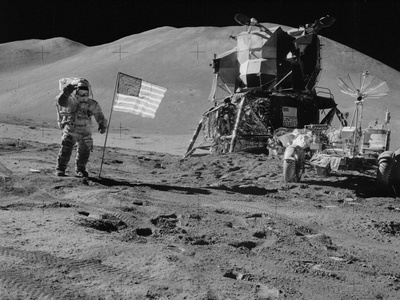
Jim Irwin
Jim Irwin served as Lunar Module Pilot on Apollo 15 (Jul–Aug 1971). He conducted multiple EVAs alongside Dave Scott, operated the lunar rover, and helped collect significant geological samples before retiring to religious pursuits.
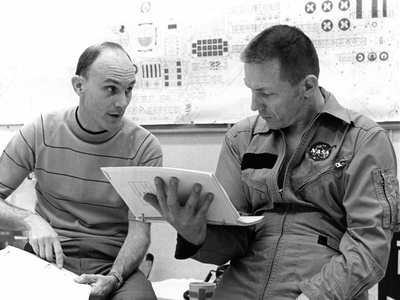
Ken Mattingly
Ken Mattingly served as Command Module Pilot on Apollo 16 (Apr 16–27, 1972), orbiting while John Young and Charlie Duke explored the lunar surface. He conducted orbital experiments and ensured command module performance for the return.
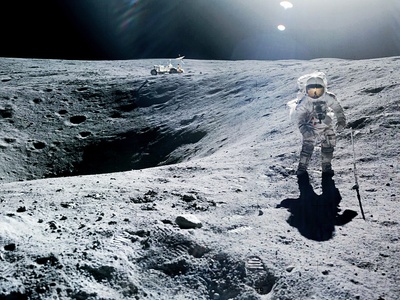
Charlie Duke
Charlie Duke was Lunar Module Pilot on Apollo 16 (Apr 1972) and walked on the Moon, conducting geology EVAs, deploying experiments, and collecting samples. He famously left a family portrait on the lunar surface.
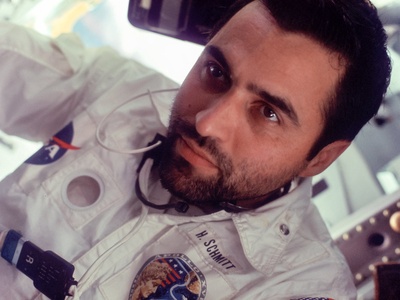
Harrison Schmitt
Harrison Schmitt, a professional geologist, served as Lunar Module Pilot on Apollo 17 (Dec 7–19, 1972). He walked on the Moon, led detailed scientific sampling, and is the only professional scientist to have walked the lunar surface.
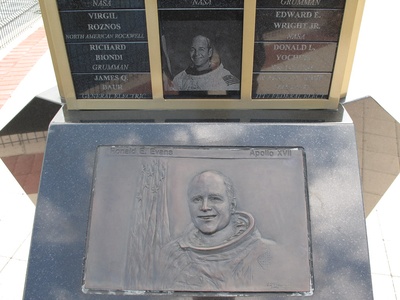
Ronald Evans
Ronald Evans was Command Module Pilot on Apollo 17 (Dec 1972), orbiting while Cernan and Schmitt carried out surface exploration. He performed a trans‑Earth EVA to retrieve film from the service module and operated SIM bay instruments from orbit.
Enjoyed this article?
Get daily 10-minute PDFs about astronomy to read before bed!
Sign up for our upcoming micro-learning service where you will learn something new about space and beyond every day while winding down.