Little Astronomy is reader-supported. As an Amazon Associate I earn from qualifying purchases made through links on this page, at no extra cost to you.
Mae Jemison is a physician, engineer and former NASA astronaut. She became the first Black woman in space on 12 September 1992, when she flew aboard the space shuttle Endeavour on mission STS-47. She was 35 years old and spent almost eight days in orbit.
Before NASA she studied chemical engineering, earned a medical degree, worked as a doctor in the Peace Corps and trained as a dancer. After she left NASA she started a company, ran a science camp for teenagers and led the 100 Year Starship project. This page has 10 fun facts about Mae Jemison, a timeline, the details of her spaceflight, her books and answers to common questions.
Quick facts
| Full name | Mae Carol Jemison |
| Born | 17 October 1956, Decatur, Alabama. She grew up in Chicago, Illinois. |
| Parents | Charlie Jemison and Dorothy Jemison, an elementary school teacher. Mae was the youngest of three children. |
| Education | Morgan Park High School (1973), Stanford University (1977, chemical engineering and African and African-American studies), Cornell University medical school (doctor of medicine, 1981) |
| Job at NASA | Mission specialist and science mission specialist, chosen in June 1987 as part of NASA Astronaut Group 12 |
| Mission | STS-47 on Endeavour, 12 to 20 September 1992 |
| Time in space | 190 hours, 30 minutes and 23 seconds (about 7 days and 22 hours), 127 orbits of Earth |
| Left NASA | March 1993 |
| Since NASA | Founder of The Jemison Group and the Dorothy Jemison Foundation for Excellence, and leader of the 100 Year Starship project |
10 fun facts about Mae Jemison
- She is the first Black woman in space. She launched on Endeavour on 12 September 1992.
- She started college at 16. She graduated from Morgan Park High School in Chicago in 1973 and went straight to Stanford University.
- She is a medical doctor. She earned her medical degree at Cornell in 1981 and treated patients in Cuba, Thailand and East Africa while she was still a student.
- She served in the Peace Corps. From 1983 to 1985 she was the medical officer for volunteers in Liberia and Sierra Leone.
- She is a trained dancer. She began ballet at age 8 or 9, took classes at the Alvin Ailey American Dance Theater and carried an Alvin Ailey poster into orbit.
- She started every shift in space with a line from Star Trek. She opened each shift with “Hailing frequencies open”, and in 1993 she became the first real astronaut to appear in a Star Trek series.
- She was one of 15 people chosen from about 2,000 applicants. Hers was the first astronaut group NASA picked after the Challenger accident.
- She tested frog eggs, bone cells and a motion sickness treatment in orbit. The experiments flew in a Japanese-American science laboratory called Spacelab-J.
- She has her own LEGO minifigure. The 2017 LEGO Ideas set Women of NASA includes Mae Jemison, Sally Ride, Margaret Hamilton and Nancy Grace Roman.
- She led a project to plan travel between the stars. Her foundation won the 100 Year Starship competition in 2012.
Mae Jemison timeline
| Date | Event |
|---|---|
| 17 October 1956 | Born in Decatur, Alabama. The family moves to Chicago. |
| 1973 | Graduates from Morgan Park High School and enters Stanford University at age 16. |
| 1977 | Graduates from Stanford with degrees in chemical engineering and African and African-American studies. |
| 1981 | Earns her medical degree from Cornell University. |
| 1983 to 1985 | Works as a Peace Corps medical officer in Liberia and Sierra Leone. |
| October 1985 | Applies to NASA’s astronaut program. |
| 28 January 1986 | The shuttle Challenger is lost. NASA postpones its next astronaut selection. |
| 5 June 1987 | NASA announces Astronaut Group 12, 15 people including Jemison. |
| 28 September 1989 | NASA assigns her to the STS-47 crew. |
| 12 September 1992 | Launches on Endeavour and becomes the first Black woman in space. |
| 20 September 1992 | Endeavour lands at Kennedy Space Center in Florida. |
| March 1993 | Leaves NASA. Founds The Jemison Group the same year. |
| 22 May 1993 | Appears in the Star Trek: The Next Generation episode “Second Chances”. |
| 1994 | Starts The Earth We Share, a science camp for students aged 12 to 16. |
| 2012 | Her foundation wins the DARPA 100 Year Starship competition. |
Early life and education
Mae Jemison was born in Decatur, Alabama. She grew up in Chicago. Her mother, Dorothy, taught English and math at an elementary school, and her father, Charlie, worked as a maintenance supervisor for a charity. Her parents supported her interest in science. Some of her teachers did not. When she told her kindergarten teacher that she wanted to be a scientist, the teacher assumed she meant a nurse.
She studied nature and the human body as a child, and she watched the Apollo missions on television. She later said she was annoyed that none of the astronauts were women. Star Trek and the character Lieutenant Uhura, played by the Black actress Nichelle Nichols, also pushed her toward space.
Dance mattered as much to her as science. She started ballet at 8 or 9 and later learned African, Japanese, jazz and modern dance. At 14 she auditioned for the lead in West Side Story. She did not get the lead and danced in the background instead.
Jemison entered Stanford University in 1973 at age 16. At Stanford she led the Black Students Union and choreographed a musical and dance show called Out of the Shadows. She graduated in 1977 with a degree in chemical engineering and a degree in African and African-American studies. She chose medicine over a dance career.
Doctor and Peace Corps volunteer
Jemison studied medicine at Cornell University. During her training she traveled to Cuba for a study, worked at a Cambodian refugee camp in Thailand and volunteered with the Flying Doctors in East Africa. She kept taking classes at the Alvin Ailey American Dance Theater while she was at Cornell. She graduated in 1981, completed an internship in Los Angeles and worked as a general practitioner.
In 1983 she joined the Peace Corps, the US volunteer program that sends people to work in other countries. As a medical officer she looked after the health of volunteers in Liberia and Sierra Leone. She ran the pharmacy, the laboratory and the medical staff and wrote self-care guides. She also worked with the Centers for Disease Control on vaccine research. She left in 1985.
Becoming an astronaut
Jemison applied to NASA in October 1985, inspired by the 1983 flights of Sally Ride and Guion Bluford. Then the shuttle Challenger broke apart in January 1986, and NASA put the selection on hold. She applied again in 1987.
NASA chose 15 astronauts from about 2,000 applicants and announced them on 5 June 1987. The group was NASA Astronaut Group 12, nicknamed the GAFFers. It was the first group chosen after the Challenger loss. The Associated Press called Jemison the first Black woman astronaut.
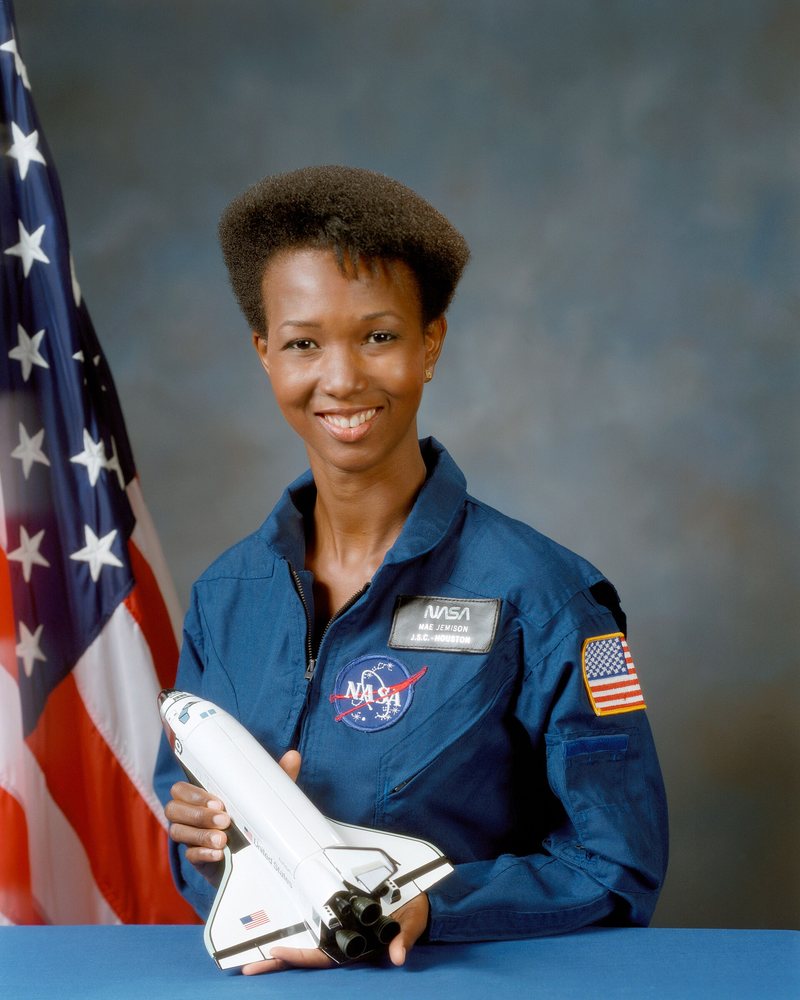
Mae Jemison in October 1987, a few months after NASA selected her. Photo: NASA.

NASA Astronaut Group 12 in 1987. Jemison stands in the middle row. Photo: NASA.
Before her flight Jemison helped with launch preparations at Kennedy Space Center and checked shuttle computer software in a NASA test laboratory. On 28 September 1989 NASA assigned her to STS-47 as a mission specialist. She was also named a science mission specialist, a new job NASA was testing in which the astronaut focuses on the experiments.
Mae Jemison’s spaceflight: STS-47 in 1992
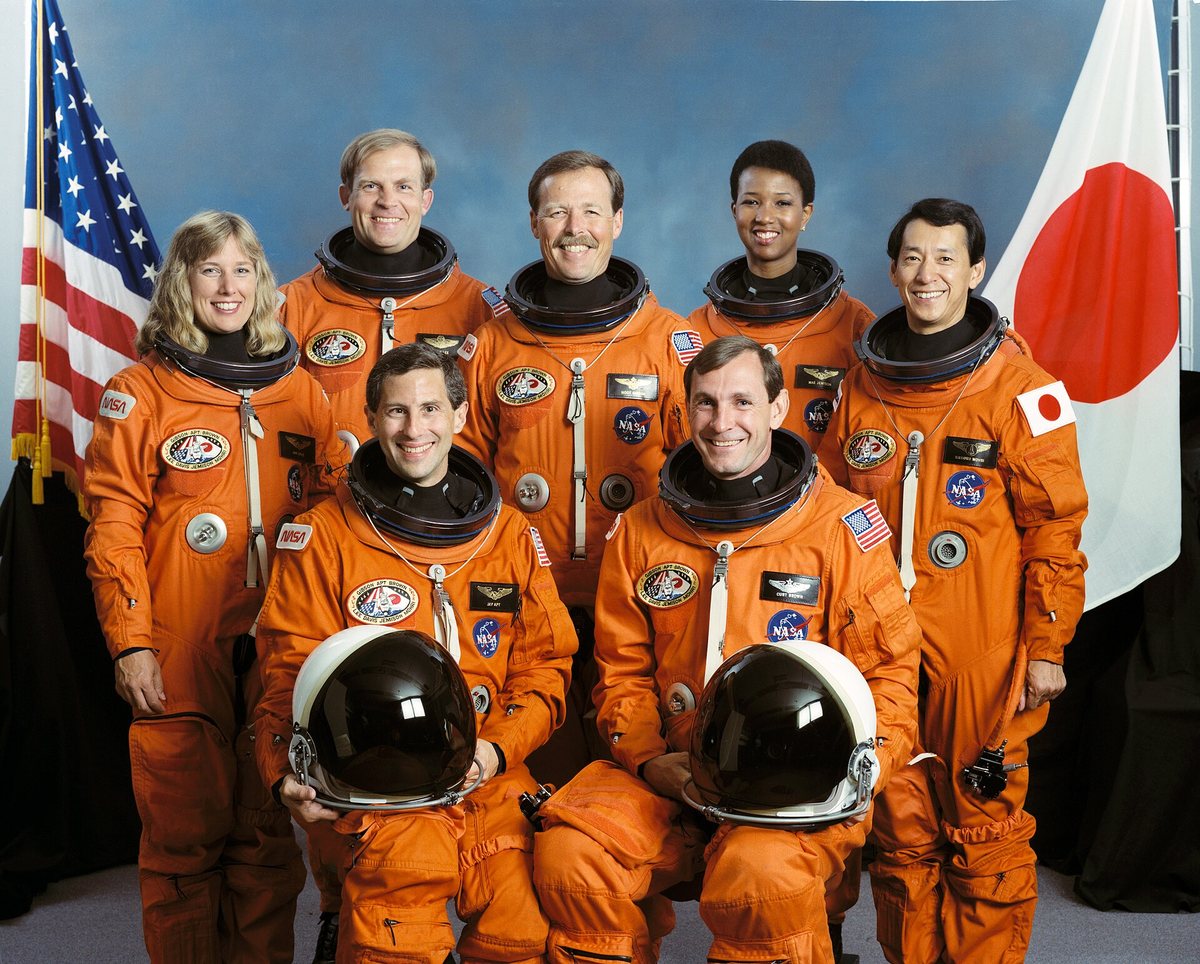
The STS-47 crew. Front, from left: Jerome Apt and Curtis Brown. Back: Jan Davis, Mark Lee, Robert Gibson, Mae Jemison and Mamoru Mohri of Japan. Photo: NASA.
STS-47 was the 50th space shuttle mission and the second flight of Endeavour. The seven crew members were commander Robert Gibson, pilot Curtis Brown, mission specialists Mark Lee, Jan Davis, Jerome Apt and Jemison. The seventh member was Mamoru Mohri, a payload specialist from Japan and the first Japanese astronaut to fly on the shuttle. Lee and Davis were married, and they are the only married couple to have flown together on the shuttle.
Endeavour launched from Pad 39B at Kennedy Space Center at 10:23 a.m. Eastern time on 12 September 1992. The main payload was Spacelab-J, a pressurized laboratory module in the cargo bay for a joint mission of NASA and Japan’s space agency. Inside it the crew ran materials science and life science experiments. The crew worked in two 12-hour shifts so the laboratory was staffed around the clock. Jemison, Davis and Apt were the Blue Shift. Brown, Lee and Mohri were the Red Shift.

Jemison floating inside the Spacelab module during STS-47. Photo: NASA.
What did Mae Jemison do in space?
Jemison worked on experiments in biology and medicine. She and Mohri tested a method called Autogenic Feedback Training, which uses biofeedback to help people control their own body responses. It was developed as a possible treatment for motion sickness, anxiety and stress. She tested a NASA system that made sterile water and mixed it into saline solution for IV bags in space. She was a co-investigator on two bone cell experiments. She also took part in an experiment that made female frogs ovulate and tracked how the fertilized eggs developed into tadpoles in weightlessness.
The other experiments on the mission used koi fish, chicken embryos, fruit flies, plant seeds and cultured cells. Spacelab-J carried 24 materials science experiments and 20 life science experiments.
Jemison brought a few personal items: a poster from the Alvin Ailey American Dance Theater, a West African statuette and a photo of Bessie Coleman, the first African American with an international pilot’s license. She began each of her shifts with “Hailing frequencies open”, the line used on the starship Enterprise.
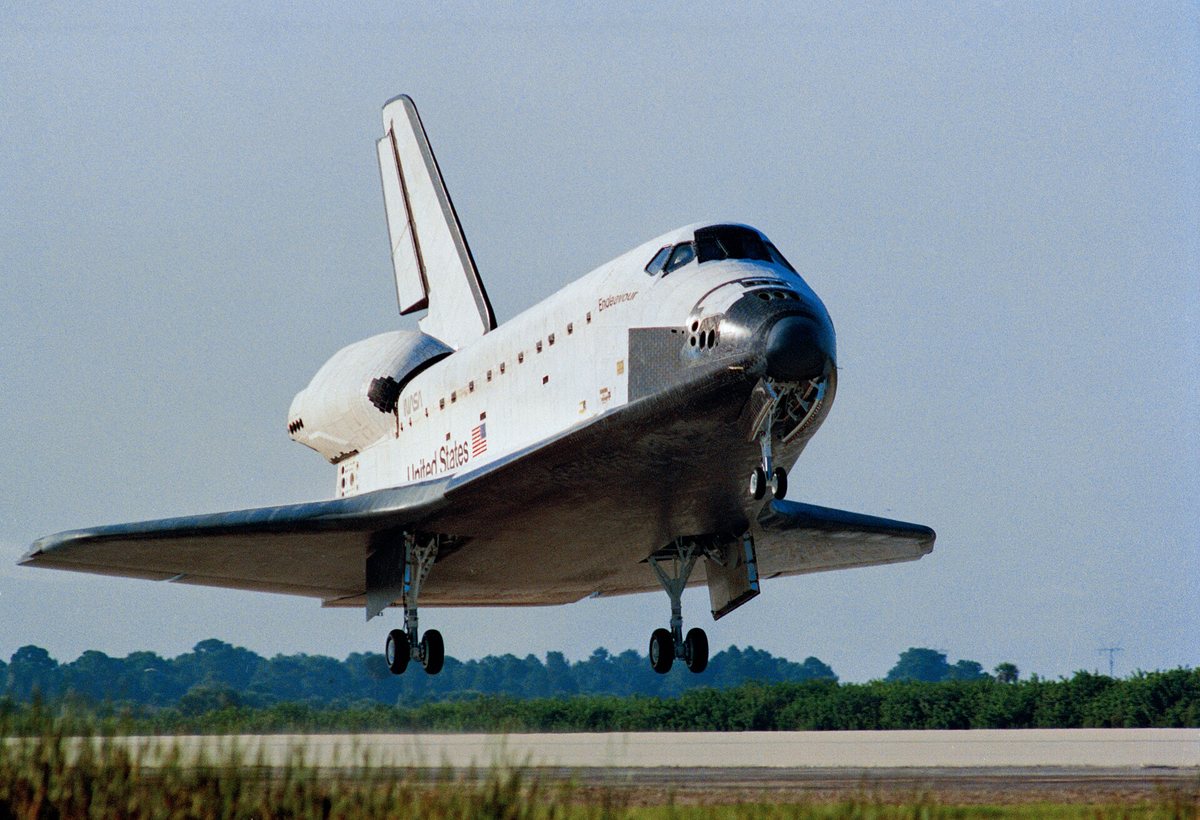
Endeavour landing at Kennedy Space Center on 20 September 1992. Photo: NASA.
The mission was planned to end on 19 September and NASA extended it by one day to finish experiments. Endeavour landed at Kennedy Space Center at 8:53 a.m. Eastern time on 20 September 1992. Jemison had made 127 orbits of Earth and logged 190 hours, 30 minutes and 23 seconds in space. It was her only spaceflight. The shuttle missions that mattered most include other flights of the same era.
After NASA
Jemison resigned from NASA in March 1993 to start her own company. The Jemison Group is a consulting firm that studies how new technology affects society and culture. In 1999 she founded BioSentient Corporation and licensed the Autogenic Feedback Training method that she and Mohri tested in orbit.
She also founded the Dorothy Jemison Foundation for Excellence, named for her mother. Its best-known program is The Earth We Share, a four-week science camp for students aged 12 to 16, started in 1994. Camps have been held at Dartmouth College and other US sites, and in South Africa, Tunisia and Switzerland. Teams of students use the scientific method to solve a real problem in their own communities.
From 1995 to 2002 Jemison was a professor of environmental studies at Dartmouth College, where she directed the Jemison Institute for Advancing Technology in Developing Countries. From 1994 to 1998 she hosted the Discovery Channel science series World of Wonder.
What is the 100 Year Starship?
The 100 Year Starship was a one-year study started by the US defense research agency DARPA with NASA’s Ames Research Center. The question was what it would take to send humans to another star within 100 years, and how to build an organization that could work on that question for a century. In 2012 the Dorothy Jemison Foundation for Excellence led the winning proposal and received a DARPA grant. The new organization kept the name 100 Year Starship, and Jemison became its leader. It held public symposia each year from 2011 to 2015 and again in 2023.
Mae Jemison on Star Trek
The actor LeVar Burton learned that Jemison was a Star Trek fan and asked whether she wanted to be on the show. She appeared as Lieutenant Palmer in “Second Chances”, the 24th episode of season 6 of Star Trek: The Next Generation. Burton directed the episode, which first aired on 22 May 1993. Jemison became the first real astronaut to guest-star in a Star Trek series.
Mae Jemison’s books
Jemison wrote a memoir for young readers and a set of four science books. Her memoir covers her childhood, Stanford, the Peace Corps and her time as an astronaut. The science books were written with Dana Meachen Rau and tell young readers about the solar system and the 100 Year Starship.
| Book | Author | First published |
|---|---|---|
| Find Where the Wind Goes: Moments from My Life | Mae Jemison | 2001 |
| Journey Through Our Solar System | Mae Jemison and Dana Meachen Rau | 2013 |
| Discovering New Planets | Mae Jemison and Dana Meachen Rau | 2013 |
| Exploring Our Sun | Mae Jemison and Dana Meachen Rau | 2013 |
| The 100 Year Starship | Mae Jemison and Dana Meachen Rau | 2013 |
Honors and namesakes
- Halls of fame: National Women’s Hall of Fame (1993), Texas Women’s Hall of Fame (2002) and International Space Hall of Fame (2004).
- Awards: The Buzz Aldrin Space Pioneer Award (2017) and the Sylvanus Thayer Award from the US Military Academy (2021). She holds more than a dozen honorary doctorates.
- Schools and museums: The Mae C. Jemison Science and Space Museum at Wilbur Wright College in Chicago, the Mae C. Jemison Academy in Detroit, the Mae Jemison School in Hazel Crest, Illinois and Jemison High School in Huntsville, Alabama.
- Google Doodle: On 8 March 2019, International Women’s Day, a Google Doodle featured her words “Never be limited by other people’s limited imaginations.”
- LEGO: Jemison is one of four minifigures in the 2017 LEGO Ideas set Women of NASA, item 21312.
Black women in space after Mae Jemison
Stephanie Wilson became the second Black woman in space when she flew on the shuttle Discovery mission STS-121 in July 2006. Joan Higginbotham was the third, on STS-116. In April 2022 Jessica Watkins became the first Black woman to join the International Space Station for a long-duration stay. The list of famous female astronauts covers more women who followed Ride and Jemison.
Quotes
“Never be limited by other people’s limited imaginations.”
Mae Jemison, featured in the Google Doodle of 8 March 2019
“Everybody was thrilled about space, but I remember being really really irritated that there were no women astronauts.”
Mae Jemison, recalling the Apollo years
More astronaut biographies
Jemison applied after the flights of Sally Ride (the first American woman in space) and Guion Bluford (the first African American in space). Yuri Gagarin made the first human spaceflight in 1961. Jemison was born on 17 October, so she appears in the list of astronauts born in October. More lists: famous American astronauts, famous astronauts and what retired astronauts do now. The space quizzes test what you learned.
Books About Mae Jemison
These six books cover Jemison’s life and work for readers from preschool to middle school. The best space books for kids guide has more picks. All six were in stock on Amazon US in November 2026.
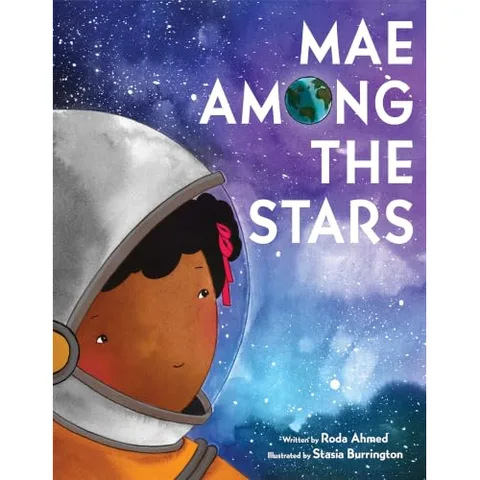
Best picture book
Mae Among the Stars
Roda Ahmed and illustrator Stasia Burrington tell the story of young Mae and the parents who encourage her dream of dancing in space. It is a 40-page hardcover for ages 4 to 8.
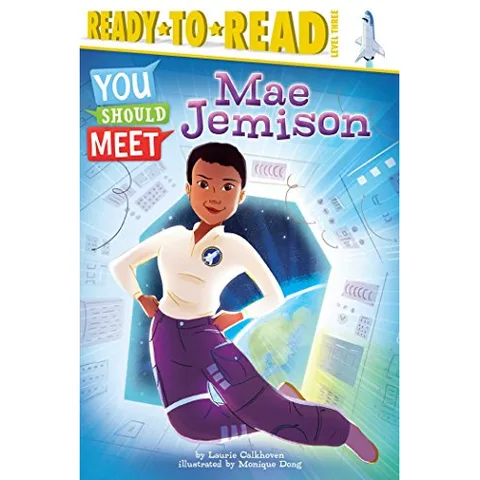
First chapter reader
Mae Jemison: Ready-to-Read Level 3 (You Should Meet)
Laurie Calkhoven covers medical school, the Peace Corps and the STS-47 flight for early readers, with a space timeline in the back. It is a 48-page paperback for ages 5 to 8.
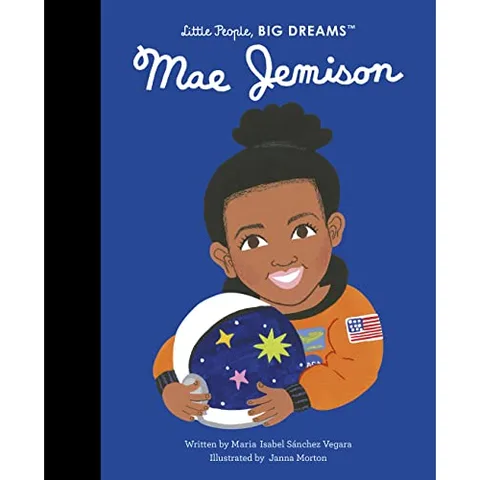
Short biography
Mae Jemison (Little People, BIG DREAMS)
Maria Isabel Sanchez Vegara and illustrator Janna Morton follow Jemison from the Apollo years to Endeavour. The 32-page hardcover ends with a timeline and photographs and is for ages 5 to 8.
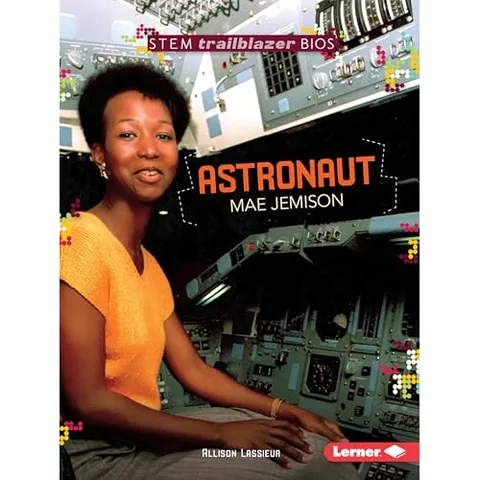
For ages 7 to 11
Astronaut Mae Jemison (STEM Trailblazer Bios)
Allison Lassieur describes how Jemison’s science background led to her bone cell experiments aboard Endeavour and to her work in science education. It is a 32-page paperback with photographs for grades 2 to 5.
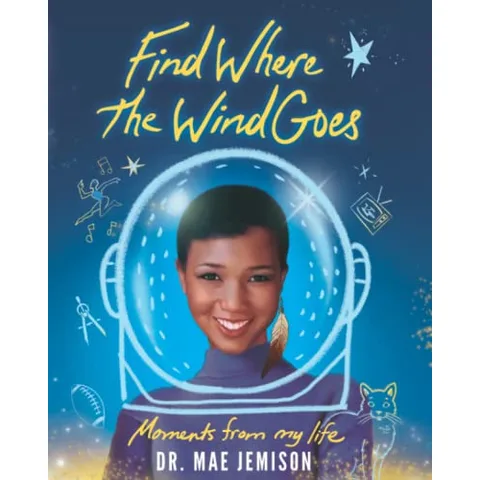
Jemison’s own memoir
Find Where the Wind Goes: Moments from My Life (Deluxe Color Edition)
Jemison tells her own story, from childhood tests of limits to her years as an astronaut. This 2022 deluxe edition adds new material and 16 color illustrations. The 191-page paperback suits middle school readers and up.
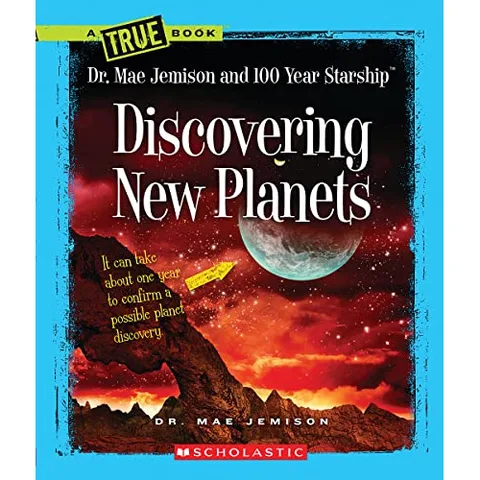
Science book by Jemison
Discovering New Planets (A True Book)
Jemison and Dana Meachen Rau explain how astronomers find planets around other stars and why some scientists think life could exist on them. The 48-page paperback is for ages 8 to 10.
Sources
- Wikipedia, “Mae Jemison”, “STS-47”, “NASA Astronaut Group 12” and “100 Year Starship”: biography, selection, crew, mission details, experiments, post-NASA career, honors and books.
- Wikipedia, “Stephanie Wilson”, “Joan Higginbotham”, “Jessica Watkins” and “Second Chances (Star Trek: The Next Generation)”.
- NASA photo captions on Wikimedia Commons: crew positions, landing time and date and the images on this page.
- Publisher and Amazon listings for the book details.
FAQ
Who is Mae Jemison?
Mae Jemison is an American physician, engineer and former NASA astronaut. She became the first Black woman in space on 12 September 1992 aboard the space shuttle Endeavour. She later founded a technology consulting company and the Dorothy Jemison Foundation for Excellence and led the 100 Year Starship project.
When did Mae Jemison go to space?
Mae Jemison launched on 12 September 1992 and landed on 20 September 1992. She flew as a mission specialist on STS-47 aboard the space shuttle Endeavour. It was her only spaceflight.
How old was Mae Jemison when she went to space?
She was 35. Jemison was born on 17 October 1956 and launched on 12 September 1992, about five weeks before her 36th birthday.
How old is Mae Jemison?
Mae Jemison turned 70 on 17 October 2026. She was born on 17 October 1956 in Decatur, Alabama.
Is Mae Jemison still alive?
Yes. Mae Jemison is alive. She turned 70 in 2026, speaks publicly about science education and leads the 100 Year Starship project.
How long was Mae Jemison in space?
She spent 190 hours, 30 minutes and 23 seconds in space, about 7 days and 22 hours. In that time Endeavour made 127 orbits of Earth.
What did Mae Jemison do in space?
She ran biology and medicine experiments inside the Spacelab-J laboratory. She tested a biofeedback treatment for motion sickness, made saline solution from sterile water, helped with two bone cell experiments and took part in an experiment on frog eggs and tadpoles.
Was Mae Jemison the first Black woman in space?
Yes. Mae Jemison was the first Black woman in space. Stephanie Wilson became the second in 2006 and Joan Higginbotham the third.
What did Mae Jemison do before NASA?
She studied chemical engineering at Stanford University, earned a medical degree from Cornell University and worked as a doctor. From 1983 to 1985 she was a Peace Corps medical officer in Liberia and Sierra Leone. She was also a trained dancer.
Was Mae Jemison on Star Trek?
Yes. She played Lieutenant Palmer in the Star Trek: The Next Generation episode “Second Chances”, first aired on 22 May 1993. She was the first real astronaut to appear in a Star Trek series.