In November 1967, radio astronomer Jocelyn Bell Burnell noticed a series of perfectly regular radio pulses coming from the sky — the first recorded pulsar, catalogued as PSR B1919+21. That steady tapping from space was startling: an object behaving like a cosmic lighthouse with clocklike regularity. The discovery mattered because it revealed a new class of compact star and opened a way to study physics at densities, magnetic fields, and rotation rates impossible to reproduce on Earth.
Pulsars are among the most precise natural clocks and strangest objects in the universe; understanding them reveals insights about extreme physics, practical navigation tools, and the structure of our galaxy. Here are eight fascinating facts about pulsars presented as compact, readable items that range from their supernova origins to their use in spacecraft navigation and tests of gravity.
The list is grouped into three themed sections: nature and formation; observation and uses; and extreme-physics probes. Read on for concise explanations, specific examples (Crab Pulsar, Vela, PSR B1919+21), and a few surprising numbers that show why these spinning stars matter.
What Pulsars Are and How They Form
Pulsars are a subtype of neutron star produced when massive stars end their lives in core-collapse supernova explosions. Their defining behavior is periodic pulses of radiation produced as the compact remnant spins with a misaligned magnetic axis. You’ll find young pulsars near supernova remnants and concentrated along the plane of the Milky Way. Typical neutron-star radii are roughly 10–20 km with masses around 1.4–2.0 times the Sun, and the environment where they form helps astronomers locate them using multiwavelength observations.
1. Pulsars are rapidly spinning neutron stars formed in supernovae
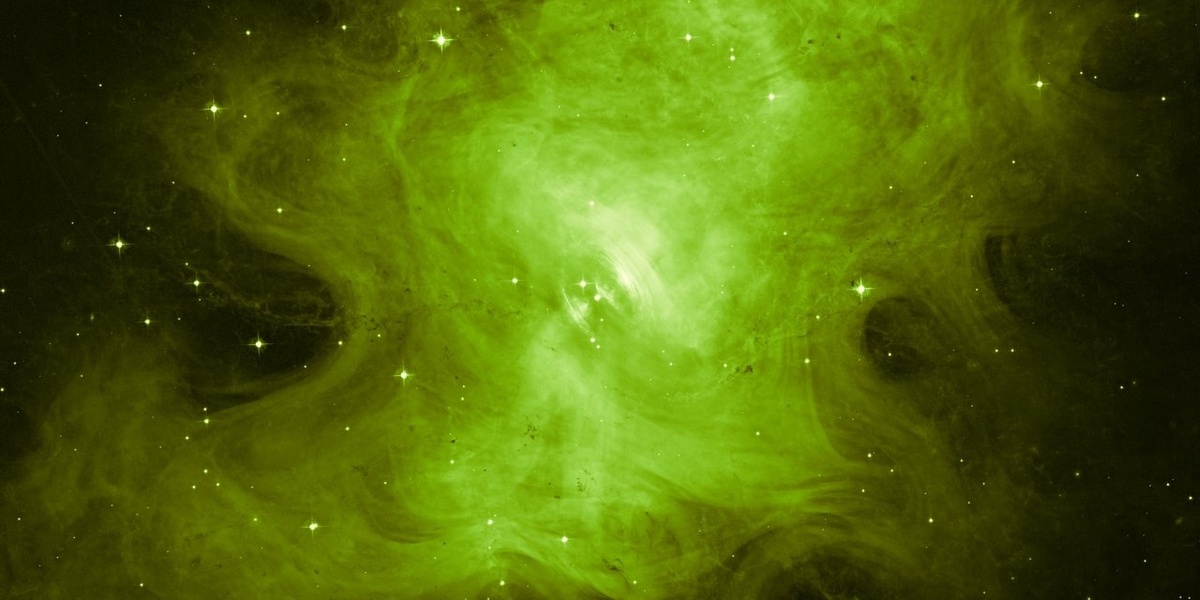
Pulsars are rotating neutron stars created when massive stars exhaust their fuel and undergo a core-collapse supernova. The connection to supernovae was reinforced by examples like the Crab Pulsar, which formed in the supernova observed in 1054, and by the spatial association of many pulsars with supernova remnants. The first pulsar identification came from Jocelyn Bell Burnell in 1967 (PSR B1919+21), which confirmed the phenomenon observationally. Typical neutron-star radii are about 10–20 km and masses lie near 1.4–2.0 solar masses, meaning a stellar core collapses to a city-sized object with enormous gravity and rapid rotation.
2. They cram more mass than the Sun into a city-sized sphere
A neutron star’s density is extreme: roughly 10^17 kg/m^3, comparable to the density of an atomic nucleus. That comes from packing about 1.4–2.0 solar masses into a radius of order 10–20 km. Precise mass measurements — for example, PSR J1614–2230 at about 1.97 M☉ and PSR J0348+0432 around 2.01 M☉ — are crucial because they rule out many theoretical equations of state for ultra-dense matter. Catalogs such as the ATNF Pulsar Catalog collect these measurements and help astrophysicists test models of neutron-star interiors and nuclear physics under extreme pressure.
3. Pulsar rotation spans milliseconds to seconds — and that variety matters
Pulsar spin periods range widely: the fastest millisecond pulsars rotate in about 1.4–1.6 ms (PSR B1937+21 spins at roughly 1.5578 ms), while some young pulsars have periods of a few tenths of a second to several seconds (the Crab Pulsar spins about once every 33 ms). Millisecond pulsars are typically “recycled” in binary systems, spun up by accretion from a companion star. Spin rate influences timing stability and observational utility: faster, recycled pulsars often make the best precision clocks for timing experiments and navigation concepts because they provide more pulses per unit time and usually lower timing noise.
How We Observe Pulsars and What We Learn
Astronomers detect pulsars across radio, X-ray, and gamma-ray bands using radio telescopes and spaceborne instruments. Long-term timing campaigns measure pulse arrival times with astonishing accuracy. Observations span discovery surveys, follow-up timing, and multiwavelength studies (radio timing for stability, X-rays for compact binaries, gamma rays for energetic young pulsars). Coordinated programs like pulsar timing arrays aggregate decade-long datasets to search for tiny perturbations in pulse times caused by gravitational waves or other astrophysical effects.
4. Pulsar signals are incredibly regular — some rival atomic clocks
Many pulsars emit pulses with astonishing regularity: the best millisecond pulsars show timing residuals down to the 100-nanosecond to microsecond level over years of observation. Programs such as NANOGrav (North America), the European Pulsar Timing Array (EPTA), and the Parkes Pulsar Timing Array (PPTA) collect these precise measurements. That stability enables searches for low-frequency gravitational waves and allows tests of fundamental physics with long-baseline timing. Examples of highly stable pulsars include PSR J1909–3744 and PSR B1937+21, which serve as the backbone for precision timing efforts.
5. Pulsar timing can power spacecraft navigation
Using pulsar timing as a natural GPS for deep space has moved from concept to demonstration. Autonomous navigation schemes exploit the predictable arrival times of pulses, particularly in X-rays where compact detectors can be flown on spacecraft. NASA’s NICER/SEXTANT demonstration showed the potential for X-ray pulsar-based navigation, and studies by ESA and industry groups explore designs for future missions. Performance depends on instrumentation, but prototypes have claimed position fixes to within tens of kilometers — useful for missions to the Moon, Mars, and beyond where Earth-based tracking is limited.
6. Binary pulsars test general relativity and revealed orbital decay
Binary systems containing pulsars provide some of the cleanest tests of gravity. The Hulse–Taylor binary pulsar (PSR B1913+16), discovered in 1974, showed orbital period decay that matched general relativity’s prediction for energy loss to gravitational waves; that result earned Hulse and Taylor the 1993 Nobel Prize. Measurements of orbital decay and relativistic timing effects in systems like the double pulsar PSR J0737–3039A/B (discovered in 2003) have tested gravity to high precision and helped pave the way for direct gravitational-wave detections by LIGO and Virgo.
Pulsars as Probes of Extreme Physics and the Galaxy
Pulsars and their relatives probe magnetic fields, dense-matter physics, and the interstellar medium. Radio pulse dispersion and scattering reveal the free-electron content and turbulence in the Galaxy, while timing and mass measurements constrain the equation of state for ultra-dense matter. Related objects, magnetars, extend the range of observed magnetic fields to levels far beyond typical pulsars, offering a laboratory for high-field electrodynamics. Together, pulsars map the Milky Way and let us study physics unattainable in terrestrial labs.
7. Pulsars map the galaxy — dispersion measures reveal distance and intervening plasma
When radio pulses travel through the interstellar medium, lower frequencies are delayed more than higher ones; that frequency-dependent delay defines the dispersion measure (DM), expressed in pc cm-3. Catalogs now list DMs for thousands of pulsars (see the ATNF Pulsar Catalog), and astronomers use those values to estimate distances and chart the Galaxy’s free-electron distribution. For example, the Crab Pulsar has a DM around 56.8 pc cm-3, while more distant objects exhibit much higher DMs. Correcting for dispersion is also essential for high-precision timing.
8. They’re natural labs for extreme magnetism and dense-matter physics
Pulsars and magnetars expose magnetic fields and densities unreachable on Earth. Typical pulsar surface fields span roughly 10^8–10^12 gauss, while magnetars can reach ~10^14–10^15 G (for example, SGR 1806–20). Densities sit near 10^17 kg/m^3, and accurate mass measurements such as PSR J0348+0432 (~2.01 M☉) help rule out soft equations of state for neutron-star cores. Observations feed back into nuclear and particle physics by constraining models of matter under extreme pressure and informing theories of neutron-star interiors.
Summary
- The discovery in 1967 (PSR B1919+21) revealed a new kind of compact star and launched precision-timing astronomy.
- Pulsars pack ~1.4–2.0 solar masses into a 10–20 km radius and reach densities near 10^17 kg/m^3, constraining nuclear physics.
- Millisecond pulsars offer timing stability down to microseconds or better, enabling pulsar timing arrays (NANOGrav, EPTA, PPTA) and searches for low-frequency gravitational waves.
- Practical uses include pulsar-based navigation demonstrations (NICER/SEXTANT) and mapping the Galaxy via dispersion measures; explore the ATNF Pulsar Catalog or follow NANOGrav to learn more.
Enjoyed this article?
Get daily 10-minute PDFs about astronomy to read before bed!
Sign up for our upcoming micro-learning service where you will learn something new about space and beyond every day while winding down.