Constellations are patterns of stars that people have named and used for thousands of years. Some are easy to spot, like Orion or the Big Dipper’s parent constellation, Ursa Major. Others take a little more patience and a darker sky.
Quick answer
A constellation is a recognized area of the sky with an official name and boundary, not just a random star pattern. The most famous examples include Orion, Ursa Major, Cassiopeia, Scorpius, Crux, Taurus, Leo, and Cygnus.
If you want a practical list of examples of constellations, the 15 below are the ones most beginners hear about first — and the ones most likely to help you actually find your way around the sky.
Table of contents
- Famous northern hemisphere constellations
- Famous southern hemisphere constellations
- Zodiac constellations
- How to tell a constellation from an asterism
- Tips for spotting constellations
Famous northern hemisphere constellations
Most of the classics people learn first are northern sky regulars. They’re easier to recognize because they show up in so many star charts, planetarium apps, and “find your way by the stars” guides.
1. Orion

Orion is probably the easiest constellation for beginners to identify. Three bright stars in a short, straight line form Orion’s Belt, which makes the whole pattern stand out even from light-polluted suburbs. The reddish star Betelgeuse sits near one shoulder, while bright blue-white Rigel marks a foot on the opposite side.
Orion is a winter constellation in the Northern Hemisphere and a summer constellation in the Southern Hemisphere. It’s one of the few that looks unmistakably like a shape, not just a star cluster with a marketing department.
2. Ursa Major
Ursa Major means “the Great Bear,” though most people know its most famous feature as the Big Dipper. Technically, the Big Dipper is an asterism inside Ursa Major, not the whole constellation.
It’s useful because two of its stars point toward Polaris, the North Star. That makes Ursa Major more than a pretty pattern — it’s a practical sky compass.
3. Cassiopeia
Cassiopeia is the zigzag “W” or “M” shape near the north celestial pole. It’s one of the easiest northern constellations to spot because it’s bright, distinct, and visible for much of the year in the Northern Hemisphere.
If Orion is the show-off constellation, Cassiopeia is the one that quietly hangs out near the pole and makes navigation easier than it has any right to.
4. Taurus
Taurus is a zodiac constellation associated with the Bull. Its most obvious marker is the bright orange-red star Aldebaran, which sits near the V-shaped Hyades star cluster. Nearby, the Pleiades cluster makes Taurus even easier to identify.
It’s a solid example of how constellations often work in practice: one bright star, a recognizable nearby cluster, and a shape that comes together only after a little training.
5. Gemini
Gemini represents the twins Castor and Pollux, who are marked by two bright stars that sit close together. That twin-star pairing is the whole trick.
Gemini is also a zodiac constellation and a familiar winter-sky pattern in the Northern Hemisphere. Once you know Castor and Pollux, the rest of the constellation is easier to piece together.
6. Leo
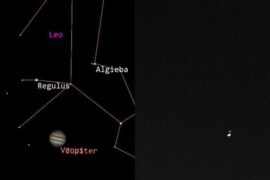
Leo is another zodiac constellation and one of the easier lion-shaped patterns to identify. The star Regulus marks the lion’s heart, and the curve of stars nearby suggests the head and mane.
It shows up prominently in spring skies in the Northern Hemisphere. If you can find the backward question mark known as the Sickle, you’ve found the front half of Leo.
7. Cygnus
Cygnus is the Swan, and the easiest way to spot it is by looking for the bright star Deneb and the cross-shaped pattern often called the Northern Cross.
It sits along the Milky Way, so Cygnus is one of the best constellations for noticing just how crowded the sky gets in that band. On a dark night, it looks like a stitched-together section of the galaxy.
Famous southern hemisphere constellations
These constellations are especially useful if you live south of the equator, but many can still be seen from parts of the Northern Hemisphere.
8. Crux
Crux, or the Southern Cross, is one of the most famous southern constellations in the world. It’s small but extremely useful for navigation. In the Southern Hemisphere, it helps point toward the south celestial pole.
Crux is compact, bright, and easy to memorize. That combination is why it appears on flags, maps, and every astronomy beginner’s shortlist.
9. Centaurus
Centaurus is a large southern constellation with two of the sky’s best-known stars: Alpha Centauri and Beta Centauri. Alpha Centauri is the nearest star system to the Sun, and that alone makes this constellation worth knowing.
It’s not as tidy-looking as Crux. It sprawls. But once you know where to look, it anchors a huge patch of the southern sky.
10. Carina
Carina means “the keel” of a ship, and it was once part of the much larger constellation Argo Navis. Its brightest star is Canopus, the second-brightest star in the entire night sky.
That’s a pretty useful calling card. If you can spot Canopus, you’re looking at one of the sky’s heavyweight constellations.
11. Sagittarius
Sagittarius is a zodiac constellation and one of the most important regions of the sky if you care about the Milky Way’s center. The constellation is often drawn as an archer, though beginners usually find the “teapot” asterism first.
That teapot shape is a classic example of why asterisms and constellations get mixed up. People remember the teapot. The official constellation is bigger and less tidy.
12. Scorpius
Scorpius is another zodiac constellation and one of the most recognizable in the southern half of the sky. The bright red star Antares marks the scorpion’s heart.
The curve of stars behind it forms the tail and stinger. Once you see it, you don’t forget it. Scorpius looks like something dangerous is crawling across the Milky Way.
Zodiac constellations
The zodiac constellations sit along the ecliptic, the path the Sun appears to follow across the sky over the course of a year. That’s why the Moon and planets often pass through them.
13. Aries
Aries is a smaller zodiac constellation with a modest star pattern. It’s not the most dramatic constellation in the sky, but it’s historically important because it has long been part of zodiac lore and sky mapping.
It’s a good reminder that not every famous constellation is flashy. Some are famous because they’ve been useful for a very long time.
14. Virgo
Virgo is one of the largest constellations in the sky and another zodiac pattern. Its brightest star is Spica, which helps make it easier to locate than its faint outline might suggest.
Virgo is a good example of a constellation that matters more for where it sits than for how obvious it looks. It occupies a huge stretch of sky, even if the stick-figure version is a little underwhelming.
15. Pisces
Pisces is a faint zodiac constellation with a loose, subtle shape. You usually won’t spot it by star power alone. It takes darker skies and a little patience.
That makes Pisces a useful reality check. Not every constellation jumps out at you. Some are more like a faint sketch than a bold outline.
For a broader taxonomy of constellations, see Types of Constellations: The Complete List.
How to tell a constellation from an asterism
This is where a lot of beginner astronomy guides get slippery.
A constellation is an official region of the sky. A asterism is an informal star pattern. The Big Dipper is the famous example: it’s not a constellation by itself, but part of Ursa Major.
The same goes for the Summer Triangle, the Teapot, and the Northern Cross. Useful? Absolutely. Official constellations? Not always.
If you want the formal map used by astronomers, the International Astronomical Union defines all 88 modern constellations and their boundaries.
For a visual reference on the ecliptic and zodiac constellations, NASA’s What Is the Zodiac? page is a good place to start.
Tips for spotting constellations
Start with the bright ones. Orion, Cassiopeia, Scorpius, Crux, and Ursa Major are easier to learn than faint constellations like Pisces or Aries.
Use a season-friendly app or star chart. Constellations move through the night and through the year because Earth is moving around the Sun. The Royal Astronomical Society of Canada has helpful observing resources if you want a beginner-friendly next step.
Look for anchor stars first. In many constellations, one bright star does most of the heavy lifting: Betelgeuse in Orion, Aldebaran in Taurus, Antares in Scorpius, Spica in Virgo. Once you have that anchor, the rest of the pattern starts to make sense.
And don’t expect every constellation to look like the drawing in a book. The sky is messier than the diagrams. That’s part of the fun.
Final thoughts on examples of constellations
The best examples of constellations are the ones you can actually use, not just memorize. Orion, Ursa Major, Cassiopeia, Crux, Scorpius, and the rest of the familiar sky patterns give you a framework for reading the night sky instead of staring at it like it’s a screensaver.
If you only learn a few examples of constellations, make them the bright, distinctive ones first. They’ll teach you how the sky is organized — and make the rest of the constellations much easier to find later.
For a broader overview of constellation types, see Types of Constellations: The Complete List.
Enjoyed this article?
Get daily 10-minute PDFs about astronomy to read before bed!
Sign up for our upcoming micro-learning service where you will learn something new about space and beyond every day while winding down.