What would happen if the Sun simply vanished right now? Imagine a bright noon that stays bright for roughly eight minutes and twenty seconds, then the sky goes dark and the world cools into an unfamiliar twilight. That delayed blackout is the first sign that something catastrophic has happened.
The Sun supplies nearly all the energy that drives Earth’s climate, ecosystems, and much of our technology. Light and gravitational information travel at the speed of light, so observers would keep seeing sunlight for about 8 minutes 20 seconds (the Earth–Sun distance is 1 AU = 149.6 million km) before the loss registers. This thought experiment—sometimes asked as what if sun disappeared—matters because the Sun underpins weather, food production, and power systems worldwide.
This article lists eight science-backed consequences, ordered from immediate astronomical effects to long-term societal outcomes. Expect clear numbers (8 minutes 20 seconds; Earth’s orbital speed ~29.78 km/s), references to NASA where relevant, and practical examples of which systems could keep working and which would fail. Below I walk through the immediate cosmic effects, the fast environmental collapse, biological consequences, and human responses.
Immediate cosmic and orbital effects
Both light and changes in gravity propagate at the speed of light, so Earth would receive both sunlight and the Sun’s pull for about 8 minutes 20 seconds after the Sun vanished. NASA explains that electromagnetic signals and gravitational information travel at c, so nothing instantaneous happens to observers at 1 AU. Then, when those signals stop arriving, dynamics shift suddenly.
For the first ~8 minutes 20 seconds everything appears unchanged. Then sunlight cuts out and, at the same instant, Earth no longer feels the Sun’s gravity; the planet’s motion becomes ballistic. The short delay is key to understanding the chain of events that follow.
1. Global darkness arrives after about 8 minutes and 20 seconds
Observers would see sunlight for roughly 8 minutes 20 seconds after the Sun vanished, then the sky would go dark. Light travels at about 299,792 km/s and the Earth is 1 AU (149.6 million km) from the Sun, so the 8 minutes 20 seconds delay follows directly from basic physics.
Twilight and atmospheric scattering would soften the transition in some places—cities might still glow from streetlights and building illumination—but solar panels and any system relying on direct sunlight would stop producing power after that interval. The International Space Station’s solar arrays would stop seeing the Sun after ~8 minutes 20 seconds, and rooftop photovoltaic systems and utility-scale battery-backed arrays would offer only limited hours of backup power.
Air traffic, outdoor work, and night-sensitive operations would face immediate disruption. Backup battery systems and diesel generators could keep critical functions running for hours to days, but without resupply and with rising heating demand, those stopgap measures would quickly be overwhelmed.
2. Earth’s orbit would stop being bound and it would fly off tangent
Gravity changes also propagate at light speed, so after the same ~8 minutes 20 seconds Earth would no longer feel the Sun’s gravitational pull. At that moment the planet would cease orbiting and continue on a straight-line path tangent to its previous orbit.
Earth’s orbital speed is about 29.78 km/s. At roughly 30 km/s, Earth would travel about 2,592,000 km in a single day, giving a sense of the distances involved in the weeks and months after the event. Initially, collision probabilities with other bodies remain very low, but over years and centuries the solar system’s dynamics would change in complex ways.
The immediate orbital change is dramatic in concept but slow in consequence for planetary encounters. Most of the short-term effects are environmental rather than collisional; the tangent motion primarily alters long-term trajectories rather than causing instant impacts.
Fast environmental collapse: atmosphere and climate
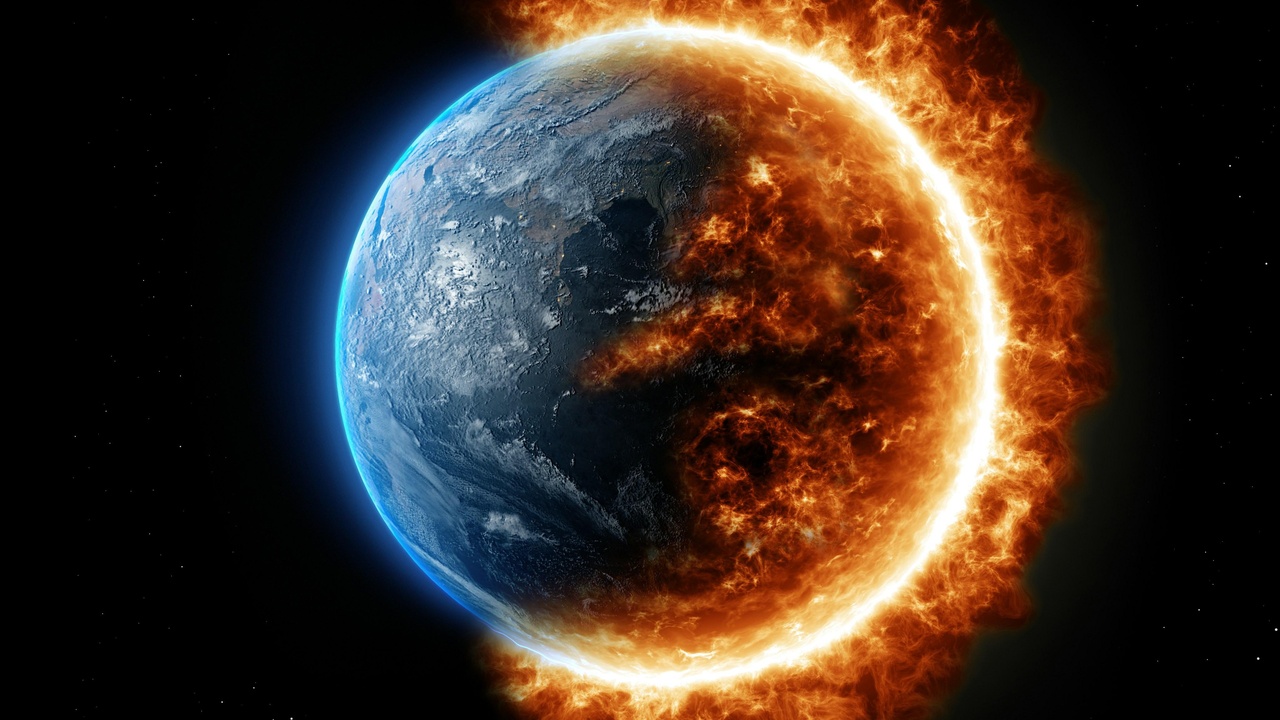
The Sun drives Earth’s weather and maintains surface temperatures. Remove incoming solar energy and the planet begins cooling immediately, with impacts that unfold on timescales from hours to years. Climate models and NASA summaries help outline plausible timelines, though exact numbers vary with model assumptions.
Within hours to days, the temperature gradient between day and night collapses. Within days to weeks, many temperate and cold regions drop below freezing, and within months large portions of the surface are covered in sea ice or permanent frost, depending on ocean circulation and atmospheric retention of heat.
3. Surface temperatures plunge and weather patterns collapse
Without incoming sunlight, the planet starts cooling immediately and weather systems powered by solar heating break down. Temperature gradients that drive wind and precipitation fade, so storms weaken and the familiar patterns of rain and jet streams collapse within days to weeks.
Models show large average drops over the first week to month, with nights and days quickly converging toward cold temperatures. Agriculture, transport, and infrastructure would suffer: crops fail without light, fuel and water systems can freeze, and heating demand spikes beyond most grids’ capacity.
Expect airport closures from frozen runways and brittle materials failing in extreme cold, plus food supply chains breaking as storage and distribution grind to a halt.
4. Oceans freeze at the surface over months; deep water persists longer
Oceans start losing surface heat within weeks, and sea surface temperatures eventually fall near the freezing point of seawater (about −2°C). Surface ice forms and grows, but the oceans’ huge heat capacity and geothermal flux slow a complete freeze.
Sea ice acts as an insulating layer, so deep water and the ocean interior remain liquid for a long time. Hydrothermal vents and the geothermal heat flux keep deep habitats relatively warm—the vents can reach temperatures up to ~400°C and support chemosynthetic life independent of sunlight.
Surface shipping and coastal infrastructure would be crippled within months, while deep-ocean habitats and vent communities could persist for centuries or longer, depending on how circulation and chemistry evolve.
Biological consequences: ecosystems and survivors
The Sun sits at the base of most food webs via photosynthesis. Remove that energy source and primary productivity stops, triggering cascading collapses across ecosystems. Some specialized ecosystems and microbes do not depend on sunlight and could endure.
Phytoplankton drive a large share of oceanic primary productivity and contribute roughly half of current net oxygen production over the long term, so their rapid decline changes food webs and chemical cycles. Atmospheric oxygen would decline only slowly, giving organisms time measured in years to decades before oxygen levels became critically low.
5. Photosynthesis stops and food chains collapse within weeks to months
Photosynthesis needs light, so plants, algae, and phytoplankton stop producing new biomass almost immediately. Herbivores lose food sources within weeks to months, and predators follow as food stocks and livestock supplies are exhausted.
Stored crops and frozen foods could sustain some populations temporarily, and seed banks like the Svalbard Global Seed Vault preserve genetic diversity for the far future, but these resources don’t solve immediate feeding for billions. Indoor agriculture and greenhouses are energy-intensive and would struggle without abundant non-solar power.
Food shortages would prompt rationing, mass migrations, and attempts to prioritize survivors in locations with reliable heat and power.
6. Life finds niches: hydrothermal vents and subterranean refuges
Some ecosystems don’t rely on sunlight. Hydrothermal vent communities, chemosynthetic bacteria, and subterranean microbes gain energy from chemical gradients and geothermal heat and could persist long after surface life collapses.
Tube worms, vent mussels, and their bacterial partners are examples of animals that thrive without sunlight. These systems—and subsurface habitats warmed by Earth’s heat—become the most promising refuges for life, and they also provide models for human survival strategies using geothermal or nuclear heat.
Researchers already study these locations for insights into life’s limits and possible analogs for life on icy worlds beyond Earth (and to learn how to keep small human groups alive in extreme environments).
Human society, infrastructure, and possible responses
Human systems depend on sunlight directly for food and solar power and indirectly for climate stability and psychological well-being. The loss of sunlight will cascade through supply chains, energy networks, and social institutions, producing both rapid failures and uneven longer-term stabilization in places with robust non-solar energy sources.
The question what if sun disappeared would force societies to prioritize heat, power, and food in ways we’ve only practiced in limited emergency contexts. Nuclear and geothermal energy, along with underground or insulated shelters, become central to any coherent survival plan.
7. Critical infrastructure would fail rapidly, then stabilize unevenly
Electricity grids would be strained immediately as heating demand spikes and solar generation disappears within minutes. Regions relying heavily on wind and solar would face the sharpest shortfalls, while those with thermal or nuclear baseload could fare better initially.
Frozen fuel lines, ruptured water mains, and failing communications equipment mirror problems seen in severe cold-weather blackouts, but on a global scale. Logistics and transport break down as roads and ports freeze, compounding shortages and hampering relief efforts.
Over time, networks might stabilize in some regions using local fuel stores, modular nuclear reactors, and geothermal plants, but recovery would be slow and unequal.
8. Possible survival strategies: underground living, geothermal and nuclear power
Plausible strategies to extend human survival center on conserving heat and using steady non-solar power sources. Underground and insulated habitats drastically reduce heat loss, and nuclear reactors or geothermal plants can provide continuous electricity and process heat for decades if managed carefully.
Existing technologies offer rough precedents: underground data centers, geothermal plants, nuclear submarines (closed-life systems), and modular nuclear reactors. Small, closed-loop food systems—fungiculture, algal bioreactors, and lab-grown proteins—could support limited populations when paired with reliable power.
These solutions scale imperfectly. They could keep small communities alive for years to decades, but they wouldn’t sustain billions. Priorities would include protecting reactors, maintaining saltwater desalination for drinking water, and preserving scientific knowledge and seed stocks for eventual recovery.
Summary
- The first sign is delayed: light and gravity reach Earth for about 8 minutes 20 seconds after the event, then sunlight and the Sun’s pull stop.
- Photosynthesis and solar power fail almost immediately after that delay, triggering rapid cooling and collapse of weather and food systems.
- Some ecosystems—deep-ocean hydrothermal vents and geothermal-dependent subterranean communities—could persist for centuries, and small human refuges using nuclear or geothermal power might survive for years to decades.
- For more on the physics and timelines, consult NASA resources (NASA) and support institutions that model extreme planetary scenarios and emergency preparedness.
Enjoyed this article?
Get daily 10-minute PDFs about astronomy to read before bed!
Sign up for our upcoming micro-learning service where you will learn something new about space and beyond every day while winding down.