When the European Space Agency’s Huygens probe descended through Titan’s orange haze on Jan 14, 2005, it became the first craft to touch down on a world with a thick atmosphere other than Earth. The probe sent back images of pebble-strewn riverbeds, a sky with methane clouds, and a surface cold enough (about −179°C, or 94 K) to freeze water yet warm enough to host seas of liquid hydrocarbons.
Titan matters because it combines a dense, nitrogen-dominated atmosphere (surface pressure ≈1.45 bar) with active weather, stable surface liquids, and chemistry that makes complex organic molecules. That mix turns it into a natural laboratory for prebiotic chemistry and a place to test climate and surface-process models far from the Sun.
Below are some surprising facts about Titan, organized into three groups — surface and atmosphere, chemistry and prebiotic potential, and interior and geology — that together show how this moon challenges our expectations about where Earth-like processes can happen.
Liquid seas, rain and surface oddities
Cassini‑Huygens (2004–2017) revealed that Titan has a working system of surface liquids, seasonal storms, shifting shorelines, and extensive dune fields. Together these features paint a picture of a world with a hydrocarbon version of a hydrologic cycle and active surface transport.
1. Lakes and seas of liquid methane and ethane
Titan is the only body besides Earth known to host stable seas on its surface — not of water but of liquid methane and ethane. Cassini’s radar and near‑infrared mapping in the mid‑2000s and later identified large dark patches at high northern latitudes that are true bodies of liquid, with well‑defined shorelines and depth signatures.
Kraken Mare, the largest of these, spans an area comparable to some large terrestrial seas (think roughly the size of the Caspian in order‑of‑magnitude terms), while Ligeia Mare and the smaller Ontario Lacus dot Titan’s poles. At Titan’s surface temperature of ≈−179°C, methane and ethane behave as liquids, allowing erosion, waves, and shoreline processes similar in principle to those on Earth.
2. Methane rain and a methane cycle
Titan has a working methane cycle: methane evaporates from seas, condenses into clouds, falls as rain, and runs off into rivers and lakes. Cassini observed cloud systems, seasonal storms, and surface changes that point to precipitation and surface runoff, including large storm events in the 2009–2010 era that produced widespread surface wetting.
Because solar ultraviolet light breaks methane down in the upper atmosphere on roughly million‑ to ten‑million‑year timescales, there must be processes replenishing the atmosphere’s methane over geologic time. That ongoing cycle drives erosion, carves channels, and creates delta‑like deposits, making Titan a valuable test case for climate modeling with unfamiliar fluids.
3. Sand dunes made of hydrocarbon ‘sand’ stretch for hundreds of kilometers
Away from the poles, Titan’s equatorial regions host vast linear dune fields composed not of silicate grains but of dark organic particles — essentially hydrocarbon “sand” produced in the atmosphere and deposited on the surface. Cassini RADAR and imaging mapped dunes that run for hundreds of kilometers across areas like Shangri‑La and Belet.
The dunes imply persistent winds and a steady supply of organic material from photochemistry. Their scale — continuous ribbons that can extend a few kilometers wide and stretch for hundreds of kilometers — shows that sediment transport and aeolian processes operate on Titan much as they do on Earth, despite the different materials and temperature.
4. Shorelines and lakes change with the seasons
Multi‑year monitoring by Cassini revealed that Titan’s lakes and shorelines are not static. Repeated flybys showed measurable changes in the extent and reflectivity of some northern lakes between passes, interpreted as lake‑level variations and temporary surface wetting after storms.
Those observations suggest seasonal exchange of hydrocarbons between atmosphere and surface over Titan’s 29.5‑year Saturnian orbit, and they raise questions about subsurface reservoirs buffering the surface. Tracking these changes is a major reason missions like Dragonfly and future orbiters are high priorities.
Complex chemistry and prebiotic potential
Titan’s dense nitrogen atmosphere bathed in sunlight and energetic particles drives rich photochemistry that builds complex organics and aerosol hazes known as tholins. That chemistry, plus possible interactions with subsurface water, makes Titan a laboratory for studying prebiotic pathways.
5. A thick nitrogen atmosphere rich in organic compounds
Titan’s surface pressure is about 1.45 bar, thicker than Earth’s, and the atmosphere is mostly molecular nitrogen with a few percent methane and trace hydrocarbons. Huygens sampled this atmosphere directly during its descent on Jan 14, 2005, and Cassini’s mass spectrometers and spectrometers expanded our knowledge of its composition and vertical structure.
The combination of high pressure and a cold surface allows gases, photochemical products, and aerosols to interact in ways uncommon elsewhere in the Solar System. That dense envelope supports clouds, weather, and long residence times for complex molecules — a unique setting for organic chemistry outside Earth.
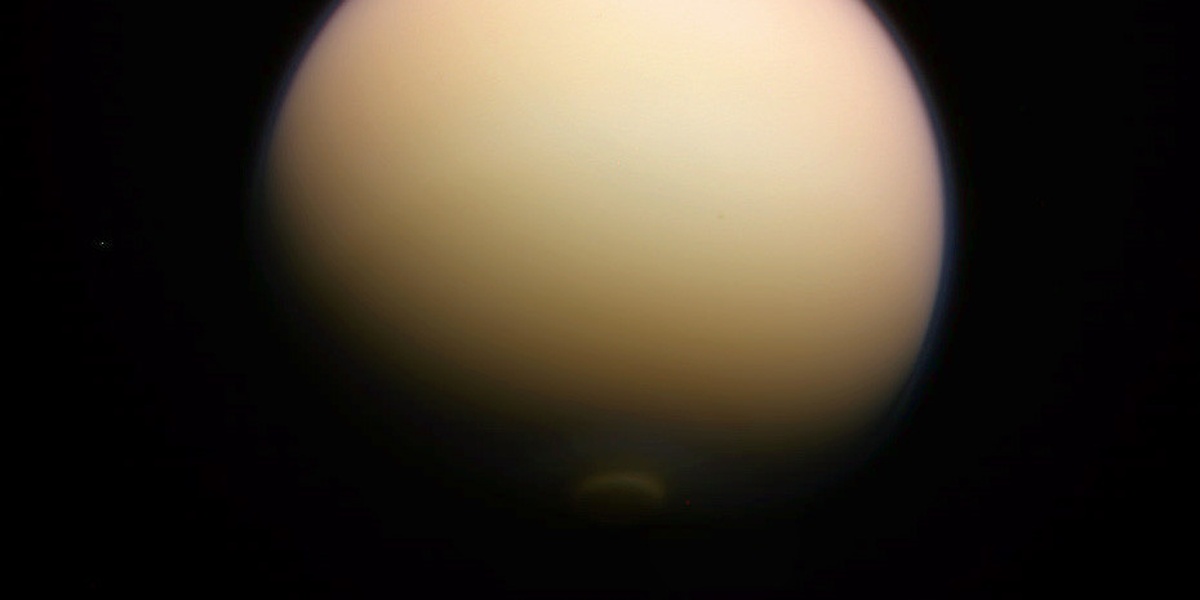
6. Tholins — complex organic aerosols that color Titan orange
High in Titan’s atmosphere, ultraviolet light and charged particles break methane and nitrogen into reactive fragments that recombine into ever more complex molecules. Those products polymerize into aerosols called tholins, which give Titan its orange‑brown haze and settle onto the surface as dark, sticky material.
Laboratory experiments that mimic Titan’s atmosphere — akin to Miller‑Urey style work but adjusted for nitrogen‑methane mixtures and low temperatures — produce tholin‑like materials. Cassini’s instruments matched spectral signatures consistent with these complex organics, making Titan a real‑world counterpart to lab prebiotic chemistry studies.
7. A likely subsurface ocean — water plus ammonia beneath the ice
Cassini’s gravity measurements and observations of tidal flexing indicate that Titan has a subsurface liquid layer beneath its icy shell. The data point to a decoupled outer ice shell floating over a global ocean of water mixed with ammonia, which acts as an antifreeze to keep liquid at lower temperatures.
Estimates place the ocean tens to a few hundred kilometers below the surface, depending on models of ice thickness and composition. That matters because transient or localized exchange between surface organics and liquid water could create environments where prebiotic chemistry proceeds along routes not possible on a dry surface alone.
Interior, geology and surprising dynamics
Titan is a large, active world with signs of internal dynamics: an icy/rocky interior, candidate cryovolcanic features, tectonic‑style deformation, and a surface continually reshaped by both external and internal forces.
8. Titan is bigger than Mercury (but much less dense)
Titan’s radius is about 2,575 km, larger than Mercury’s roughly 2,440 km, making Titan the second‑largest moon in the Solar System after Ganymede. Despite that size, Titan’s mass and density are much lower because it contains a large fraction of water ice mixed with rock.
That combination — planetary scale with a low density and a thick atmosphere — gives Titan a planet‑like character: weather, surface liquids, and climate processes operate on a world that is, in some ways, more like a cold, wet Earth than like a typical small, airless moon.
9. Possible cryovolcanoes and a shifting, active crust
Cassini imagery uncovered features that resemble cryovolcanic constructs and signs of surface renewal. Sotra Patera and several dome‑like edifices were highlighted in studies in the early‑to‑mid 2010s as candidate cryovolcanic sites, where icy lavas or slurries of water and ammonia might have flowed or erupted.
If cryovolcanism occurs on Titan, it provides a mechanism to transport subsurface materials, including water and dissolved compounds, to the surface. That exchange could replenish atmospheric methane and refresh surface organics, reinforcing the idea that Titan is geologically alive rather than dead.
10. Titan is a high-priority target for exploration — Dragonfly is coming
Titan remains one of the most compelling exploration targets in the outer Solar System, and NASA’s Dragonfly rotorcraft mission will visit to investigate surface organics and habitability. Selected in 2019, Dragonfly is scheduled to launch in 2027 and arrive at Titan around 2034, where it will fly to multiple sites to sample diverse terrains.
Dragonfly’s mobility lets it make repeated short flights to examine dunes, organic deposits, impact sites, and possible cryovolcanic terrains — doing surface science at a scale Huygens could only hint at in 2005. The mission aims to directly probe the chemistry and context that make Titan a natural testbed for prebiotic studies.
Summary
- Titan hosts stable seas and seasonal rain, but with methane and ethane instead of water — a truly alien version of Earth‑like processes.
- Its dense nitrogen atmosphere and sunlight‑driven chemistry produce complex organics and tholins that coat the surface and create a rich prebiotic chemistry laboratory.
- Gravity and tidal data point to a subsurface ocean of water mixed with ammonia, and surface features suggest ongoing geologic activity, so Titan combines surface organics with interior dynamics.
- After Huygens landed on Jan 14, 2005, Cassini transformed our view of Titan, and Dragonfly’s arrival in the 2030s promises to take that exploration to the next level.
- Keep an eye on the latest research and mission updates to follow new surprising facts about titan as Dragonfly and ongoing analyses refine what we know.
Enjoyed this article?
Get daily 10-minute PDFs about astronomy to read before bed!
Sign up for our upcoming micro-learning service where you will learn something new about space and beyond every day while winding down.