In 1933, Fritz Zwicky noticed that galaxies in the Coma cluster were moving as if far more mass existed than could be seen — the first hint of dark matter and a reminder that one sharp observation can rewrite our view of the cosmos.
Nearly a century later, astronomers still wrestle with clear empirical puzzles. These are not idle curiosities; they shape particle physics, cosmology, and the instruments we build at organizations such as NASA, ESA, CERN, and the LIGO/Virgo collaboration. Solving them changes textbooks and spurs technologies that filter down into medicine, computing, and remote sensing.
Below are a dozen striking space phenomena that challenge understanding, grouped into three categories: fundamental physics puzzles; exotic compact objects and high-energy transients; and unusual signals, bodies, and cosmic leftovers. For each I’ll note what we know, what remains mysterious, and why it matters.
Fundamental Physics Puzzles
These puzzles address the universe’s basic inventory and its earliest moments. Results from the Planck satellite, building on COBE and WMAP, give precise cosmological parameters: about 68% of the universe’s energy is dark energy and roughly 27% is dark matter, with ordinary baryons making up the rest.
Resolving these issues will reshape particle physics and cosmology, drive detector development (from cryogenic dark-matter experiments to sensitive space telescopes), and rewrite textbooks if current paradigms fail. The four items below sit at the heart of that challenge.
1. Dark Matter — Invisible Mass That Shapes Galaxies
Dark matter is unseen mass inferred from gravity. Galaxy rotation curves remain flat at large radii instead of falling off, and gravitational lensing maps — most famously the Bullet Cluster — show mass displaced from X-ray–bright gas, implying a dominant nonluminous component.
Astrophysicists estimate dark matter constitutes about 85% of the universe’s matter. That number drives simulations such as Illustris and Millennium, which reproduce the large-scale cosmic web and galaxy clustering only when cold dark matter is included.
Laboratory searches are active: underground detectors like LUX, LZ, and XENON seek weakly interacting particles; CERN probes complementary signatures at colliders; and astronomical surveys constrain candidates via halo structure. Even without a detection, the search has advanced low-background techniques, cryogenics, and high-performance computing.
2. Dark Energy — The Universe’s Accelerant
Dark energy is the name given to whatever drives the accelerating expansion discovered in 1998 by Type Ia supernova surveys (the High-Z Supernova Search Team and the Supernova Cosmology Project). Subsequent measurements from Planck and baryon acoustic oscillation studies reinforce the need for a dominant, negative-pressure component.
About 68% of the universe’s energy density appears to be dark energy, a figure that shapes cosmic history and fate. Is it a cosmological constant, a new field, or a sign that gravity needs modification? Each option demands different physics and different observational strategies.
Ongoing programs like the Dark Energy Survey and future missions — ESA’s Euclid and NASA’s Nancy Grace Roman Space Telescope — push instrumentation and statistical methods to higher precision, improving photometry, spectroscopy, and data analysis tools that benefit many branches of astronomy.
3. Baryon Asymmetry — Why Matter Won Out
The observable universe is overwhelmingly made of matter, not antimatter, even though early-universe physics would naively produce equal amounts. Explaining that imbalance requires processes satisfying Sakharov’s conditions: baryon number violation, C and CP violation, and departure from thermal equilibrium.
Experiments at CERN and other labs measure CP violation in kaon and B-meson systems, but those effects appear too small to account for the cosmic asymmetry. That gap motivates baryogenesis and leptogenesis scenarios where heavy particles or neutrino-sector CP violation create the excess.
Particle facilities such as the LHC, and neutrino programs like T2K and NOvA, are central to this quest. Progress ties high-energy collider physics to precision cosmology, and solving the asymmetry would explain why anything — including life — exists at all.
4. Cosmic Inflation and CMB Oddities
Inflation — a brief burst of exponential expansion in the first 10^-32 seconds or so — explains the universe’s flatness and the uniformity of the cosmic microwave background (CMB). COBE first measured the CMB’s blackbody spectrum; WMAP and Planck refined its temperature anisotropies to exquisite precision.
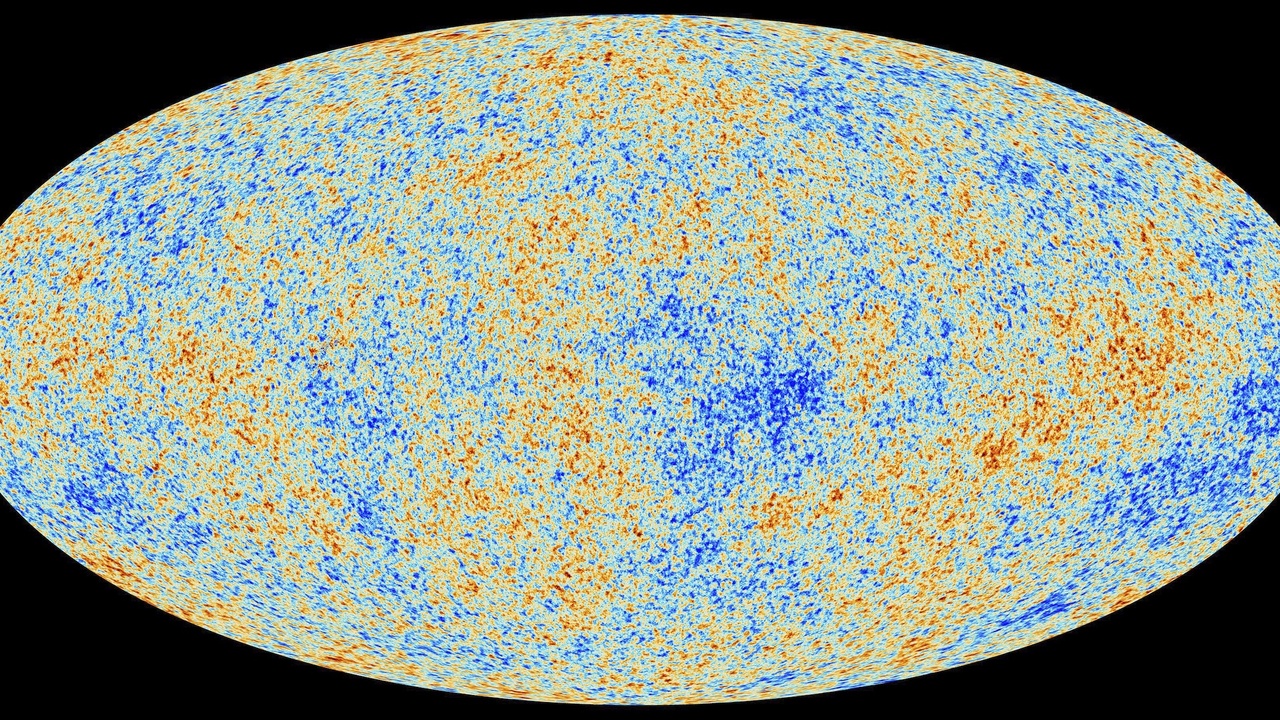
Yet the CMB also shows puzzling large-scale features: a cold spot and a hemispherical power asymmetry that resist simple explanation. Are these statistical flukes, foreground contamination, or hints of exotic physics in the primordial era?
Inflation predicts primordial gravitational waves that would imprint B-mode polarization on the CMB. Experiments like BICEP/Keck continue to push limits after the 2014 BICEP2 episode, which turned out to involve dust foregrounds. Finding primordial B-modes would be transformative for inflationary theory.
Exotic Compact Objects and High-Energy Transients
Compact objects and short-lived high-energy events probe physics at extremes: intense gravity, densities above nuclear saturation, and magnetic fields trillions of times stronger than Earth’s. LIGO’s first gravitational-wave detection in 2015 ushered in multi-messenger astronomy, where gravitational and electromagnetic signals together reveal richer detail.
These phenomena demand fast-response networks, broad spectral coverage, and improved algorithms — all of which have ripple effects across observational astrophysics and data science.
5. Black Hole Information Paradox — Do Black Holes Destroy Information?
The paradox pits quantum mechanics against general relativity. Hawking’s 1970s calculation showed black holes radiate thermally, implying that an evaporating black hole could erase information about what fell in, violating quantum unitarity.
Theoretical progress has been brisk: the holographic principle and AdS/CFT suggest information is preserved, and recent work using quantum extremal surfaces reproduces the Page curve expected for unitary evaporation. Debates over firewalls and the detailed mechanism continue.
Although experimental tests are currently impossible for astrophysical black holes, these ideas influence quantum gravity research and even concepts in quantum computing, where analogous information-recovery protocols are studied.
6. Magnetars — Stars with Colossal Magnetic Fields
Magnetars are neutron stars with surface fields of order 10^14–10^15 gauss. Those fields power dramatic episodes: giant flares can release ~10^44–10^46 joules in seconds, producing bright X-ray and gamma-ray outbursts detectable across the Galaxy.
SGR 1806−20’s 2004 giant flare is a standout example; its spike briefly affected Earth’s ionosphere. Observatories such as Fermi, Swift, and NICER continue to monitor magnetars and reveal complex pulse behavior and spectral changes.
Magnetars matter beyond exotic astrophysics. They test plasma physics and radiative processes in extreme magnetic fields, and some hypotheses link them to a subset of fast radio bursts, a connection strengthened by the 2020 radio burst seen from the Galactic magnetar SGR 1935+2154.
7. Gamma-Ray Bursts — The Brightest Explosions in the Universe
Gamma-ray bursts (GRBs) are brief, intense flashes of gamma rays that can outshine their host galaxies. They split into two broad classes: long GRBs tied to massive-star collapses (collapsars) and short GRBs linked to compact-object mergers.
Energy releases can range from about 10^44 to 10^47 joules. The 2017 multi-messenger event GW170817 and its counterpart GRB 170817A confirmed that at least some short GRBs arise from neutron-star mergers and produce kilonovae rich in heavy elements.
Satellites such as Swift and Fermi-GBM provide rapid localizations that enable ground-based follow-up. That capability transformed transient astronomy and improved our understanding of jet physics, nucleosynthesis, and compact-object populations.
8. Fast Radio Bursts (FRBs) — Mysterious Millisecond Flashes
FRBs are millisecond radio pulses first reported in 2007; by mid-2024 catalogs number in the thousands thanks largely to CHIME. Large dispersion measures place most FRBs at extragalactic distances, implying prodigious brightness temperatures.
Some FRBs repeat (FRB 121102 was the first known repeater) while many appear as one-off events. Localization efforts have tied several FRBs to specific host galaxies, and the 2020 association of a radio burst with the Galactic magnetar SGR 1935+2154 suggests magnetars could explain at least part of the population.
FRB science drives real-time pipelines, wide-field radio arrays, and cross-disciplinary work in statistics and machine learning, with implications for using FRBs as probes of the intergalactic medium.
Unusual Signals, Bodies, and Cosmic Leftovers
Some puzzles arrive as surprises: odd signals, unexpected visitors, or missing components. Observational oddities often spawn entire subfields, and they force rapid cross-disciplinary follow-up that changes how we design surveys and instruments.
The four items below illustrate how concrete, sometimes single-event observations can have outsized consequences for theory and mission planning.
9. Cosmic Microwave Background Anomalies
The CMB is a near-perfect blackbody, first pinned down by COBE in the mid-1960s and later mapped in detail by WMAP and Planck. Still, anomalies persist at large angular scales: the cold spot and unusual low-l multipole alignments have provoked debate over their statistical significance.
Researchers weigh explanations ranging from foreground contamination to genuinely primordial features tied to inflation or topology. The community remains cautious because cosmic variance limits confidence on the largest scales, but the anomalies keep theorists and observers engaged.
Precision CMB work also drives instrument calibration, detector development, and polarization studies aimed at detecting primordial gravitational waves — a discovery that would illuminate inflationary physics.
10. The Missing Baryons — Where Are the Ordinary Atoms?
Measurements from Big Bang nucleosynthesis and the CMB predict more ordinary baryonic matter than surveys of stars and cold gas find. The leading reservoir is the warm-hot intergalactic medium (WHIM), tenuous gas at 10^5–10^7 kelvin in filamentary structures between galaxies.
Detecting the WHIM is hard. Hubble’s Cosmic Origins Spectrograph has found UV absorption lines along quasar sightlines, and XMM-Newton and Chandra have yielded tentative X-ray detections. Statistical stacking and targeted blazar sightline studies suggest much of the missing baryons live in the WHIM.
Finding those baryons refines models of galaxy formation and feedback and pushes improvements in UV/X-ray spectroscopy that have broad utility for astrophysics.
11. Interstellar Objects — Visitors from Beyond the Solar System
Pan-STARRS discovered ʻOumuamua in 2017 and 2I/Borisov arrived in 2019, the first confirmed interstellar interlopers. They surprised observers: ʻOumuamua showed an elongated shape and a subtle non-gravitational acceleration without a visible coma, whereas Borisov behaved like a more ordinary comet.
Those differences spurred a range of hypotheses, from porous ice outgassing to more exotic ideas, and highlighted the need for all-sky surveys and rapid-response follow-up. Project Lyra and similar concepts explored rendezvous missions at interstellar-object speeds.
These visitors teach us about planetesimal formation in other systems and change survey strategies for detecting rare, fast-moving targets in future Rubin Observatory data.
12. Weird Exoplanets and Rogue Planets
Exoplanet searches have revealed a zoo that challenges classical formation models. As of mid-2024 there are roughly 5,000 confirmed exoplanets, including hot Jupiters in tight orbits, ultra-short-period rocky worlds, and planets with unexpectedly inflated radii or extreme eccentricities.
Free-floating rogue planets, inferred from microlensing surveys, raise questions about formation and ejection mechanisms. Hot Jupiters such as WASP-12b force refinements to migration theories, while unexpected architectures push models of disk dynamics and planet–planet interactions.
Studying these worlds drives telescope missions like JWST for atmosphere characterization and informs the design of future direct-imaging and survey instruments.
Summary
- Dark matter and dark energy dominate the cosmos; finding their nature would rewrite physics and cosmology.
- Compact objects and transients — from magnetar flares to black-hole mergers — test physics at extremes and fuel multi-messenger advances initiated by LIGO and electromagnetic observatories.
- Surprising signals and objects — FRBs, interstellar interlopers, and the missing baryons — force new survey strategies and rapid follow-up, reshaping instrumentation and theory.
- Keep an eye on upcoming programs: Roman, Euclid, JWST observing campaigns, Rubin Observatory surveys, and LIGO A+ upgrades will drive discoveries and clarify many of these outstanding puzzles.
Enjoyed this article?
Get daily 10-minute PDFs about astronomy to read before bed!
Sign up for our upcoming micro-learning service where you will learn something new about space and beyond every day while winding down.