In 1974, radio astronomers at Arecibo sent a deliberately encoded message toward the globular cluster M13 — humanity’s first purposeful technosignature. A few years later, in 1977, an anomalous narrowband spike known as the “Wow!” signal briefly captured attention and imagination. Those moments framed decades of thinking about how to spot intelligence beyond Earth.
We now have far more powerful tools than in the 1970s: wide radio arrays, optical SETI programs, infrared sky surveys, and space telescopes that can dissect exoplanet atmospheres. Yet the data remain sparse, so searches rely on clear expectations for what engineered activity would look like.
This article explains ten observable signs of advanced alien civilization and how astronomers are actively looking for them, organized into four categories: signals, astroengineering, planetary technosignatures, and artifacts or probes. Examples range from the 1977 Wow! signal and the 1974 Arecibo broadcast to the 2015 Tabby’s Star anomaly and the 2017 interstellar visitor ‘Oumuamua. Across these cases, the same idea recurs: find anomalies that natural physics struggles to explain, then rule out mundane causes with careful follow-up.
Technological Signals and Directed Emissions
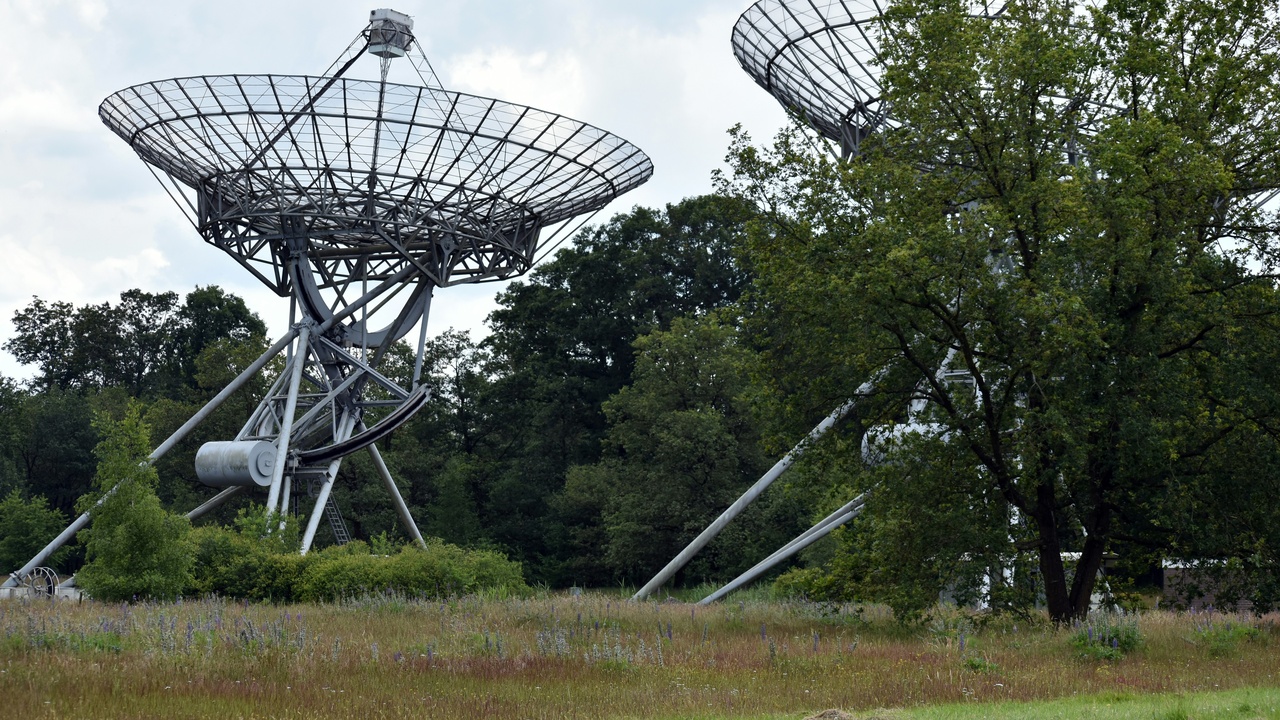
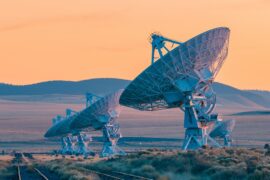
Electromagnetic emissions — intentional beacons or incidental leakage from power systems and communications — are the most familiar way to search for intelligent life. Radio and optical SETI programs scan for narrowband carriers, short, high-power laser pulses, or highly structured modulations that differ from astrophysical sources. Programs like Breakthrough Listen operate wide-band receivers on instruments such as the Green Bank Telescope and the Allen Telescope Array, while optical SETI teams use large optical apertures to hunt for brief laser flashes. Historical anchors include Arecibo’s 1974 broadcast and the 1977 Wow! signal; modern searches add digital signal processing and machine learning to push sensitivity thresholds lower.
1. Narrowband Radio Signals and Structured Transmissions
Narrowband signals — those confined to Hz-level bandwidths — are extremely unlikely to arise from natural astrophysical processes, which tend to produce broadband emission. The Wow! signal (1977) is a classic example: a strong, narrow spike detected near the hydrogen line frequency of 1.42 GHz that lasted about 72 seconds and has not repeated.
Search strategies focus on that hydrogen line and nearby “magic frequencies” because they may be universally recognizable. Modern facilities like the 100-meter Green Bank Telescope and the Allen Telescope Array (originally ~42 small dishes) can detect narrowband transmitters with sensitivities that, in favorable cases, rival terrestrial planetary radars out to tens of light-years. Breakthrough Listen has deployed wideband receivers and real-time signal classification to separate candidates from terrestrial interference.
2. Directed Energy Beacons (Optical and Infrared Lasers)
Directed-energy beacons are powerful, focused lasers or masers aimed to be seen across interstellar distances — think of an interstellar lighthouse. Optical SETI surveys in the 2010s (including campaigns supported by Breakthrough Initiatives) looked for nanosecond-scale pulses or continuous narrowband optical carriers.
Because lasers can be tightly collimated, a relatively modest transmitter (kilowatt to megawatt class) could outshine a star in a narrow beam as seen from a distant telescope if the pointing is right. Large optical apertures on terrestrial and space telescopes search for such pulses; positive detections would show pulse durations and spectral purity inconsistent with stellar flares or atmospheric scintillation.
3. Modulated or Repeating Non-Natural Patterns (Pulsar-Like Tampering)
Periodicity is a powerful clue. Pulsars discovered in 1967 were initially puzzling because of their regular radio pulses, and the methods used to recognize and characterize them — Fourier analysis and timing — are the same tools SETI uses to find engineered periodic signals.
Anomalous modulations might show prime-number spacing, narrowband frequency hops, or highly regular duty cycles that don’t match known astrophysical clocks. Observatories apply Fourier transforms, matched filters, and machine-learning classifiers, then cross-check with multiple sites to reject terrestrial interference and natural pulsar-like sources.
Astroengineering and Megastructures
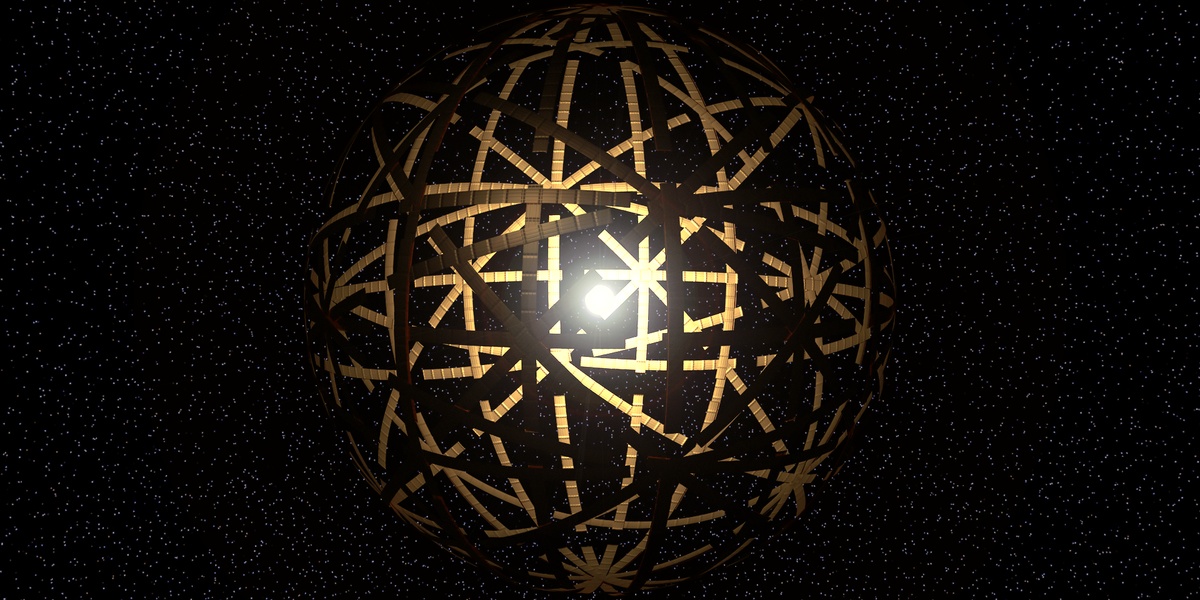
Among the signs of an advanced alien civilization, large-scale engineering around stars or planets offers distinct, measurable effects. If a civilization harnesses a substantial fraction of a star’s energy, thermodynamics implies waste heat will appear in the mid- to far-infrared. Transit light curves can reveal irregular, non-planetary occultations, and in theory one could alter stellar output through “stellar engineering.”
High-profile examples include Tabby’s Star (KIC 8462852), first widely noted for its strange light curve in 2015, and Freeman Dyson’s 1960 proposal of a star-encompassing structure. Infrared surveys like IRAS (1983) and WISE (2010s) have been used to search for excess emission, while precise photometric missions monitor transit behavior.
4. Excess Infrared Emission (Waste Heat from Megastructures)
Thermodynamics demands that large-scale energy consumption produces waste heat. For engineering on stellar scales, that waste heat would peak in the mid-infrared if released at temperatures of a few hundred kelvin — roughly the 10–20 μm wavelength band. Freeman Dyson proposed in 1960 that such signatures would be the telltale sign of a civilization capturing a star’s output.
All-sky infrared missions — IRAS in the 1980s and WISE in the 2010s — enable searches for anomalous infrared-to-optical ratios. Teams look for stars with unexpectedly high mid-IR flux or blackbody fits corresponding to hundreds of kelvin. To date, surveys have constrained the prevalence of very bright, warm megastructures around nearby stars but leave room for subtler swarms or low-temperature waste heat.
5. Transit Anomalies and Irregular Light Curves
Unusual dips in a star’s brightness during transit surveys can indicate opaque or semi-opaque structures that don’t resemble planets. Tabby’s Star, flagged around 2015 from Kepler data, showed irregular, aperiodic dips as deep as roughly 20%, far larger than typical exoplanet transits.
Kepler and TESS provide precise light curves that are mined for non-planet-like signatures: asymmetric profiles, long ingress or egress times, or complex multi-dip events. Follow-up uses multi-wavelength photometry and spectroscopy to test dust, comet swarms, and instrumental artifacts before considering engineered explanations.
6. Stellar Engineering: Artificially Altered Star Behavior
Some theoretical proposals envision civilizations manipulating their host star — for example, “stellar lifting” to extract mass or using large starshades to modulate flux. Such interventions would produce secular trends in brightness or spectral changes over years to decades, differing from the slow, predictable course of stellar evolution.
Detecting these would require long-term, high-precision photometric and spectroscopic monitoring. Observational signatures might appear as fractional changes in brightness at the parts-per-thousand to parts-per-million level accumulated over years, or unusual shifts in stellar activity that lack a natural stellar-cycle explanation.
Planetary-Scale Technosignatures
Civilization-scale activities tend to alter a planet’s atmosphere, surface reflectance, or night-side brightness in ways that can be measured remotely. Spectroscopy of transiting exoplanets matured in the 2000s, and the James Webb Space Telescope (launched 2021) plus upcoming extremely large telescopes greatly improve sensitivity to small molecular abundances.
Potential indicators include industrial pollutants that don’t have plausible abiotic production routes, night-side city lights seen in reflected or thermal light, and large-scale surface albedo changes from terraforming or extensive agriculture.
7. Atmospheric Technosignatures (Industrial Pollutants)
Certain long-lived industrial molecules — chlorofluorocarbon (CFC) analogues, for example — are difficult to produce by natural geochemical or photochemical processes and make compelling technosignature targets. On Earth, CFCs appeared in the mid-20th century as a clear industrial marker.
JWST and future ELT-class instruments can search transiting exoplanet atmospheres for absorption features associated with such molecules. Modeling studies suggest, in ideal cases, sensitivities reaching parts-per-billion (ppb) levels for strong spectral features given multiple transits and favorable target-star brightness. Detection would require ruling out plausible abiotic pathways and spectral confusion with other gases.
8. Night-Side Illumination and Surface Alterations
Artificial lighting on a planet’s nightside would create an excess of visible or near-infrared flux that alters the planet’s phase curve. Model studies show that, to be detectable from light-years away, a substantial fraction of the nightside would need continuous lighting at brightness levels comparable to Earth’s cities.
Rough estimates put the required illuminated fraction in the ballpark of 0.1%–1% of the nightside at Earth-like intensity for detection with large (30–40 m) ground-based telescopes or future space missions, depending on distance and observation time. Disentangling city lights from aurora, reflected moonlight, or high-albedo surfaces will demand multi-wavelength phase curves and high-contrast imaging.
Artifacts, Probes, and Local Evidence
Advanced civilizations might leave physical traces: probes parked at stable Lagrange points, engineered satellites, or altered small bodies. The 2017 discovery of ‘Oumuamua — our first-known interstellar visitor — sparked lively debate because its behavior and shape were unexpected, illustrating how ambiguous such evidence can be without rapid, detailed follow-up.
Searching nearby space uses different tools than deep-sky technosignature hunts: optical sky surveys like Pan-STARRS find interstellar visitors, while lunar reconnaissance missions and space-based imaging search for anomalous objects in Earth–Moon space and geosynchronous orbit.
9. Interstellar Objects and Unusual Trajectories (e.g., ‘Oumuamua)
Anomalous interstellar visitors raise questions when their motion, shape, or surface behavior departs from expectations. ‘Oumuamua was discovered by Pan-STARRS in 2017 and showed an extreme light-curve suggestive of a highly elongated or flattened shape, complex rotation, and a small non-gravitational acceleration on the order of 10⁻⁶ m/s² reported in follow-up studies.
Sky surveys now prioritize rapid follow-up spectroscopy and photometry for new interstellar objects. Key measurements include precise astrometry to quantify any non-gravitational acceleration, spectra to detect outgassing or unusual surface composition, and high-cadence light curves to constrain shape and spin.
10. Local Artifacts, Unusual Orbital Debris, or Engineered Structures
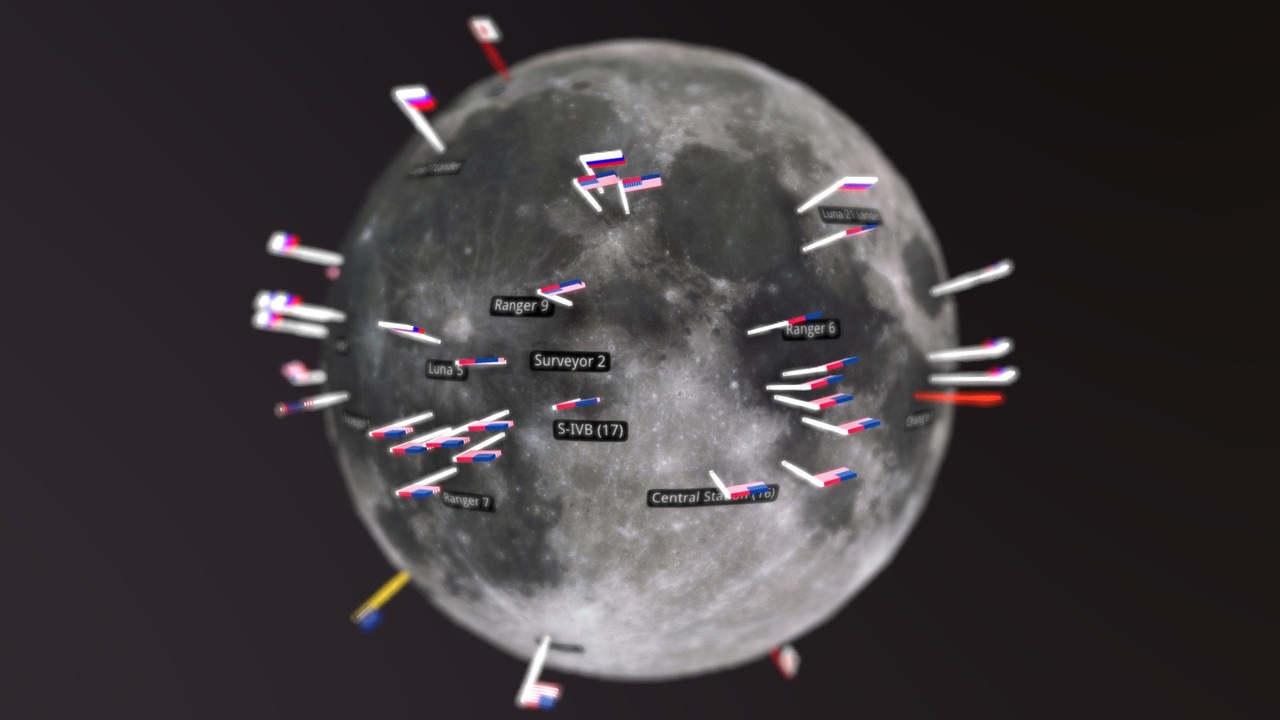
Technosignatures could be found in our own backyard: on the Moon, in stable Earth–Moon Lagrange points, or as unexplained objects in Earth orbit. We already have human-made artifacts on the Moon from six successful lunar landings (Apollo 11–17, excluding 13) between 1969 and 1972, and modern satellites like the Lunar Reconnaissance Orbiter map those sites in detail.
Proposed searches include high-resolution imaging of Lagrange points, spectral scans of suspicious debris, and targeted imaging of the lunar surface and near-Earth space. Finding an artifact would pose immediate policy and ethical questions about access, preservation, and the chain of scientific custody, so international coordination is essential ahead of any discovery.
Summary
- Different approaches pick up different signals: radio and optical searches hunt for directed emissions, infrared surveys look for waste heat, spectroscopy reads planetary atmospheres, and local imaging seeks physical artifacts.
- Historical cases — Arecibo’s 1974 message, the 1977 Wow! spike, Tabby’s Star (2015), and ‘Oumuamua (2017) — show both promise and the risk of ambiguous data, so rigorous follow-up is essential.
- New observatories (JWST since 2021, ELT-class telescopes, and expanded radio arrays) and open-data programs like Breakthrough Listen make this a particularly data-rich decade for searching plausible technosignatures.
- Practical next steps are complementary: continue sensitive radio/optical searches, expand mid-IR waste-heat surveys, push atmospheric spectroscopy for industrial gases, and fund rapid-response systems for interstellar visitors and local artifact candidates.
Enjoyed this article?
Get daily 10-minute PDFs about astronomy to read before bed!
Sign up for our upcoming micro-learning service where you will learn something new about space and beyond every day while winding down.