On clear nights away from city lights, a pair of binoculars opens up a surprising selection of fuzzy deep-sky objects that are easy to enjoy from a backyard, park, or campsite. Binoculars give a wide field and natural view that make star-hopping and averted vision especially rewarding.
There are 32 Nebulae Visible with Binoculars, ranging from the California Nebula to the Western Veil (Witch’s Broom). For each entry the table lists Catalog ID, Coordinates (RA Dec J2000), and Brightness (mag), which you’ll find below.
What binoculars work best for seeing these nebulae?
Aim for a balance of aperture and handheld usability: 7×50 or 10×50 are classic choices for wide fields and good light gathering; 15×70 or larger will show fainter detail but are heavier and benefit from a tripod. Dark skies, steady hands or support, and using averted vision make the biggest practical difference.
How do I locate faint objects like the California Nebula with binoculars?
Use star-hopping from bright nearby stars and a detailed chart or mobile app to guide you, observe on moonless nights, and let your eyes adapt to the dark. Narrowband filters can help for some emission nebulae, and patience with short sweeps and averted vision often reveals targets that don’t look obvious at first.
Nebulae Visible with Binoculars
| Name | Catalog ID | Coordinates (RA Dec J2000) | Brightness (mag) |
|---|---|---|---|
| Orion Nebula | M42 | 05:35:17 −05:23:28 | 4.00 |
| De Mairan’s Nebula | M43 | 05:35:31 −05:16:00 | 9.00 |
| M78 (reflection nebula) | NGC 2068 | 05:46:45 +00:04:42 | 8.00 |
| Flame Nebula | NGC 2024 | 05:41:42 −01:51:00 | 10.00 |
| California Nebula | NGC 1499 | 04:03:13 +36:25:00 | 6.50 |
| North America Nebula | NGC 7000 | 20:58:56 +44:20:00 | 4.00 |
| Pelican Nebula | IC 5070 | 20:51:00 +44:25:00 | 8.00 |
| Western Veil (Witch’s Broom) | NGC 6960 | 20:45:36 +30:43:00 | 6.50 |
| Eastern Veil | NGC 6992 | 20:56:36 +31:43:24 | 7.20 |
| Rosette Nebula | NGC 2237 | 06:32:58 +04:58:00 | 6.00 |
| Lagoon Nebula | M8 | 18:03:37 −24:23:12 | 6.00 |
| Trifid Nebula | M20 | 18:02:23 −23:01:48 | 6.30 |
| Eagle Nebula | M16 | 18:18:48 −13:47:00 | 6.00 |
| Omega (Swan) Nebula | M17 | 18:20:24 −16:10:36 | 6.00 |
| Dumbbell Nebula | M27 | 19:59:36 +22:43:16 | 7.50 |
| Pacman Nebula | NGC 281 | 00:52:24 +56:37:00 | 7.50 |
| IC 1396 (Elephant Trunk region) | IC 1396 | 21:36:58 +57:27:00 | 6.00 |
| Heart Nebula | IC 1805 | 02:32:42 +61:27:00 | 7.00 |
| Soul Nebula | IC 1848 | 02:51:18 +60:28:00 | 7.50 |
| Iris Nebula | NGC 7023 | 21:01:36 +68:10:42 | 6.80 |
| Flaming Star Nebula | IC 405 | 05:16:12 +34:18:50 | 7.30 |
| Monkey Head Nebula | NGC 2174 | 06:09:40 +06:24:00 | 8.00 |
| Tarantula Nebula | NGC 2070 | 05:38:38 −69:05:42 | 8.00 |
| Carina Nebula | NGC 3372 | 10:45:03 −59:52:04 | 1.00 |
| Cat’s Paw Nebula | NGC 6334 | 17:20:54 −35:46:59 | 7.00 |
| Lobster Nebula | NGC 6357 | 17:24:43 −34:12:00 | 6.50 |
| Corona Australis Nebula (CrA) | NGC 6726 | 19:01:54 −36:58:07 | 8.00 |
| Gamma Cygni (Sadr) Nebula | IC 1318 | 20:22:43 +40:15:33 | 5.50 |
| NGC 6820 (Gulf/Collinder complex) | NGC 6820 | 19:43:28 +23:20:00 | 8.50 |
| Cone / Christmas Tree Nebula region | NGC 2264 | 06:41:00 +09:53:00 | 6.90 |
| IC 410 (Tadpoles) | IC 410 | 05:28:39 +34:46:00 | 8.50 |
| IC 2944 (Running Chicken) | IC 2944 | 11:38:24 −63:22:00 | 7.80 |
Images and Descriptions

Orion Nebula
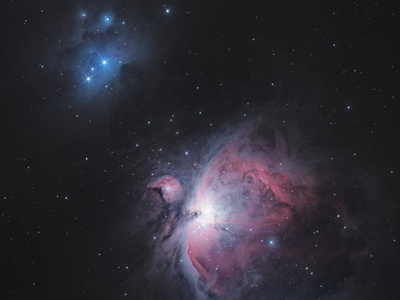
Bright, large emission nebula in Orion; spectacular in 7×50–10×50 binoculars as a fuzzy patch with obvious structure. Best in winter (Northern Hemisphere). Easy find: below Orion’s Belt, part of Orion’s Sword. Great for beginners.
De Mairan’s Nebula
Adjacent to M42, M43 appears as a separate glowing knot in binoculars under suburban to dark skies. Best winter nights in northern latitudes. Look immediately north of the main Orion Nebula; often seen together with M42.

M78 (reflection nebula)
Small reflection nebula north of Orion’s Belt seen as a faint, compact patch in 10×50+ binoculars on dark skies. Best winter observing (N Hemisphere). Finder tip: about 2° north of Alnitak.

Flame Nebula
Bright emission region close to Alnitak in Orion; binoculars show a glowing patch or haze under dark skies. Best in winter for northerners. Use Alnitak as a guide; emission contrast is enhanced with averted vision.
California Nebula
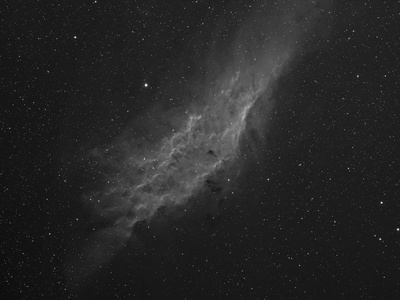
Very large, low surface-brightness H II region in Perseus; visible in 10×50 binoculars from dark sites as an elongated haze. Best autumn/winter in northern latitudes. Finder tip: east of the star Menkib (ξ Persei).

North America Nebula
Huge emission nebula in Cygnus; distinctly visible as a broad mottled patch with 7×50–10×50 from dark or good suburban skies. Best summer for N Hemisphere. Find near Deneb; look for a North America-shaped glow.

Pelican Nebula
Close to NGC 7000, IC 5070 shows as fainter extension or separate patch in binoculars under dark skies. Best in summer in northern latitudes. Use the North America Nebula as an anchor; expect subtle contrast.

Western Veil (Witch’s Broom)
Part of the Veil supernova remnant in Cygnus; seen as a long filamentary streak with 7×50 binoculars under dark skies. Best summer. Easy to find near bright star 52 Cygni.

Eastern Veil
Another portion of the Veil Nebula complex; binoculars show filamentary haze pieces under dark skies. Best summer viewing in northern latitudes. Finder tip: east of the Western Veil, near the star 52 Cyg for orientation.

Rosette Nebula
Large emission nebula in Monoceros; appears as a diffuse round glow with 10×50 binoculars from dark sites. Best winter to spring in N Hemisphere. Finder tip: near the cluster NGC 2244 at center of the glow.

Lagoon Nebula
Bright H II region in Sagittarius; visible as a diffuse patch with 7×50 binoculars from dark or good suburban skies. Best in summer for northern observers and year-round in southern. Find near the star λ Sagittarii.

Trifid Nebula
Fainter companion to M8; binoculars will show a small, distinct fuzz near M8 under dark skies. Best summer. Finder tip: once you have M8 in the field, scan north slightly to spot M20’s compact glow.

Eagle Nebula
M16 is visible as a small glow in 10×50 binoculars from dark skies, usually showing no pillars but a fuzzy patch. Best summer. Located in Serpens; use nearby bright stars in Sagittarius/Scutum region for guidance.
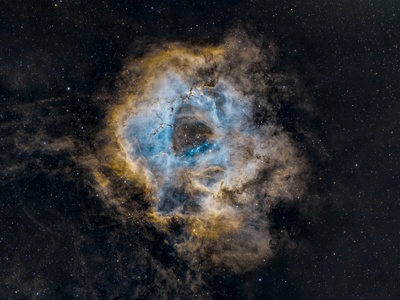
Omega (Swan) Nebula
Compact, bright emission nebula in Sagittarius; binoculars reveal a banana-shaped haze under dark to suburban skies. Best in summer. Easy to find between the Sagittarius teapot stars.

Dumbbell Nebula
Large planetary nebula in Vulpecula; appears as a bright, oval fuzzy patch in 7×50 binoculars. Best late summer/autumn in N Hemisphere. Find midway between Deneb and Sagitta.

Pacman Nebula
Compact emission region in Cassiopeia; binoculars show a small hazy patch around the open cluster. Best autumn/winter in northern latitudes. Finder tip: about 3° east of the bright star β Cassiopeiae.

IC 1396 (Elephant Trunk region)
Huge emission/reflection complex in Cepheus; visible in 7×50–10×50 as a broad glow with denser knots like the Elephant Trunk faintly visible. Best autumn for N Hemisphere. Use bright star Deneb-ish region guides.

Heart Nebula
Large H II region in Cassiopeia; binoculars show a diffuse heart-shaped glow from dark skies. Best autumn/winter in northern latitudes. Finder tip: near the bright star cluster Melotte 15.

Soul Nebula
Neighbor to the Heart; appears as a faint, extended glow in 10×50 binoculars under dark skies. Best autumn/winter. Look southeast of IC 1805 — often seen together in the same binocular field on wide views.

Iris Nebula
Reflection nebula in Cepheus; in 10×50 binoculars appears as a compact misty patch around a bright star. Best autumn in northern latitudes. Easy finder: just northwest of the bright star β Cephei.

Flaming Star Nebula
Emission/reflection nebula around AE Aurigae; visible as a faint patch in 10×50 binoculars under dark skies. Best winter for northern observers. Finder tip: locate the bright star AE Aurigae in Auriga.

Monkey Head Nebula
Emission nebula in Orion/Monoceros complex; binoculars can show a faint, compact haze from dark skies. Best winter/spring. Find near the cluster NGC 2175 and the bright star Rigel’s region.

Tarantula Nebula
Huge H II region in the Large Magellanic Cloud; easily visible in binoculars across southern skies and spectacular from dark southern sites. Best summer in S Hemisphere. Distinct naked-eye/handheld view.
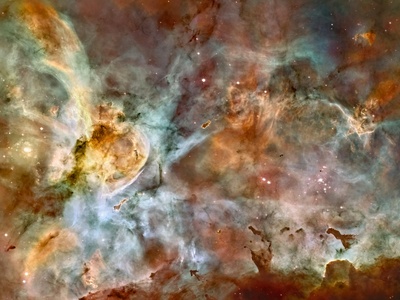
Carina Nebula
Massive and bright southern H II region; outstanding in binoculars from southern latitudes, with strong nebulosity and dark lanes. Best autumn/winter in S Hemisphere. Find near the bright star η Carinae.
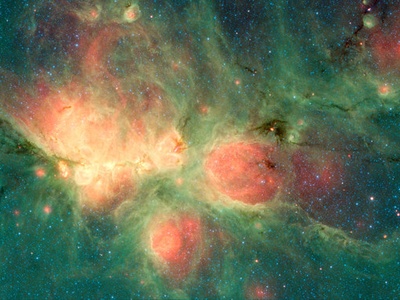
Cat’s Paw Nebula
Bright emission complex in Scorpius; binoculars show clumpy nebulosity and star-forming knots from southern/low-latitude sites. Best summer in S Hemisphere. Finder tip: near the tail of Scorpius.

Lobster Nebula
Neighbor to NGC 6334; binoculars reveal extended, patchy nebulosity in Scorpius. Best summer in southern skies. Often seen as a diffuse glow surrounding embedded clusters in larger binocular fields.
Corona Australis Nebula (CrA)
Compact nebulous region in Corona Australis; visible as a faint patch in 10×50 binoculars from dark southern or low-northern skies. Best southern winter. Finder: near the bright star R CrA and the small Corona Australis group.

Gamma Cygni (Sadr) Nebula
Large emission/reflection complex around Sadr in Cygnus; binoculars show a broad, mottled glow with darker lanes. Best summer for northern observers. Easy finder: centered on the star Sadr.
NGC 6820 (Gulf/Collinder complex)
H II region near M27 in Vulpecula; seen in 10×50 binoculars as a faint haze surrounding young clusters under dark skies. Best summer/autumn in northern latitudes. Use M27 as a pointer.
Cone / Christmas Tree Nebula region
NGC 2264 includes the Cone Nebula and associated nebulosity; binoculars show a subtle glow around the Christmas Tree cluster under dark skies. Best winter/spring. Find near the bright star Procyon’s general RA range.

IC 410 (Tadpoles)
Emission region in Auriga containing “tadpole” features; binoculars reveal a faint cloud around a loose cluster from dark sites. Best winter in northern latitudes. Use nearby open clusters as guides.
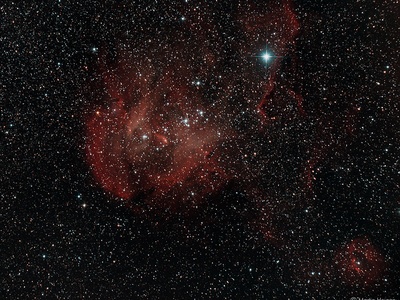
IC 2944 (Running Chicken)
Bright emission/reflection complex in Centaurus; visible as a diffuse patch in binoculars from southern skies. Best autumn/winter for southern observers. Finder tip: near the rich Milky Way fields of Centaurus.
Enjoyed this article?
Get daily 10-minute PDFs about astronomy to read before bed!
Sign up for our upcoming micro-learning service where you will learn something new about space and beyond every day while winding down.