Out past the major planets, dwarf planets and their small companions offer a compact window into how the Solar System assembles and evolves. Observing these moons gives clues about collisions, capture events, and surface processes on bodies that are often overlooked.
There are 9 Moons of Dwarf Planets, ranging from Charon to Styx. The list is organized with Host dwarf planet,Diameter (km),Orbital period (days); you’ll find below.
How were these dwarf-planet moons discovered?
Most were found as telescope resolution and survey coverage improved: Charon was detected in 1978 from ground-based observations, while several smaller moons—including Styx—were identified in Hubble images and subsequent targeted searches; tracking their motion over time and using occultations confirms their orbits and refines sizes.
Could any of these moons be targets for future missions?
Pluto’s system has been visited by New Horizons, which provided detailed maps of Charon and the smaller satellites; future missions could pursue additional flybys or orbiters, but planners must weigh long travel times, low gravity environments, and mission cost against scientific goals like geology or searching for subsurface activity.
Moons of Dwarf Planets
| Name | Host dwarf planet | Diameter (km) | Orbital period (days) |
|---|---|---|---|
| Charon | Pluto | 1,212 | 6.39 |
| Nix | Pluto | 50 | 24.85 |
| Hydra | Pluto | 52 | 38.20 |
| Kerberos | Pluto | 19 | 32.17 |
| Styx | Pluto | 16 | 20.16 |
| Hiʻiaka | Haumea | 320 | 49.12 |
| Namaka | Haumea | 170 | 18.28 |
| Dysnomia | Eris | 700 | 15.77 |
| S/2015 (136472) 1 | Makemake | 175 | 12.43 |
Images and Descriptions
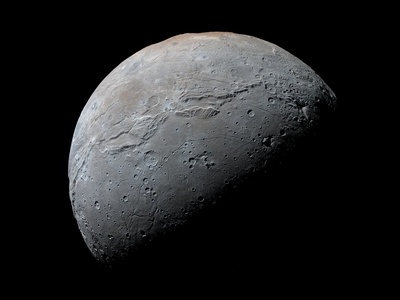
Charon
Charon is Pluto’s large, tidally locked moon, roughly half Pluto’s size. At about 1,212 km across it dominates the system, orbits in 6.39 days, and gives Pluto–Charon a binary-planet like dynamical relationship discovered in 1978.

Nix
Nix is a small, irregular icy moon about 50 km across. It orbits Pluto in 24.85 days, shows bright, variable surface patches, and was discovered in 2005 by Hubble; named after the Greek goddess of night, companion to Charon.

Hydra
Hydra is a roughly 52 km icy moon of Pluto with an elongated shape. It completes an orbit every 38.20 days, discovered with Nix in 2005 and named for the many-headed water‑serpent of Greek myth.

Kerberos
Kerberos is a small, dark moon about 19 km across orbiting Pluto every 32.17 days. Discovered in 2011, it’s unusually faint and likely has a low albedo; named after the multi-headed dog that guards the underworld in Greek myth.

Styx
Styx is the smallest known Pluto moon, roughly 16 km wide, orbiting in about 20.16 days. Discovered in 2012 during Hubble searches, it completes the system’s nested resonant architecture and is named after the river separating Earth and the underworld.
Hiʻiaka
Hiʻiaka is Haumea’s outer, larger moon around 320 km diameter. It orbits in about 49.12 days, shows crystalline water-ice features, and is likely a fragment from Haumea’s collisional family; named for a Hawaiian goddess associated with dance and healing.
Namaka
Namaka is Haumea’s smaller inner moon, about 170 km across, orbiting in roughly 18.28 days. It has an eccentric, inclined orbit influenced by Hiʻiaka and Haumea’s spin; named after a Hawaiian goddess of the sea and daughter of Hiʻiaka.
Dysnomia
Dysnomia is Eris’s sole moon, discovered in 2005. Its size is uncertain (estimates vary widely) but it’s much smaller than Eris. It orbits Eris every 15.77 days and is named after the Greek spirit of lawlessness.
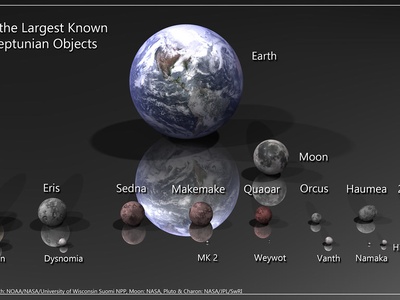
S/2015 (136472) 1
S/2015 (136472) 1 (often called MK2) is Makemake’s faint moon, roughly 175 km across by estimate. Discovered in 2015 by Hubble, it orbits Makemake in about 12.43 days and helped reveal Makemake’s darker, complex system.
Enjoyed this article?
Get daily 10-minute PDFs about astronomy to read before bed!
Sign up for our upcoming micro-learning service where you will learn something new about space and beyond every day while winding down.