Italy’s skies have been studied from Renaissance piazzas to modern observatories, and Italy’s long scientific tradition shaped many breakthroughs in celestial science. That history is visible in the careers of people who mapped comets, developed spectral classification and built observatories across the peninsula.
There are 20 Italian Astronomers, ranging from Angelo Secchi to Vincenzo Cerulli; for each entry I list Lifespan (YYYY–YYYY),Primary affiliation,Main contribution so you can quickly compare dates, institutions and achievements. You’ll find those details below.
How were the astronomers chosen for this list?
The selection focuses on historically significant figures connected to Italian institutions or born in Italy who made notable contributions (observations, theories, instrumentation or leadership); it’s not exhaustive but aims to showcase a representative span of eras and specialties.
Where can I find original sources or further reading on specific entries?
For each name, check linked biographies, observatory archives and published papers (many digitized) — national libraries, university repositories and astronomy history sites are the best next steps for primary documents and deeper context.
Italian Astronomers
| Name | Lifespan (YYYY–YYYY) | Primary affiliation | Main contribution |
|---|---|---|---|
| Galileo Galilei | 1564–1642 | University of Padua; Florence | Pioneered telescopic astronomy; discovered Jupiter’s moons, phases of Venus |
| Giovanni Battista Riccioli | 1598–1671 | University of Bologna | Lunar mapping and nomenclature; Almagestum Novum co-author |
| Giovanni Domenico Cassini | 1625–1712 | Paris Observatory | Discovered Saturn’s Cassini Division and several moons |
| Francesco Fontana | 1589–1656 | Naples observatory/telescopic workshop | Early telescopic lunar and planetary observations and maps |
| Giovanni Battista Hodierna | 1597–1660 | Sicily (Siracusa)/private observatory | Early cataloguer of deep-sky objects predating Messier |
| Niccolò Zucchi | 1586–1670 | Rome (Jesuit) | Built early reflecting telescope; observed Jupiter’s belts |
| Giuseppe Piazzi | 1746–1826 | Palermo Astronomical Observatory | Discovered the dwarf planet Ceres in 1801 |
| Giovanni Schiaparelli | 1835–1910 | Brera Observatory, Milan | Mapped Mars; reported “canali” leading to Mars debate |
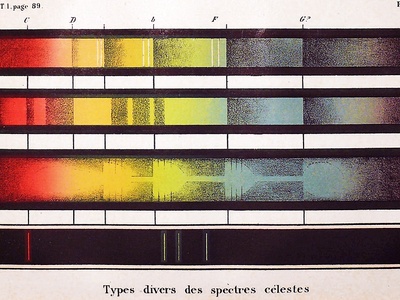
| Angelo Secchi | 1818–1878 | Pontifical Gregorian University; Collegio Romano | Pioneer of stellar spectroscopy and spectral classification |
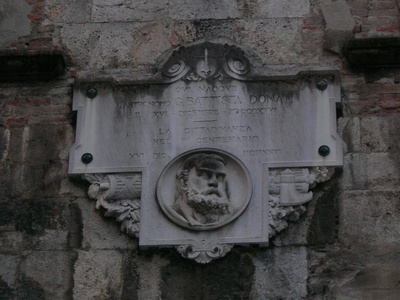
| Giovanni Battista Donati | 1826–1873 | Florence Observatory | Discovered and spectroscopically studied comets |
| Annibale de Gasparis | 1819–1892 | Capodimonte Observatory, Naples | Discoverer of multiple asteroids in the 19th century |
| Pietro Tacchini | 1838–1905 | Palermo and Rome observatories | Solar spectroscopy and chromospheric studies |
| Vincenzo Cerulli | 1859–1927 | Collurania-Teramo Observatory | Founded Collurania Observatory; studied asteroids and Mars |
| Francesco de Vico | 1805–1848 | Rome Observatory | Discovered several comets and improved orbital calculations |
| Giuseppe Lorenzoni | 1843–1914 | Padua Observatory | Positional astronomy and geodetic measurements |
| Margherita Hack | 1922–2013 | Trieste Astronomical Observatory; University of Trieste | Modern astrophysics; stellar spectroscopy and public outreach |
| Paolo Maffei | 1926–2009 | Arcetri Observatory, Florence | Discovered obscured galaxies Maffei 1 and 2; infrared astronomy |
| Guido Horn d’Arturo | 1879–1967 | Padua and Florence institutions | Pioneer of segmented mirror telescope design |
| Joseph-Louis Lagrange | 1736–1813 | Turin/Berlin/Paris (mathematical astronomy) | Key developer of celestial mechanics and Lagrangian points |
| Niccolò Cacciatore | 1770–1841 | Palermo Observatory | Succeeded Piazzi; compiled star catalogs and ephemerides |
Images and Descriptions
Galileo Galilei
Galileo was a Renaissance scientist who transformed astronomy with telescopic observations in the early 1600s. Working at Padua and later Florence, he discovered Jupiter’s moons, recorded planetary phases, and championed observational methods that reshaped science and supported heliocentrism.
Giovanni Battista Riccioli
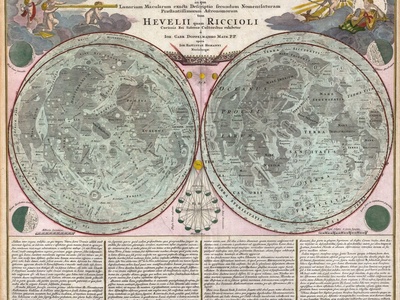
Riccioli was a Jesuit astronomer at Bologna who produced detailed lunar maps and a comprehensive astronomical synthesis. His Almagestum Novum compiled observations, proposed lunar nomenclature still used today, and exemplified rigorous 17th-century observational astronomy.

Giovanni Domenico Cassini
Born in Italy and active at the Paris Observatory, Cassini mapped planetary motions, discovered structures such as the Cassini Division in Saturn’s rings and multiple moons, and helped professionalize observational astronomy in the late 17th century.
Francesco Fontana
Fontana built telescopes and produced some of the earliest detailed lunar maps and planetary drawings. Working in Naples, his practical observations contributed to early telescopic studies despite later controversies about instrument authorship.
Giovanni Battista Hodierna
Hodierna, a Sicilian nobleman and observer, compiled an early catalog of nebulous objects and observed comets and novae before Messier. His hands-on observing produced a useful list of deep-sky objects for later astronomers.
Niccolò Zucchi
Zucchi was a Jesuit physicist who experimented with reflecting telescopes and recorded observations of Jupiter’s belts and Saturn. His optical experiments and planetary sightings contributed to early telescope development and seventeenth-century observational astronomy.
Giuseppe Piazzi
Piazzi directed Palermo Observatory and in 1801 discovered Ceres, the first-known asteroid (now classed a dwarf planet). He compiled precise star catalogues and advanced positional astronomy during the transition to modern planetary studies.
Giovanni Schiaparelli
Schiaparelli produced detailed nineteenth-century maps of Mars and reported linear features called “canali,” which sparked scientific debate and popular imagination about Mars. Working at Brera Observatory, his careful planetary studies had long influence.
Angelo Secchi
Angelo Secchi was a Jesuit scientist in Rome who pioneered the use of spectroscopy in astronomy and developed one of the first stellar classification schemes. His systematic spectral studies linked stellar appearance to physical properties and founded aspects of astrophysics.
Giovanni Battista Donati
Donati was an observer in Florence best known for discovering Donati’s Comet in 1858 and applying spectroscopy to cometary and stellar studies. He combined public engagement with careful observational work during a pivotal era for astronomy.
Annibale de Gasparis
De Gasparis worked at Naples and discovered numerous asteroids in the mid-19th century, contributing to early minor-planet catalogs. His precise observations and orbital computations were important to the growing field of asteroid astronomy.
Pietro Tacchini
Tacchini was a pioneering Italian solar physicist who organized systematic solar observations and advanced chromospheric spectroscopy. Working in Palermo and Rome, he helped establish coordinated solar research programs and promoted instrumentation for solar studies.
Vincenzo Cerulli
Cerulli founded the Collurania Observatory in Teramo and led studies of Mars and minor planets. His institutional work expanded regional Italian astronomy and supported observational programs at the turn of the 20th century.
Francesco de Vico
Francesco de Vico discovered several bright comets and worked on improving cometary orbital calculations. Based in Rome, he contributed observationally to nineteenth-century comet studies and helped communicate recent discoveries to the scientific community.
Giuseppe Lorenzoni
Lorenzoni served at Padua conducting precise positional astronomy, astronomical photography, and geodetic measurements. His careful observations supported stellar position catalogs and practical applications like mapping and timekeeping in late 19th-century Italy.
Margherita Hack
Margherita Hack was a twentieth-century astrophysicist who directed Trieste’s observatory, conducted influential work on stellar atmospheres, and became a prominent science communicator and advocate for scientific literacy and astronomy education in Italy.
Paolo Maffei
Maffei worked at Arcetri and specialized in infrared observations, discovering the nearby, heavily obscured galaxies Maffei 1 and Maffei 2. He combined research with effective science writing and helped introduce modern extragalactic studies to Italian audiences.
Guido Horn d’Arturo
Horn d’Arturo developed early ideas for segmented mirror telescopes and contributed to optical design and astronomical instrumentation in Italy. His experimental approach anticipated later large-telescope technology and blended practical optics with observational goals.
Joseph-Louis Lagrange
Born in Turin, Lagrange made foundational contributions to celestial mechanics, perturbation theory, and the three-body problem. His theoretical advances, including Lagrangian points, became central to orbital dynamics and modern spaceflight trajectory design.
Niccolò Cacciatore
Cacciatore succeeded Piazzi at Palermo Observatory and produced star catalogs, ephemerides, and positional work that maintained Palermo’s role in early nineteenth-century observational astronomy. He continued systematic surveys that supported planetary and stellar research.
Enjoyed this article?
Get daily 10-minute PDFs about astronomy to read before bed!
Sign up for our upcoming micro-learning service where you will learn something new about space and beyond every day while winding down.