Black holes come in many sizes, and astronomers are filling in the gap between stellar remnants and the supermassive objects that anchor galaxies. Recent surveys and follow-up observations across X-ray, optical, and radio bands have produced a small, useful sample worth comparing side by side.
There are 10 Intermediate Black Holes, ranging from 3XMM J2150-0551 to RGG 118. For each entry, the data are organized as Mass (M☉),Detection method,Host (galaxy; distance Mpc), and you’ll find them below.
How are these intermediate-mass candidates actually identified?
Detections come from different lines of evidence: dynamical measurements (stellar or gas motions), bright X-ray or radio emission consistent with accretion, and AGN-like optical signatures in low-mass galaxies. Each method has its limits, so confirming a candidate usually means combining multiple datasets and noting uncertainties.
Why does it matter whether these mid-size black holes exist?
Finding and measuring them fills the mass gap between stellar and supermassive black holes, informs models of black hole seed formation and growth, and helps explain how feedback and mergers shape galaxies over time. The table below shows methods and host distances to help you judge each case.
Intermediate Black Holes
| Name | Mass (M☉) | Detection method | Host (galaxy; distance Mpc) |
|---|---|---|---|
| ESO 243-49 HLX-1 | 10,000-100,000 | X-ray variability and optical counterpart | ESO 243-49; 92 Mpc |
| M82 X-1 | 400-5,000 | X-ray timing (high-frequency QPOs) | M82; 3.6 Mpc |
| NGC 2276-3c | 50,000 | Radio+X-ray fundamental-plane scaling | NGC 2276; 33 Mpc |
| G1 (Mayall II) | 20,000 | Stellar dynamics in globular cluster | M31 (G1); 0.78 Mpc |
| RGG 118 | 50,000 | Optical broad lines (virial reverberation scaling) | Dwarf galaxy RGG 118; 100 Mpc |
| GW190521 (remnant) | 142 | Gravitational waves (binary merger remnant) | Luminosity distance ~5,200 Mpc |
| 3XMM J2150-0551 | 50,000 | X-ray tidal-disruption flare modeling | Host dwarf galaxy; ~300 Mpc |
| NGC 5408 X-1 | 1,000-10,000 | X-ray timing and spectral scaling | NGC 5408; 4.8 Mpc |
| CXO J133815.6+043255 | 30,000 | Radio+X-ray fundamental-plane scaling | NGC 5252; 102 Mpc |
| Omega Centauri (ω Cen) | 40,000 | Stellar dynamics in globular cluster | Milky Way; 0.0052 Mpc |
Images and Descriptions
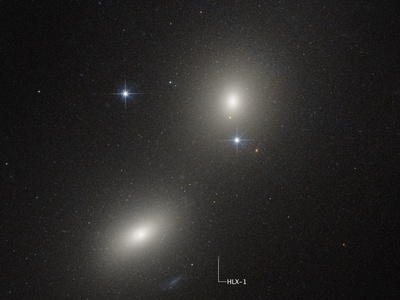
ESO 243-49 HLX-1
Off-nuclear ultraluminous X-ray source with repeat outbursts; spectral and timing fits plus an optical counterpart imply a 10,000–100,000 M☉ IMBH. One of the strongest candidates, though exact mass depends on accretion-model assumptions.
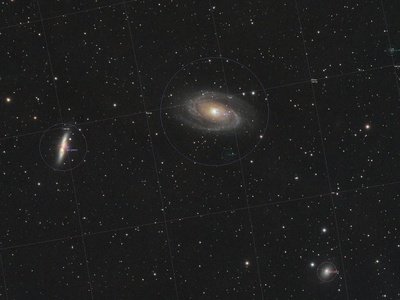
M82 X-1
Bright ULX showing twin high-frequency QPOs whose frequency scaling suggests a few hundred to a few thousand solar-mass accretor. Timing evidence is robust, but super-Eddington alternatives keep the exact mass uncertain.

NGC 2276-3c
Off-nuclear radio and X-ray source placed on the black-hole fundamental plane, yielding a mass estimate around 50,000 M☉. Strong multiwavelength evidence, interpretation as a stripped nucleus or recoiling SMBH remains debated.
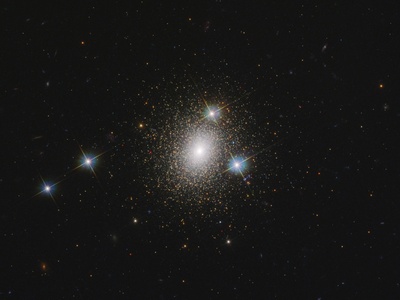
G1 (Mayall II)
Dynamical modeling of star motions in M31’s massive globular cluster originally indicated a ~20,000 M☉ central dark mass. Evidence is mixed—alternate cluster models can reduce or remove the need for an IMBH.
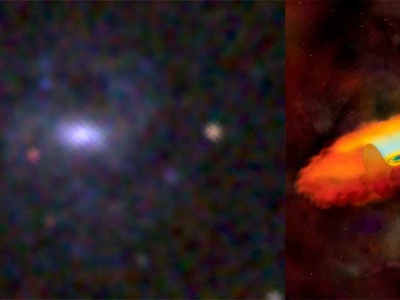
RGG 118
Dwarf-galaxy nucleus with broad Hα emission implying ~50,000 M☉ by virial scaling. One of the lowest-mass widely cited AGN black holes; reasonably robust detection though scaling relations carry systematic uncertainties.
GW190521 (remnant)
LIGO/Virgo gravitational-wave event whose remnant black hole mass is ~142 M☉, the first direct IMBH formed by merger. Robust detection; notable for producing a black hole that lies in the intermediate-mass regime.
3XMM J2150-0551
Bright soft X-ray flare interpreted as a tidal disruption event in a small galaxy; modeling the flare suggests a ~50,000 M☉ black hole. Strong TDE-based evidence though host ID and modeling uncertainties remain.
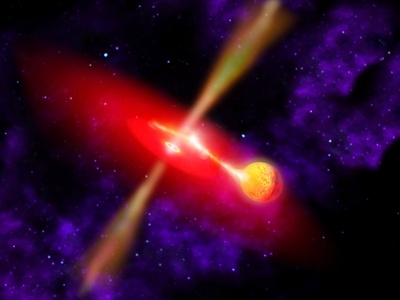
NGC 5408 X-1
Persistent ULX with low-frequency QPOs and spectral behavior that could indicate a ~1,000–10,000 M☉ accretor. Alternative explanations (super-Eddington stellar remnants) challenge the IMBH interpretation, so confidence is moderate.
CXO J133815.6+043255
Off-nuclear X-ray/radio source whose luminosity ratio places it on the fundamental plane, implying ~30,000 M☉. Interpreted as an accreting stripped nucleus; mass has substantial scatter and remains somewhat uncertain.
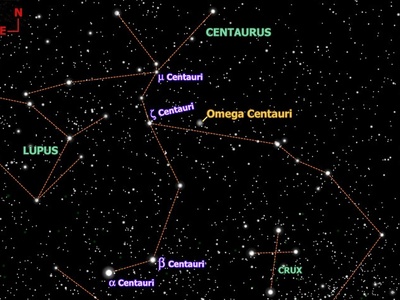
Omega Centauri (ω Cen)
Early dynamical studies suggested a central ~40,000 M☉ IMBH, but newer proper-motion and dispersion analyses place tighter upper limits or find none. The claim is controversial and remains unsettled observationally.
Enjoyed this article?
Get daily 10-minute PDFs about astronomy to read before bed!
Sign up for our upcoming micro-learning service where you will learn something new about space and beyond every day while winding down.