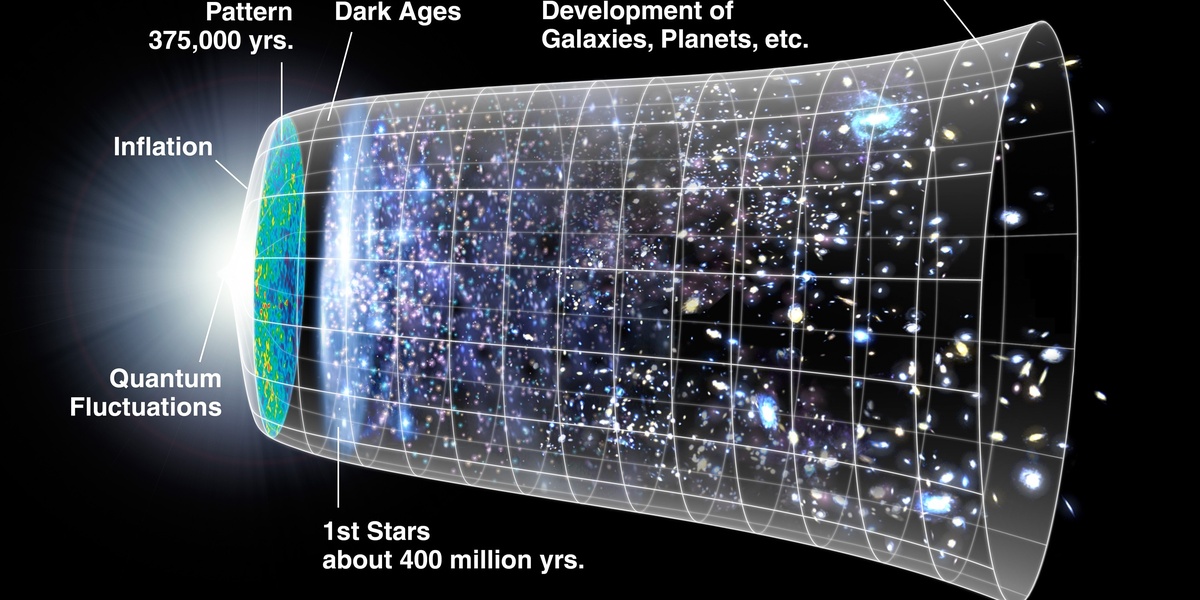
Within the first 10-32 seconds after the Big Bang, a burst of expansion called cosmic inflation stretched tiny quantum ripples into structures that would become galaxies, clusters, and the cosmic web.
Inflation was a brief epoch of exponential expansion that magnified microscopic quantum fluctuations into macroscopic variations in density.
Understanding how cosmic inflation shaped universe helps explain why the oldest light, the arrangement of galaxies, and even measurements of space’s curvature fall into a consistent story backed by missions like COBE (1992) and Planck (2013/2018).
The points below trace ten concrete ways that inflation set the initial conditions for the observable cosmos, each tied to real data or active observatories. Onward to the specifics.
How Inflation Shaped Large-Scale Structure
Inflation set the tiny initial density variations that gravity later amplified into the cosmic web we map today. The next three items explain the mechanisms, the numbers, and the observations that link inflation to structure formation.
1. Quantum fluctuations became seeds for galaxies
Tiny quantum fluctuations during inflation were stretched from subatomic scales to cosmological sizes, becoming slight over- and under-densities in the primordial plasma.
Those perturbations left an imprint with amplitude Δρ/ρ of order 10-5, first seen as temperature anisotropy by COBE in 1992 and later measured precisely by WMAP and Planck. Planck’s data set the normalization that cosmologists use when predicting structure growth.
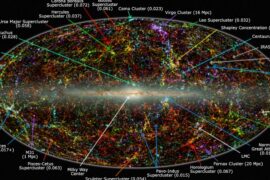
Over billions of years, regions that were a bit denser attracted more matter and collapsed into the first halos, eventually giving rise to galaxies including the Milky Way. Modern galaxy surveys like SDSS trace the clustering patterns that grew from these inflationary seeds.
2. Scale invariance set how structure appears at different sizes
Inflation generically predicts a nearly scale-invariant spectrum of primordial fluctuations, meaning similar amounts of power on a wide range of length scales.
Planck 2018 measured the scalar spectral index ns ≈ 0.965 ± 0.004, a value slightly below unity that tells us power tilts toward larger scales. That tilt shapes when small halos collapse versus when massive clusters form.
Cosmologists feed this spectrum into N-body simulations, and those simulations reproduce the observed similarity of structure from dwarf galaxies up to galaxy clusters, simplifying models of hierarchical formation.
3. Inflation made distant regions appear uniform by solving the horizon problem
The horizon problem asks why regions of the CMB separated by vast angles have nearly the same temperature despite being out of causal contact in a standard Big Bang timeline.
Exponential expansion during roughly 10-36 to 10-32 seconds took a tiny, causally connected patch and blew it up to encompass the entire observable universe, explaining the CMB’s uniform 2.725 K background.
COBE, WMAP, and Planck confirmed this large-scale isotropy, while the small anisotropies on top of that uniform temperature are the inflationary fingerprints cosmologists study.
The CMB: Inflation’s Fingerprints on the Oldest Light
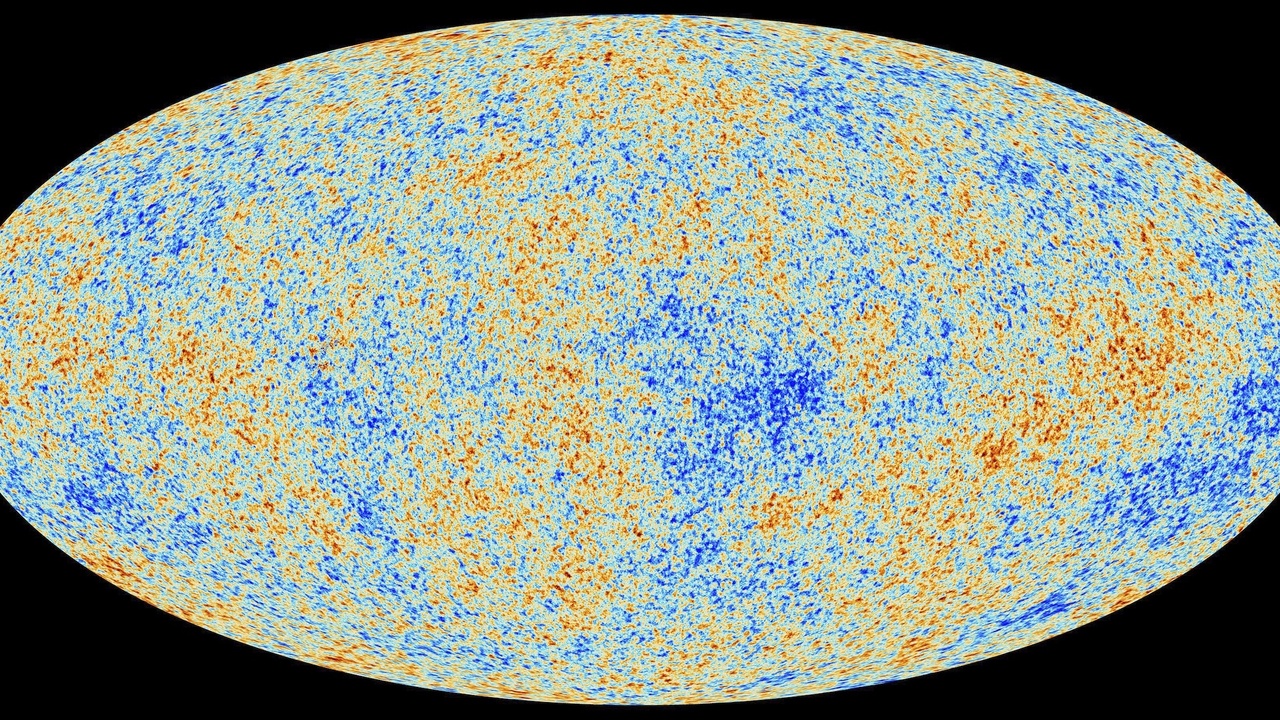
The cosmic microwave background is where inflation leaves the clearest, testable signatures. The following three items look at temperature anisotropies, polarization (and the hunt for primordial gravitational waves), and the acoustic peak pattern that became a cosmic ruler.
4. Tiny temperature variations in the CMB preserve inflationary information
The ∆T/T ≈ 10-5 temperature fluctuations in the CMB are direct records of the density perturbations seeded during inflation.
COBE first detected anisotropy in 1992; WMAP mapped those fluctuations with finer detail in the 2000s, and Planck provided the most precise full-sky maps (2013/2018). From these maps cosmologists extract parameters like the universe’s age (≈13.8 billion years) and the relative amounts of matter and dark energy.
Because the CMB anchors the cosmological model, inflation’s predictions get tested against high-precision data rather than qualitative statements—making cosmology an increasingly empirical field.
5. Polarization and the search for primordial gravitational waves
Inflation can generate a background of primordial gravitational waves; those tensor modes would produce a distinctive curl, or B-mode, pattern in the CMB’s polarization.
In 2014 BICEP2 announced a B-mode detection that was later shown to be largely contamination from galactic dust after joint analysis with Planck. Combined BICEP/Keck and Planck results now place an upper limit on the tensor-to-scalar ratio r at roughly r ≲ 0.06.
Next-generation experiments like the Simons Observatory and CMB-S4 are explicitly designed to dig below current limits and either detect primordial tensors or push the bounds much lower.
6. Acoustic peaks in the CMB and the BAO ‘standard ruler’
The pattern of acoustic peaks in the CMB power spectrum arises from sound waves in the early photon–baryon fluid, with the first peak appearing near multipole ℓ ≈ 220.
Those same physics set a preferred length scale—baryon acoustic oscillations—seen as a peak in galaxy correlations at about 150 Mpc, first robustly measured by SDSS and follow-up surveys.
Because the acoustic scale serves as a standard ruler, combining CMB and BAO measurements yields precise constraints on the expansion history and dark energy, turning inflation’s initial conditions into practical cosmological tools.
Consequences for Matter, Cosmology, and Fundamental Physics
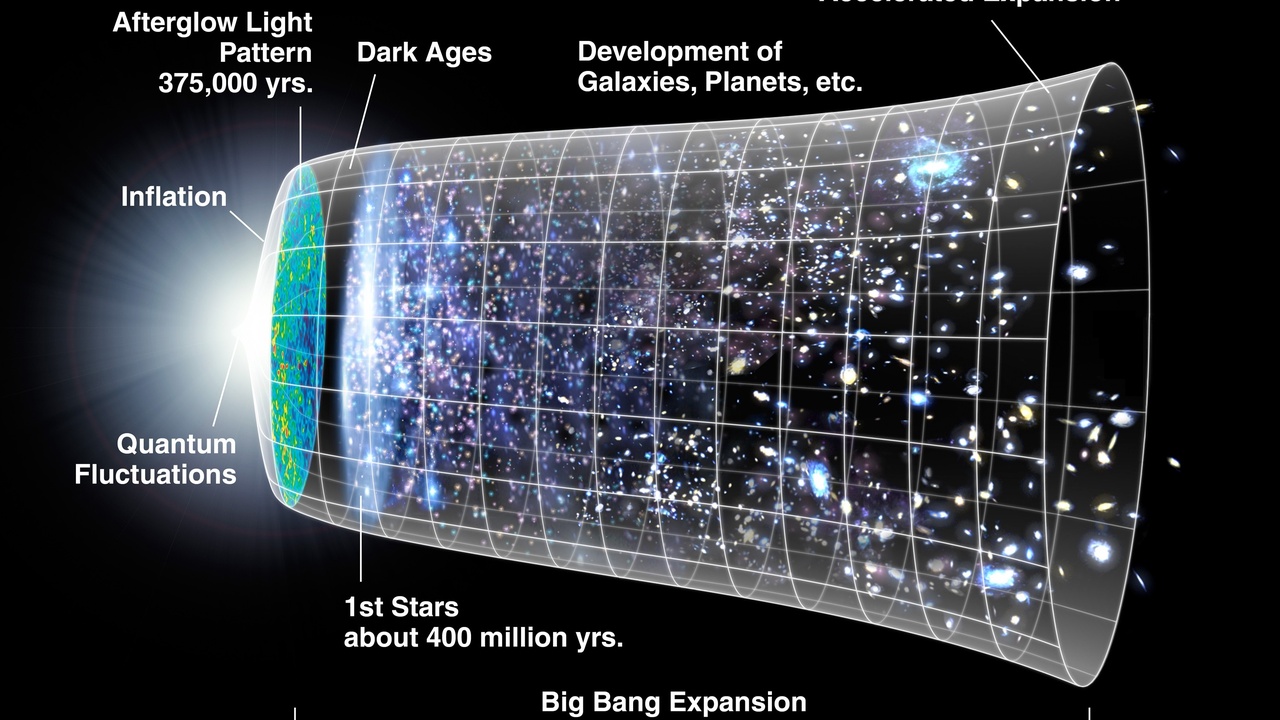
Beyond seeding structure and CMB signatures, inflation has broad implications for the universe’s geometry, for exotic relics predicted by particle theories, and for how cosmology informs high-energy physics searches.
7. Inflation explains the universe’s near-flat geometry
A short burst of exponential expansion drives any initial spatial curvature toward zero, making the observable universe appear nearly flat today.
Planck’s results are consistent with spatial curvature Ωk ≈ 0 to within parts in 10-3 (roughly 0.1%), which matches the simple expectation from inflationary stretching.
Near-flatness simplifies distance calculations used by Type Ia supernova and BAO surveys and reduces the number of free parameters cosmologists must consider when modeling cosmic expansion.
8. Inflation diluted exotic relics (monopoles and other unwanted particles)
Some Grand Unified Theories from the 1970s predicted heavy relics—magnetic monopoles among them—that would have been catastrophically abundant in a standard thermal history.
Exponential expansion dilutes the number density of such relics to effectively zero in the observable patch, resolving the monopole problem and making the particle inventory we observe plausible.
That dilution affects how theorists model reheating and baryogenesis, since inflation changes when and how new particles repopulate the universe after the expansion ends.
9. Setting conditions that allowed perturbations to grow into stars and galaxies
Inflationary perturbations provided the initial contrasts that gravity amplified into dense regions where gas could cool and form the first stars and galaxies.
Simulations show how the initial power spectrum determines the timing and abundance of collapsed halos; the first stars appear roughly 100–300 million years after the Big Bang, a window now probed by Hubble and JWST.
Observations of high-redshift galaxies (z > 7–10) feed back into models, helping refine the primordial spectrum and improving our picture of how the Milky Way’s progenitors assembled.
10. Inflation guides searches for fundamental physics (energy scale, non-Gaussianity, multiverse implications)
Inflation links cosmology with particle physics by pointing to very high energy scales—some models imply scales near 1016 GeV—and by predicting specific observational signatures to test those models.
Planck constrained primordial non-Gaussianity (fNL) to be near zero (i.e., only a few in amplitude), and combined BICEP/Keck + Planck analyses push r down to roughly r ≲ 0.05–0.07. Those limits rule out whole classes of models such as some large-field scenarios and favor single-field slow-roll variants.
Measurements of how cosmic inflation shaped universe therefore inform particle-physics model-building and motivate future instruments—CMB-S4, Simons Observatory, and wide spectroscopic surveys—that can sharpen constraints on tensors, non-Gaussianity, and reheating signatures.
Summary
- Inflation set the initial conditions for almost every large-scale feature we observe today, turning quantum ripples into the seeds of galaxies and the cosmic web.
- CMB missions—COBE (1992), WMAP, and Planck (2013/2018)—measured ΔT/T ≈ 10-5 and the spectral tilt ns ≈ 0.965, providing precise tests of inflationary predictions.
- Acoustic peaks and BAO (≈150 Mpc) serve as standard rulers for expansion history, while galaxy surveys like SDSS map the large-scale structure that grew from inflationary seeds.
- Ongoing and future projects—BICEP/Keck, Simons Observatory, CMB-S4, JWST, and large spectroscopic programs—aim to detect primordial tensors or non-Gaussianity and further connect cosmology to high-energy physics.
Enjoyed this article?
Get daily 10-minute PDFs about astronomy to read before bed!
Sign up for our upcoming micro-learning service where you will learn something new about space and beyond every day while winding down.