In 1962, NASA’s Mariner 2 became the first spacecraft to successfully fly by another planet when it passed Venus and returned data on its temperature, atmosphere, and magnetic field. Those measurements transformed Venus from a mysterious bright point in our sky into a real, if hostile, world.
Why does Venus still matter? Because it offers a stark lesson in planetary evolution — a world nearly identical to Earth in size and composition that took a radically different path. It also serves as a natural laboratory for understanding runaway greenhouse effects, atmospheric dynamics, and the boundaries of planetary habitability.
This piece presents twelve carefully chosen facts about Venus that span geology, atmosphere, exploration history, and the search for life. The list mixes mission data, orbital mechanics, and real science to show why Earth’s “twin” continues to fascinate researchers and the public alike.
Short, concrete, and rooted in spacecraft observations, each fact points to why Venus remains a priority target for space agencies worldwide. Read on for a compact tour of what makes Venus special.
Physical Characteristics
This section covers Venus’s size, rotation, and the extreme surface conditions that make it one of the most hostile environments in the solar system. These features matter because they reveal how similar starting points can lead to vastly different outcomes.
1. Venus is almost the same size as Earth
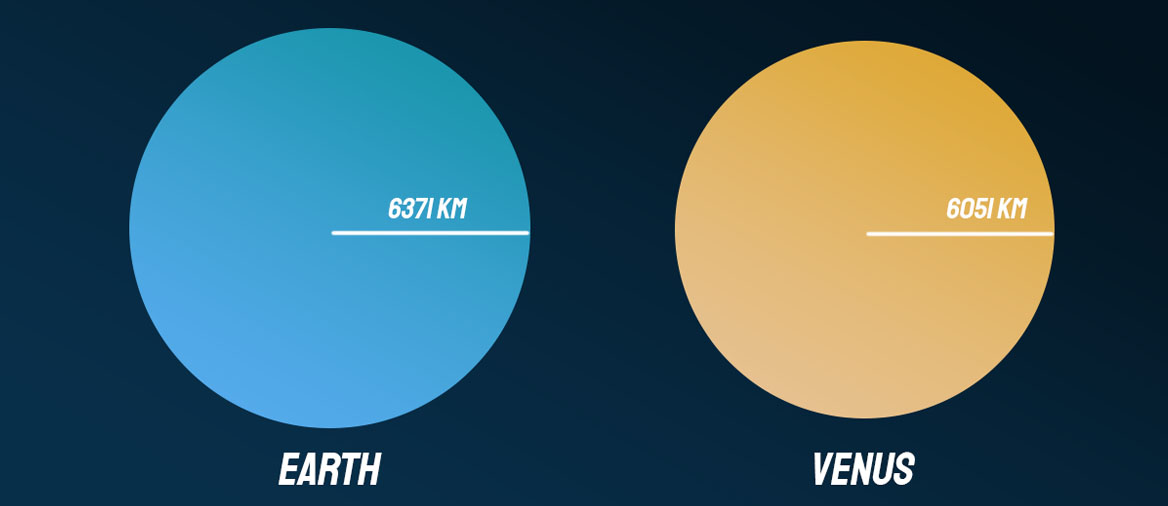
Venus is often referred to as Earth’s twin, and for good reason. Both planets formed approximately at the same time 4.6 billion years ago, they both have rocky surfaces, dense atmospheres, and one curious thing is that they are almost exactly the same size.
The difference in diameter between Earth and Venus is less than 5%, with our planet being slightly bigger. Venus has a diameter of about 12,104 kilometers compared to Earth’s 12,742 kilometers. This similarity in size means Venus also has comparable mass and gravity to Earth.
Despite these similarities, the surface conditions couldn’t be more different — a reminder that size alone doesn’t determine a planet’s habitability.
2. Venus rotates backward
The Sun rotates counterclockwise. As a result, when they originally formed, scientists believe that all the planets also rotated in the same direction due to the law of conservation of momentum.
4.6 billion years later, here we are, but Venus (and Uranus) is now spinning backward while the rest of the planets continued to rotate counterclockwise. What happened?
There are a few theories as to how that could have happened. The most popular one is that Venus got hit by a large object (or by many small objects) and the impact was strong enough to change its spin.
The second theory says that at some point Venus and the nearby planets, including Earth, found themselves at a very specific position where the gravity of the nearby planets as well as the Sun “pulled” Venus in the opposite direction, slowing its rotation and then reversing it.
While we still don’t know exactly what happened, this is a fascinating fact about Venus that often shows up in trivia games, so make sure to memorize it.
3. A person from Venus is not a Venusian
Here’s a fun fact to keep in mind. To denote something that is from Venus, we generally use the term “Venusian” — as in the Venusian atmosphere, the Venusian craters, and so on. If a person were to be born on Venus, we would probably call them a Venusian.
But this is incorrect.
The proper demonym to refer to something that is from Venus or that belongs to Venus is “Venerian.” However, it is not conventionally used because it sounds too much like the word “venereal” and could create confusion. Instead, Venusian has replaced it as a convention, although that is not used often either because, well, you don’t know anyone from Venus, do you?
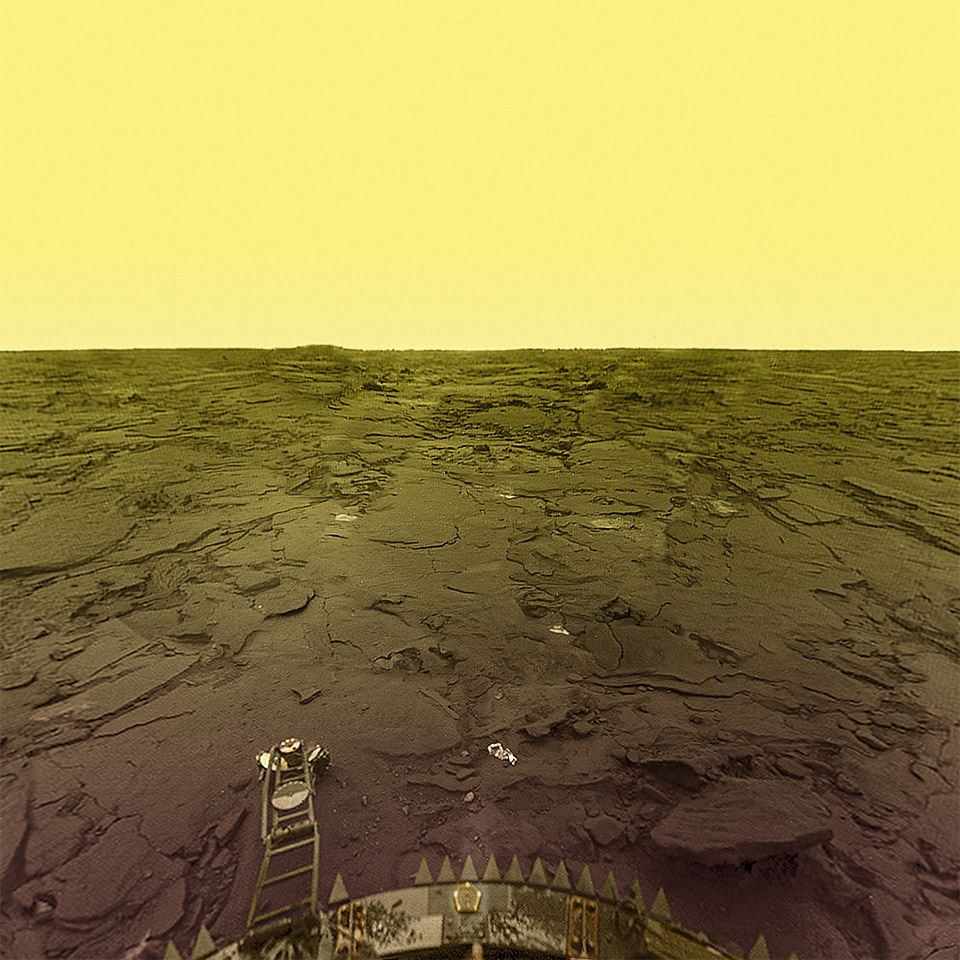
4. We don’t know the true color of the Venusian surface
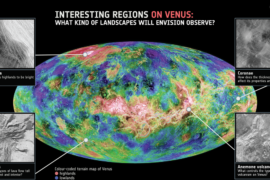
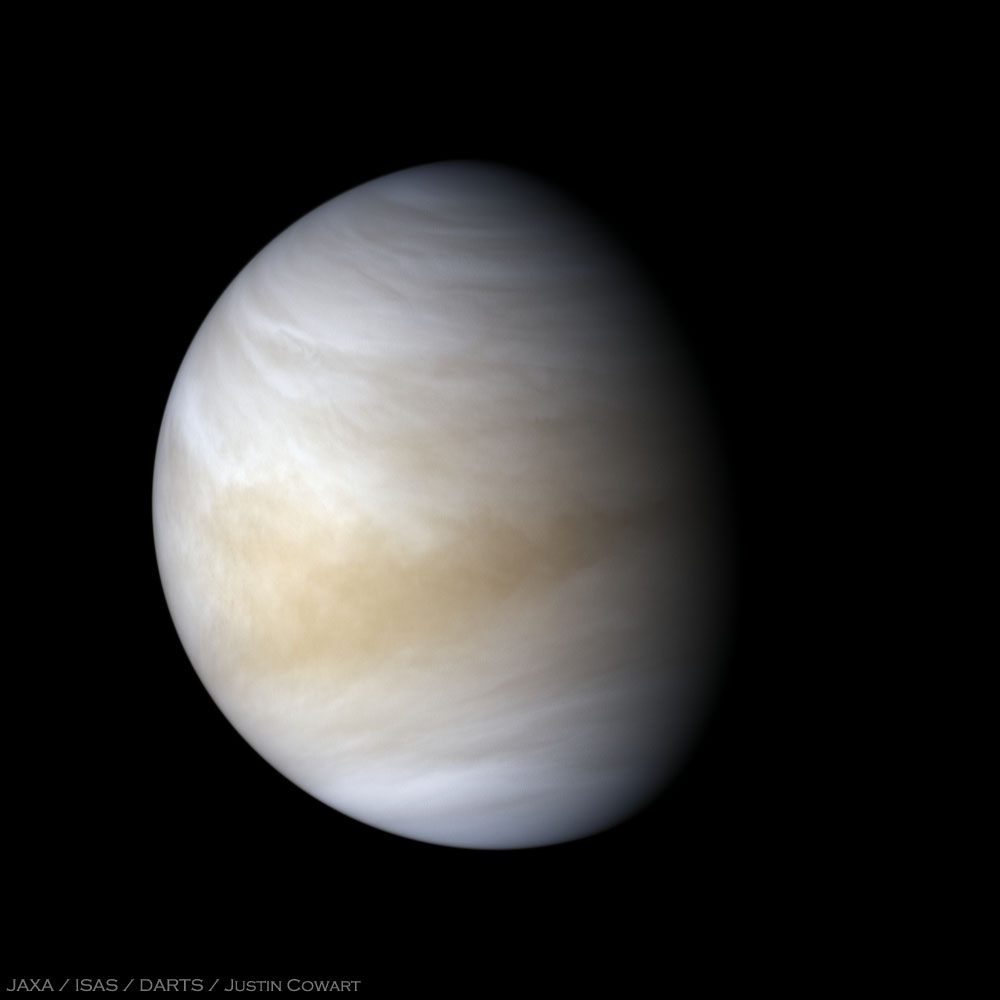
The only part of Venus that we can see from Earth is the clouds. Most of the images that we have from its surface are taken using radio, X-ray, or infrared telescopes. This means that these images have colors that our eyes can’t see.
All the photos that you will find from Venus’s surface have been edited to reflect the colors that we believe it has. We think the surface of Venus has rusty colors (orange, brown, yellow) but we don’t know for sure.
The only true-color images that we have from the surface of Venus were taken by the Soviet landers named Venera in 1975 and 1982. These showed dark yellow rocks on the surface, but they were heavily influenced by the yellow clouds and sky, so it is possible they aren’t totally reliable.
Atmosphere and Climate: A Greenhouse Gone Extreme
Atmosphere and Climate
Venus has the densest atmosphere of any rocky planet in the solar system, creating crushing surface pressure and extreme heat. The atmosphere shapes everything from surface conditions to the potential for life and defines Venus as a cautionary tale of climate feedback.
5. Earth and Venus have almost the same quantity of CO₂
Venus’s atmosphere is extremely toxic because it is full of CO₂ (carbon dioxide) — approximately 96% of it, which makes it deadly for humans.
Our atmosphere, on the other hand, is about 78% nitrogen, 21% oxygen, and small quantities of other gases, including less than 1% of CO₂. But that’s not all the carbon dioxide we have.
It turns out there’s a lot of CO₂ stored in carbonate rocks due to the carbon cycle (like the water cycle but for CO₂).
The interesting part is that when scientists did the math including all that captured CO₂, it turns out that Earth and Venus have almost the same total amount of it.
And if that wasn’t enough, we also have similar amounts of nitrogen too.
No other two planets in the solar system share numbers so similar.
6. Venus is the brightest planet in the solar system
The Venusian atmosphere is thick — so thick that what we see from Earth or space with a regular telescope are just dense white and yellow clouds. We didn’t know what the actual surface of Venus looked like until radio telescopes started being used.
Thanks to such a dense atmosphere, Venus reflects a lot of the sunlight that it receives, making it look extremely bright. Ancient civilizations even thought Venus was a star for a long time.
Astronomers use a metric called apparent magnitude to measure and rank the brightness of an object as seen from Earth. In this scale, a lesser magnitude means that an object is brighter. For example, the Sun has a magnitude of −27, Saturn has a magnitude of 0, and Polaris (the North Star) has 2.
Venus is the brightest of the planets with a magnitude of −5. Mars and Jupiter are next with −3, and Neptune has the lowest of them all with 8.
Magnitude can be used to tell if a telescope is able to see an object and how much detail you might be able to get out of it. The average basic backyard telescope can reach magnitudes between 10 and 13 depending on the sky conditions.
7. There are possible signs of life on Venus
The surface of Venus is too hot for any kind of life form; however, there are zones of its atmosphere that are much cooler and that might be hiding a secret.
Scientists have discovered traces of a gas called phosphine in Venus’s atmosphere. That doesn’t sound very exciting, but it is. And that is because on Earth, this gas is only produced by biological processes.
This has led some people to believe that the Venusian atmosphere could somehow be home to some sort of microbial life.
While there is still a lot of research to be done before reaching any definitive conclusion, it is exciting to think that our neighboring planet could support some kind of life, even if it is just microbes.
8. Venus had liquid water at some point
Scientists believe that 600 million years ago, Venus could have had liquid water on its surface.
Both Venus and Mars are on the edges of the habitable zone of the solar system (the region where liquid water on the surface of a planet is possible), so it is possible that in the past they both had at least some.
The origin of water on Venus would have been the same as on Earth. The planet was probably hit by multiple asteroid-like objects that contained large quantities of ice.
After Venus underwent the runaway greenhouse effect that made its surface hot and toxic, the water evaporated and was lost to space.
Orbital Dynamics and Surface Features
Venus’s orbit, transits, and surface geology offer insights into planetary formation, historical astronomy, and impact processes. These characteristics reveal Venus’s role in advancing our understanding of the solar system.
9. Venus also creates eclipses
When the Moon passes between the Earth and the Sun, it obscures it for a few minutes, forming an eclipse.
Venus does that sometimes too. Except that due to the large distance between it and Earth, it looks very small and only covers a tiny portion of the Sun.
Scientists call this a Venus transit, and it doesn’t happen very often. The last one occurred in 2012, and the next ones won’t happen until 2117 and 2125.
Venus transits were very useful to astronomers in the past because thanks to them, they were able to precisely measure the distance between the Earth and the Sun using a method called parallax that required taking measurements at different points on the planet. In 1761, during one of Venus’s transits, astronomers collaborated and traveled to remote parts of the world to take these measurements. With that, they were also able to know the distances between all the planets of the solar system that had been discovered up to that point.
10. Ancient astronomers believed Venus was two stars
Ancient civilizations knew about Venus, but they didn’t know that it was a planet. They believed it was a star because of its high brightness.
But that’s not all.
Venus can be better seen with the naked eye right after sunrise and before sunset. It can usually be found close to the Sun, so it is easy to recognize. During the rest of the day when there’s daylight, Venus still travels close to the Sun, but it can’t be seen because the Sun outshines it.
This made ancient Greeks believe that the “stars” they saw at sunrise and sunset were two different bodies. They named them Phosphoros (morning star) and Hesperus (evening star).
11. Venus has more than 900 craters
Venus has suffered through a lot of asteroid and meteor impacts. Its surface has more than 900 craters. The only two bodies with more craters in the solar system are the Moon and Mars.
The craters range in size from a few meters to the largest one, called Mead, which has a diameter of 280 kilometers (174 miles).
All the known craters have received proper names, and they have all been named using female names because Venus was the Roman goddess of beauty and the planet is often associated with female qualities.
Exploration: Robotic Missions to a Hostile World
Despite its extreme conditions, Venus has been a major target for space exploration. Missions to Venus have pushed the boundaries of engineering and provided crucial data about planetary atmospheres and surfaces.
12. Venus was the first planet explored by a spacecraft
Before the Apollo mission that put a man on the Moon for the first time, NASA was looking to test a lot of systems that would serve as the foundation for those spacecraft.
The chosen target was Venus, and in 1962 the Mariner 2 spacecraft was launched.
The objective of Mariner 2 was to fly by Venus and take measurements of its temperature, magnetic field, and solar winds. It was also a test for the communications system of the spacecraft.
Since then, more than 15 spacecraft from various space agencies have been sent to study Venus, making it one of the most visited planets despite being too hot to send long-lasting landers or rovers as they do on Mars.
Summary
- Venus is nearly identical in size to Earth — less than 5% difference in diameter — yet evolved into a hellish world due to a runaway greenhouse effect.
- Venus rotates backward (retrograde rotation), likely due to a massive impact or gravitational interactions early in the solar system’s history.
- The Venusian atmosphere is 96% CO₂ and so thick that it creates crushing surface pressure; surprisingly, Earth has a similar total amount of CO₂ when you include what’s locked in rocks.
- Ancient astronomers thought Venus was two different stars — Phosphoros (morning star) and Hesperus (evening star) — because it appears at different times of day.
- Mariner 2 made Venus the first planet explored by a spacecraft in 1962, and more than 15 missions have followed despite the planet’s extreme surface conditions.
Enjoyed this article?
Get daily 10-minute PDFs about astronomy to read before bed!
Sign up for our upcoming micro-learning service where you will learn something new about space and beyond every day while winding down.