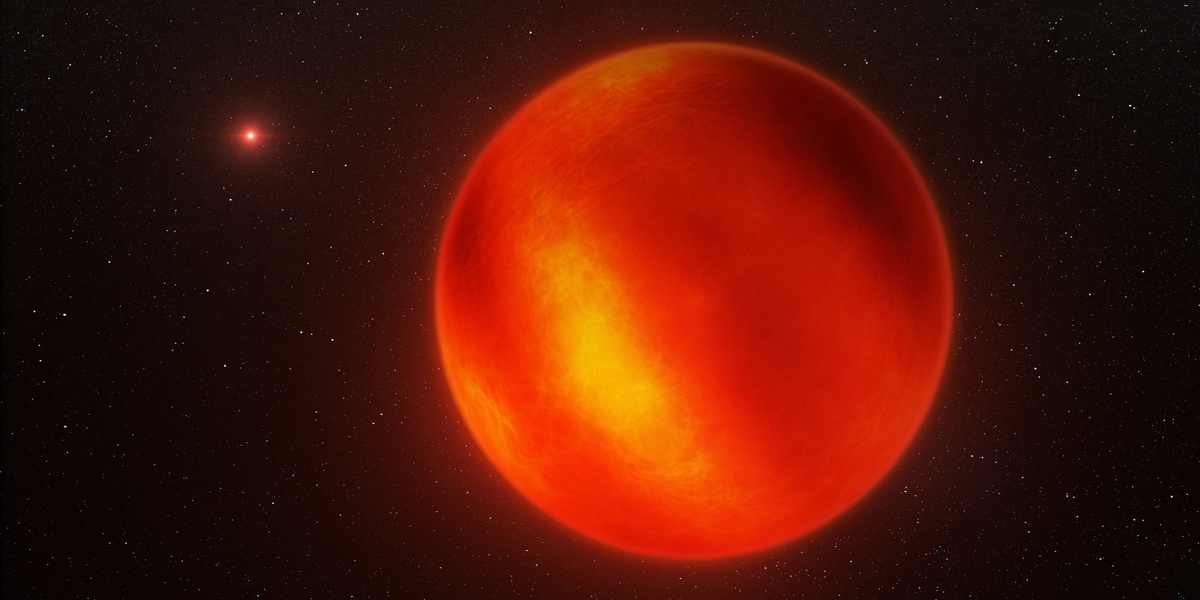
Brown dwarfs sit between stars and giant planets: too low in mass for sustained hydrogen fusion, yet massive enough to show complex atmospheres and cloud chemistry. Studying them helps trace formation pathways and the physics of cool, faint objects across the galaxy.
There are 15 Examples of Brown Dwarfs, ranging from 2M1207A to WISE 1828+2650 to demonstrate the span from young, warm companions to extremely cool isolated objects. Entries are organized with Spectral type,Distance (ly),Mass (M_Jup) so you can quickly compare spectral class, distance, and estimated mass for each—you’ll find those details below.
How do brown dwarfs differ observationally from low-mass stars or giant planets?
Brown dwarfs lack sustained hydrogen fusion, so they cool and fade over time; observationally this means different spectral features (L, T, Y types), strong molecular bands (like methane and water), and lower luminosities than stars but often higher masses than planets, placing them in an intermediate regime that requires spectral and luminosity measurements to classify.
How accurate are the listed distances and masses for these objects?
Distances are generally reliable when measured by parallax, but mass estimates depend on models of cooling, age, and atmosphere; for young objects or very cool examples like WISE 1828+2650, mass can be quite uncertain, while well-studied companions such as 2M1207A often have tighter constraints from dynamical or cluster-age information.
Examples of Brown Dwarfs
| Name | Spectral type | Distance (ly) | Mass (M_Jup) |
|---|---|---|---|
| Teide 1 | L5 | 400 | 55-60 |
| Gliese 229B | T7 | 19 | 20-50 |
| Luhman 16A | L7.5 | 6.5 | 30-50 |
| Luhman 16B | T0.5 | 6.5 | 25-45 |
| WISE 0855−0714 | >Y2 | 7.5 | 3-10 |
| 54 Piscium B | T7.5 | 36 | 50 |
| Epsilon Indi Ba | T1 | 12 | 40-60 |
| Epsilon Indi Bb | T6 | 12 | 40-60 |
| WISE 1828+2650 | >Y2 | 33 | 5-15 |
| 2M1207A | M8 | 170 | 25 |
| SIMP J013656.5+093347 | T2.5 | 20 | 13 |
| Gliese 570 D | T7.5 | 19 | 50 |
| Kelu-1 | L2 | 61 | 60 |
| WD 0806-661 B | >Y1 | 63 | 6-9 |
| 2MASS J2139+0220 | T1.5 | 47 | 30 |
Images and Descriptions
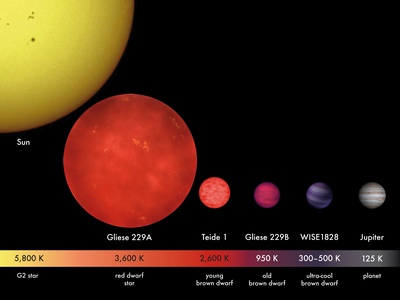
Teide 1
The very first confirmed brown dwarf, discovered in 1995 in the Pleiades star cluster. Its discovery provided concrete evidence that these “failed stars” exist, bridging the gap between giant planets and true stars.
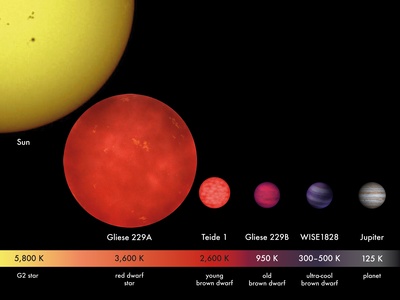
Gliese 229B
The first T-dwarf ever discovered, found orbiting a nearby red dwarf star. Its atmosphere contains methane, a key feature of cool brown dwarfs, and it became the prototype for the “T” spectral class.
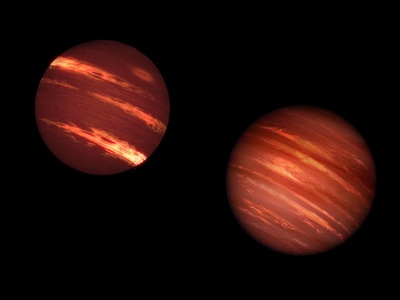
Luhman 16A
One half of the closest brown dwarf system to the Sun. This binary pair, discovered in 2013, provides a perfect natural laboratory for studying the properties of substellar objects right in our cosmic backyard.
Luhman 16B
The other half of the Luhman 16 binary system. It is famous for its dramatic weather patterns, with rapidly changing cloud features that cause its brightness to vary significantly as it rotates.
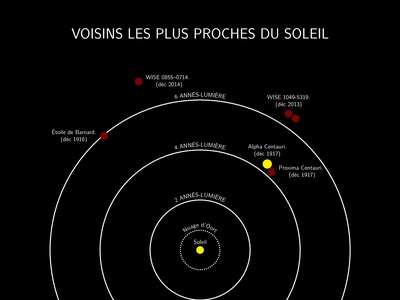
WISE 0855−0714
The coldest known brown dwarf, with a surface temperature colder than Earth’s North Pole (around -23 °C or -10 °F). This incredibly faint, free-floating object is one of the Sun’s closest neighbors.
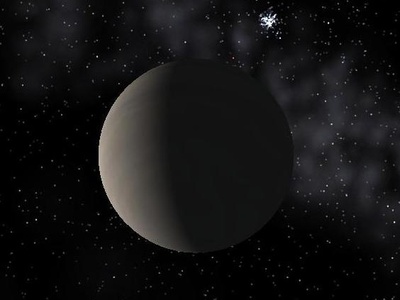
54 Piscium B
A brown dwarf companion orbiting a Sun-like star in a long, eccentric orbit. It was found by detecting its gravitational pull on its host star, showcasing a common method for finding such objects.
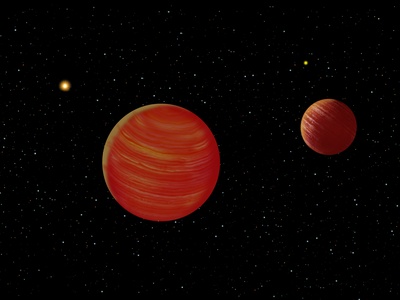
Epsilon Indi Ba
The larger of two brown dwarfs that orbit the nearby star Epsilon Indi. This pair forms a “mini binary” and was one of the first brown dwarf binaries to be directly resolved and studied in detail.
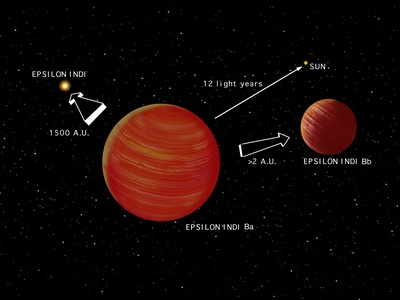
Epsilon Indi Bb
The smaller and cooler companion in the Epsilon Indi brown dwarf binary. Together with its partner, it provides a crucial benchmark for testing models of brown dwarf cooling and evolution at a known age.
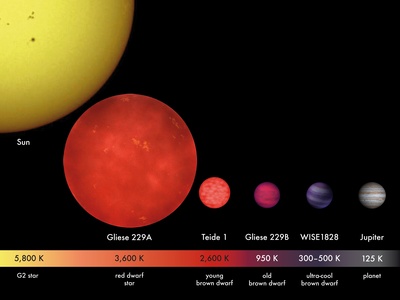
WISE 1828+2650
The “prototype” Y-dwarf, representing the coldest class of brown dwarfs. Its discovery by the WISE space telescope helped formally establish the Y spectral type for objects cooler than any previously known.
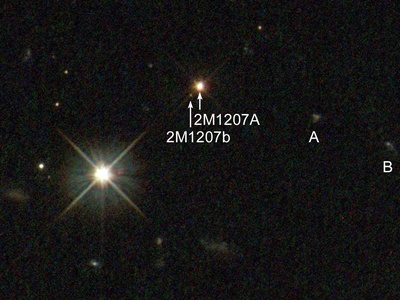
2M1207A
A young, hot brown dwarf in the TW Hydrae stellar association. It is famous for being one of the first brown dwarfs found to host its own directly-imaged, planetary-mass companion (2M1207b).
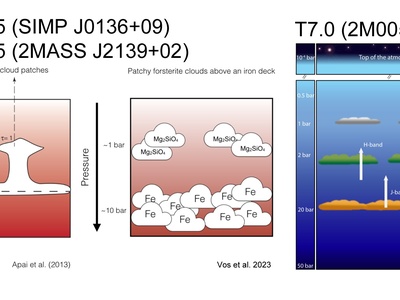
SIMP J013656.5+093347
A fascinating free-floating object on the boundary between planet and brown dwarf. It has a powerful magnetic field that generates stunningly strong aurorae, a million times more powerful than Jupiter’s.

Gliese 570 D
A well-studied, cool brown dwarf that is the outermost member of a quadruple system of stars and substellar objects. Its position within a complex system makes it an important object for study.
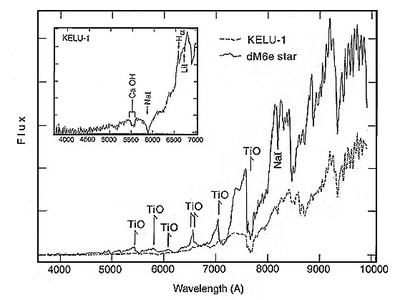
Kelu-1
One of the first free-floating brown dwarfs discovered, found in 1997. As an isolated object not orbiting a star, its discovery helped confirm that brown dwarfs could form on their own, like stars.
WD 0806-661 B
An extremely cold Y-dwarf discovered orbiting a white dwarf (the remnant of a dead star). Its survival proves that brown dwarf companions can endure their host star’s entire life cycle.
2MASS J2139+0220
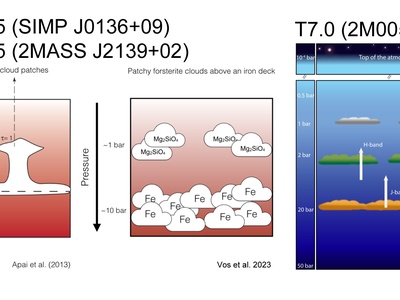
Nicknamed a “weather champion,” this brown dwarf shows some of the most extreme brightness variations ever seen on a substellar object, likely caused by a turbulent, stormy atmosphere with fast-moving clouds.
Enjoyed this article?
Get daily 10-minute PDFs about astronomy to read before bed!
Sign up for our upcoming micro-learning service where you will learn something new about space and beyond every day while winding down.