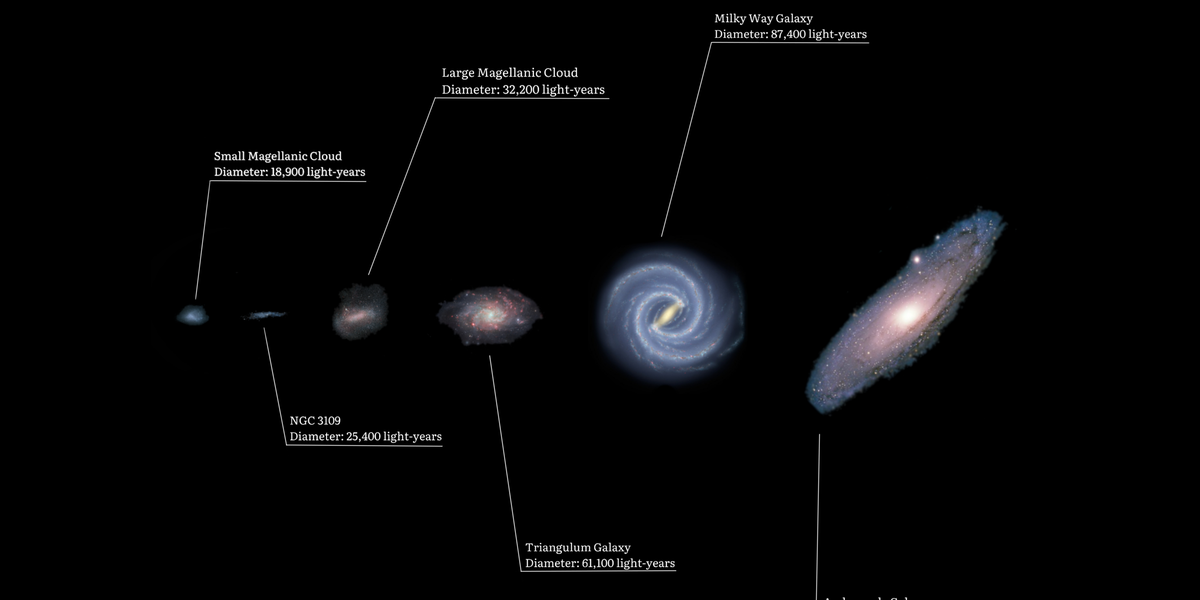
In 1926, Edwin Hubble published the famous “tuning fork” that split galaxies into broad families and gave astronomers a simple visual language for billions of stellar systems. That diagram still matters because morphology, motion, gas content, and nuclear activity all carry fingerprints of a galaxy’s past. An elliptical is a smooth, spheroidal collection of old stars (think M87 in the Virgo Cluster); a spiral is a flattened, rotating disk with a central bulge and winding arms (our Milky Way is a barred spiral). To be specific, we’ll outline the difference between elliptical spiral galaxies in six clear, evidence-backed points so you can see how observations—from Hubble imaging to ALMA and Chandra—tell a consistent evolutionary story.
1. Structure and Morphology
At the simplest level, ellipticals look smooth and rounded while spirals show disks, bulges, bars, and arms; that visual contrast drives much of how astronomers classify and study them.
1. Shape and light distribution
Ellipticals are spheroidal systems with smooth brightness profiles; observers often fit their surface light with Sersic functions and many massive examples follow de Vaucouleurs’ r¹/⁴ law (Sersic index n ≈ 4). Spirals have a central bulge plus a flattened exponential disk, with scale lengths of a few kiloparsecs (the Milky Way’s stellar disk scale length is roughly 2.5–3 kpc).
Because shape affects projection, researchers deproject images to estimate true mass and rotational support; optical imaging highlights arms, while near‑IR helps see the bulge through dust.
2. Visual features: arms, bars, and shells
Spiral galaxies commonly show prominent arms, bars, and dust lanes where star-forming H II regions glow in optical and UV light; those arms host most ongoing star formation, with typical SFRs of order 1–10 M☉/yr for Milky‑Way–like systems (our Galaxy ≈1–2 M☉/yr).
Classical ellipticals usually lack bright arms, though deep imaging often reveals faint shells or tidal streams (for example, shells around NGC 474) that record past mergers rather than in‑situ disk dynamics.
2. Kinematics and Dynamics
The way stars move separates disks from spheroids: spirals are rotation‑supported, ellipticals are dispersion‑supported, and that distinction changes how we measure mass and infer dark matter.
3. Support mechanism: rotation vs. dispersion
Spiral disks show ordered circular motion measured with emission lines (Hα, HI); the Milky Way’s circular speed is about 220 km/s and many spirals display flat rotation curves beyond the optical disk, a classic dark‑matter signature. Ellipticals lack large-scale ordered rotation; their stars exhibit random motions quantified by a velocity dispersion σ, often 200–350 km/s in massive ellipticals.
Observers use HI surveys like THINGS for disk rotation and integral-field projects such as SAURON and ATLAS3D to map stellar dispersion and kinematic substructures in early‑type galaxies.
4. Angular momentum and formation implications
Specific angular momentum differs systematically: spirals retain high angular momentum, which favors disk formation, whereas many ellipticals show lower angular momentum consistent with a merger history that redistributes and reduces ordered motion.
Cosmological simulations such as Illustris and EAGLE reproduce this dichotomy, and observational programs (ATLAS3D, circa 2011) separated early‑type galaxies into fast and slow rotators—an axis tied directly to formation via gas‑rich versus gas‑poor mergers.
3. Gas, Stars, and Evolutionary State
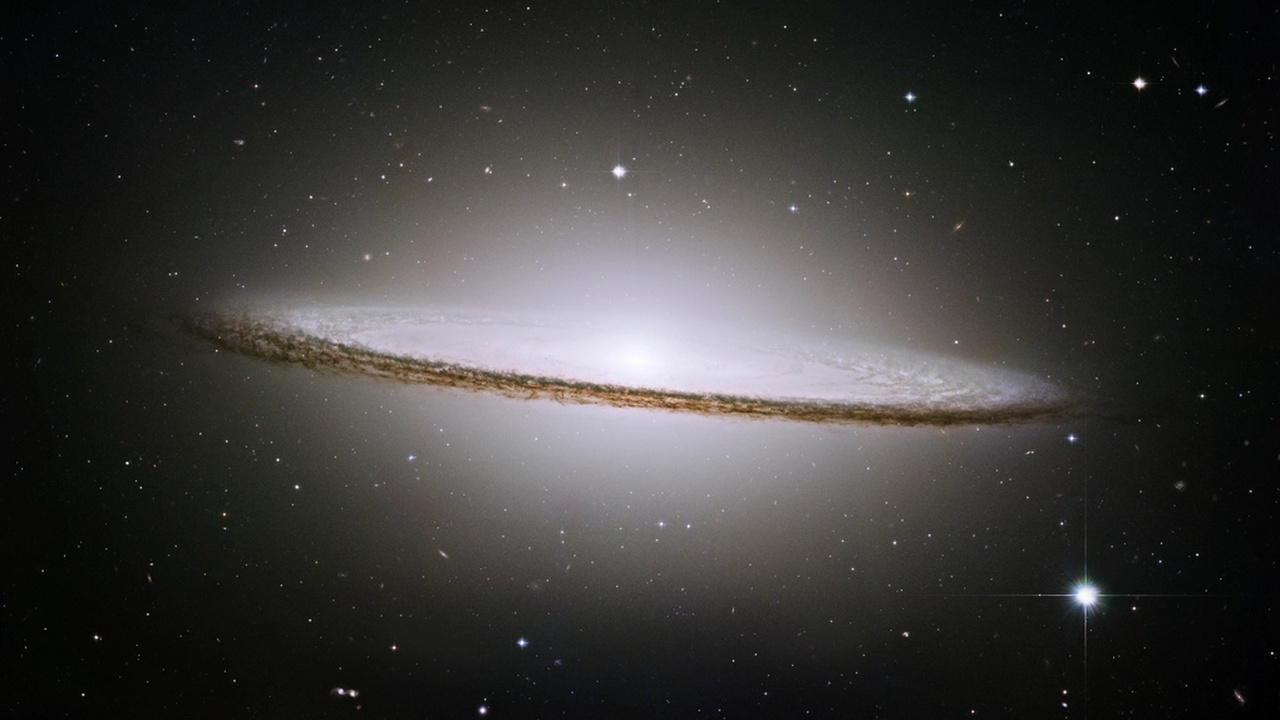
Gas content, recent star formation, and nuclear activity set spirals and ellipticals on different evolutionary tracks: spirals are gas‑rich and blue; ellipticals are often gas‑poor, red, and dominated by old stars with hot gaseous halos.
5. Gas reservoirs and star-formation activity
Large spirals commonly contain >10⁹ M☉ of neutral hydrogen and substantial molecular gas, measured via 21‑cm HI and CO lines, which fuels ongoing star formation. Typical star‑formation rates for Milky‑Way–like galaxies are ~1–2 M☉/yr; many spirals sit in the 1–10 M☉/yr range.
Classical ellipticals are often HI‑poor and show SFRs below ~0.1 M☉/yr, with spectra dominated by old populations aged ~8–12 Gyr. Still, surveys with ALMA and IRAM reveal that a minority of early‑type galaxies retain cold molecular gas and can form stars at low levels.
6. Active nuclei, feedback, and long-term evolution
Massive ellipticals frequently host powerful, radio‑loud AGN and extensive hot X‑ray halos; M87 is the textbook example, with a relativistic jet and Chandra observations showing the AGN sculpting the surrounding intracluster gas and suppressing cooling.
By contrast, spirals tend to host weaker or more obscured AGN and experience milder feedback, allowing cold gas to keep forming stars. AGN feedback in ellipticals helps maintain a red, quiescent state by heating or expelling gas—an evolutionary path tied to their environments, especially cluster centers.
Summary
- Structure: Ellipticals are smooth spheroids (E0–E7); spirals have disk, bulge, arms (Sa–Sc).
- Kinematics: Spirals are rotation‑supported with flat rotation curves; ellipticals are dispersion‑supported with high σ.
- Angular momentum: High j in disks leads to stable rotation; mergers lower j and build spheroids.
- Gas and stars: Spirals are cold‑gas rich and blue with SFR ~1–10 M☉/yr; ellipticals are gas‑poor, red, and older.
- AGN and feedback: Powerful radio AGN and hot X‑ray halos are common in massive ellipticals, quenching future star formation.
- Observable signatures: Use Hubble and SDSS imaging for morphology, HI/CO for gas, ALMA for cold molecular gas, and Chandra/VLA for hot gas and jets.
Enjoyed this article?
Get daily 10-minute PDFs about astronomy to read before bed!
Sign up for our upcoming micro-learning service where you will learn something new about space and beyond every day while winding down.